As an Amazon Associate, I earn from qualifying purchases made through links on this site.
Finding the best spotting scopes for birding can completely transform your time outdoors. While standard binoculars are wonderful for quick scans, a dedicated spotting scope brings distant plumage, shorebirds, and nesting raptors into crisp, vivid detail. In this guide, we review top-performing optics across every budget to help you pick the perfect gear for your next birding adventure.
Quick Product Comparison
Our Top 9 Best Spotting Scopes For Birding Reviews – Expert Tested & Recommended
1. SVBONY SV28 Spotting Scope
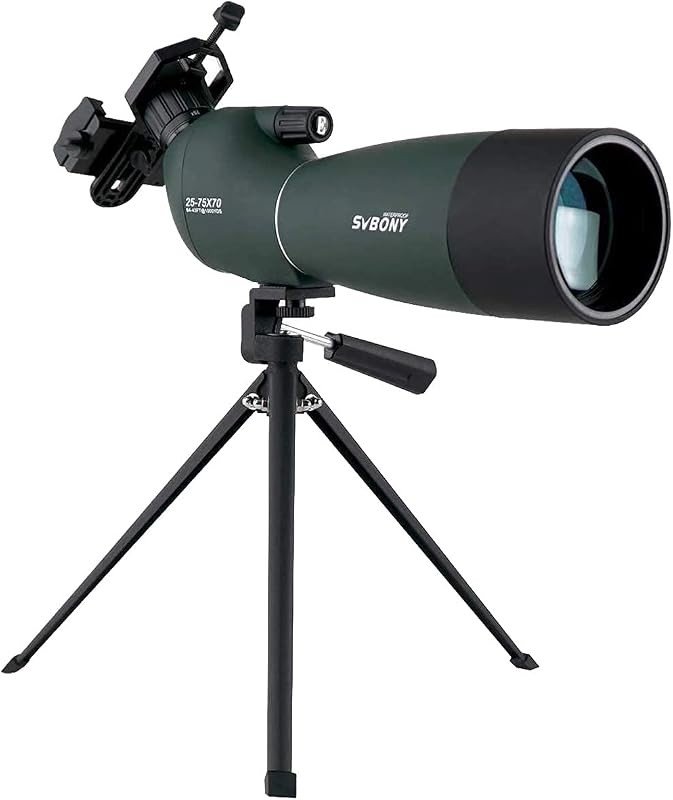
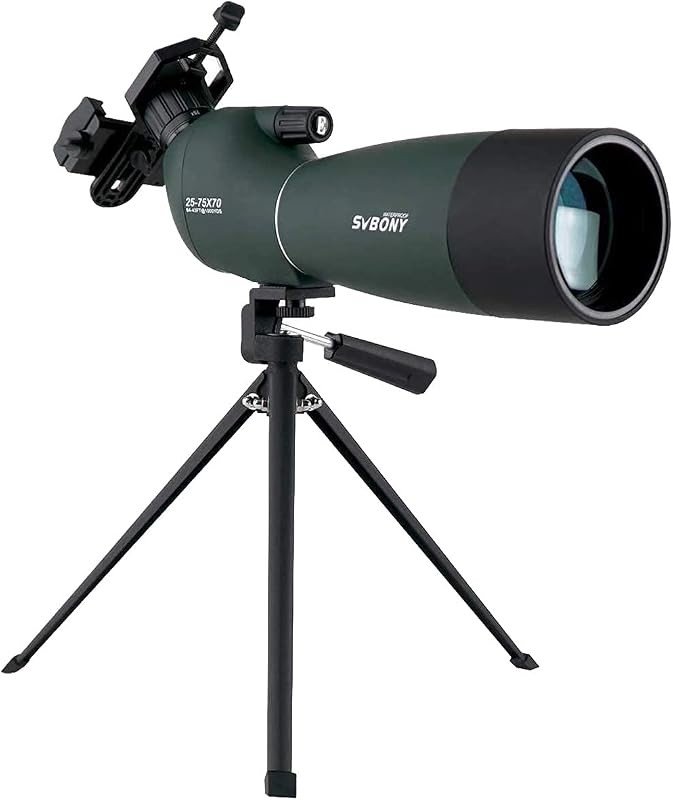
The SVBONY SV28 is a user-friendly angled optic built for outdoor lovers. It gives you flexible zoom and dependable light gathering in a lightweight body. It is simple to pack for family camping trips or casual birding afternoons.
Key Features That Stand Out
- ✓ 25-75x zoom range that makes it easy to focus and track distant scenery
- ✓ 70mm large objective lens tube that gathers ample light for a clear target view
- ✓ Extendable sunshade built onto the main barrel to effectively reduce glare
- ✓ Waterproof build with a seamless non-slip finish for secure wet handling
- ✓ Included phone adapter and portable desktop tripod for digiscoping and viewing
Why We Recommend It
This model makes nature watching accessible and fun. The simple focus mechanism lets you dial in targets quickly without hassle. The included accessories allow you to share great bird sightings right from your phone.
Best For
Beginners and novices who need a lightweight, portable setup for casual outdoor birding.
Pros and Cons
Pros:
- Wide 25-75x zoom magnification
- Non-slip waterproof exterior body
- Comes with phone adapter and desktop tripod
- Built-in sunshade controls glare
Cons:
- Desktop tripod is short for standing use
- 70mm lens gathers less light than larger 85mm scopes
2. Falcon 20-60×85 Spotting Scope

The Falcon 20-60×85 delivers bright images thanks to its huge 85mm objective lens. It comes bundled with a full-size adjustable tripod that supports both low and high viewing angles. The durable exterior handles rugged outdoor environments easily.
Key Features That Stand Out
- ✓ Powerful 20-60x magnification with a 101ft-48ft/1000 yards field of view
- ✓ 85mm objective lens with BAK4 prism and FMC coating for crisp low-light views
- ✓ Adjustable full-size tripod extending from 13.3 inches to 63 inches with a bubble level
- ✓ Waterproof and dirt-resistant body designed for tough conditions
- ✓ Bundled with carrying bag, phone adapter, and cleaning kit
Why We Recommend It
The large 85mm aperture provides exceptional clarity during early dawn and late dusk birding sessions. The tall tripod eliminates back strain by adapting to your standing height in the field. It offers a complete out-of-the-box kit for birders.
Best For
Birders seeking bright low-light viewing with an included standing-height tripod.
Pros and Cons
Pros:
- Large 85mm objective lens for superior light gathering
- Full-size tripod extends up to 63 inches
- High quality BAK4 prism and FMC optics
- Comprehensive kit with bag and phone adapter
Cons:
- Larger 85mm size adds weight in your pack
- Full-size tripod takes up extra storage space
3. Athlon Optics Forerunner Spotting Scope

The Athlon Optics Forerunner offers crisp optical clarity paired with an intuitive dual focus system. It utilizes argon purging inside a shock-resistant composite chassis to keep optics pristine. The 80mm front lens ensures true color fidelity across broad viewing ranges.
Key Features That Stand Out
- ✓ 20-60x zoom magnification paired with a generous 80mm objective lens
- ✓ Advanced fully multi-coated lenses delivering true color representation
- ✓ Dual focus knobs for fast coarse tracking and precise fine tuning
- ✓ Argon-purged, waterproof, and fog-proof weather sealing
- ✓ Rugged rubber armor over a shock-resistant composite chassis
Why We Recommend It
We appreciate the dual focus mechanism that makes locking onto moving songbirds quick and accurate. Argon purging prevents internal fogging during wet or chilly mornings. The durable rubber armor protects the body during rough hikes.
Best For
Field birders who need rapid dual-focus control in harsh, changing weather.
Pros and Cons
Pros:
- Dual focus knobs allow micro-adjustments
- Argon-purged fog-proof construction
- Shock-resistant composite chassis with armor
- Advanced multi-coated lenses preserve color
Cons:
- Included tripod is heavier duty and less compact
- Slightly bulkier body than ultralight travel models
4. Celestron Ultima 100 Spotting Scope
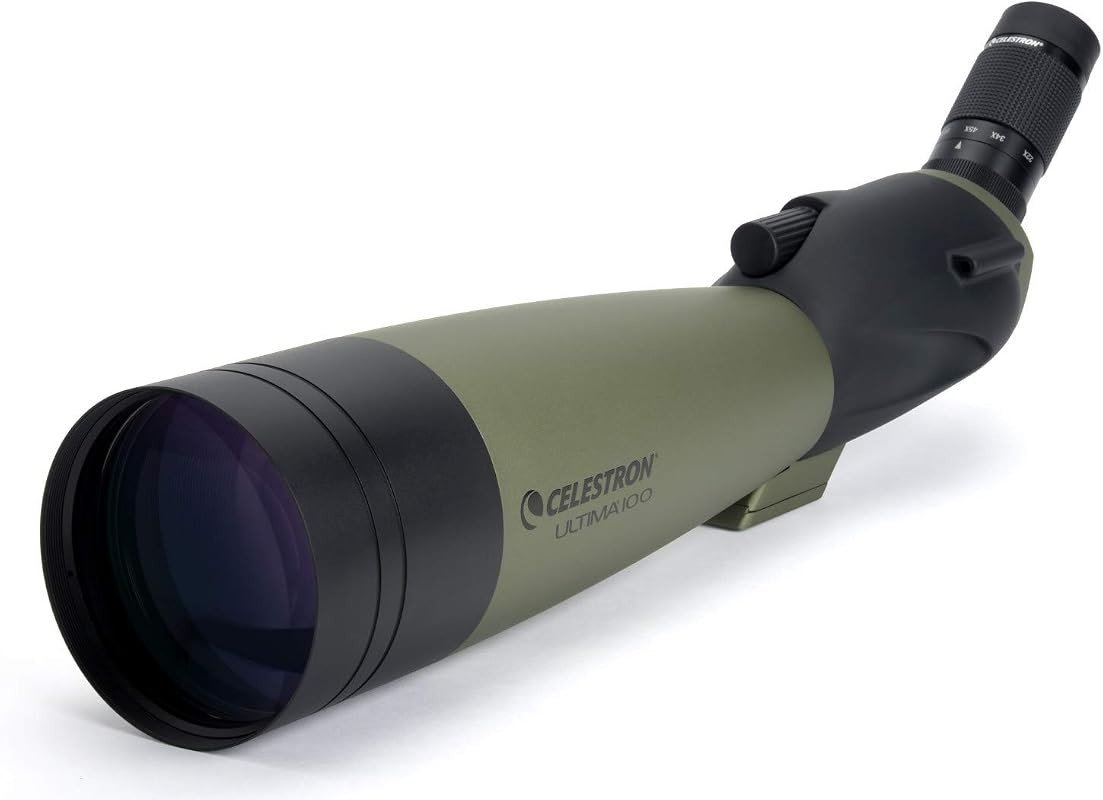
The Celestron Ultima 100 boasts an enormous 100mm objective lens that gathers light like a champ. Featuring an ergonomic 45-degree angled eyepiece, it excels at long-range outdoor viewing. It comes complete with digiscoping readiness thanks to its integrated T-adapter threading.
Key Features That Stand Out
- ✓ Massive 100mm objective lens for maximum light capture in dim ambient conditions
- ✓ 22-66x magnification zoom with an ergonomic 45-degree angled viewing angle
- ✓ Multi-coated optics applied to every glass surface for enhanced contrast
- ✓ Integrated T-adapter threads on the eyepiece for camera attachment
- ✓ Backed by a Celestron Limited Lifetime US Warranty
Why We Recommend It
If you observe shorebirds across massive coastal mudflats or lakes, the 100mm glass is a game changer. It keeps images vivid when darkness creeps in. The large focus dial brings distant details into view smoothly.
Best For
Long-distance birders who prioritize maximum light gathering and digiscoping capabilities.
Pros and Cons
Pros:
- Massive 100mm lens provides outstanding brightness
- Built-in T-adapter threads make camera connection easy
- Comfortable 45-degree angled viewing angle
- Backed by a limited lifetime warranty
Cons:
- Large 100mm barrel requires a very sturdy tripod
- Heavier to carry on long backpacking treks
5. DiamondEdge 25-75×80 Spotting Scope

The DiamondEdge 25-75×80 combines a large 80mm aperture with a generous 23mm eyepiece for expansive views. It is nitrogen-filled and O-ring sealed to withstand rain, damp wetlands, and sudden temperature shifts. The rotatable body allows you to comfortably position the ocular from any angle.
Key Features That Stand Out
- ✓ 25-75x zoom magnification with an 80mm objective lens and BAK4 prism
- ✓ Large 23mm eyepiece that delivers a wide and comfortable field of view
- ✓ Nitrogen-filled and O-ring sealed for dependable waterproof protection
- ✓ Rotatable body design with a retractable glare-reducing sunshade
- ✓ Sturdy metal base with standard 1/4″-20 universal tripod threading
Why We Recommend It
The extra-wide 23mm eyepiece reduces eye fatigue during extended viewing sessions. Rotating the body makes it easy to switch between seated and standing observation. It is a proven, reliable outdoor tool.
Best For
All-weather bird watchers who value eye comfort and flexible viewing angles.
Pros and Cons
Pros:
- Large 23mm eyepiece provides comfortable viewing
- Rotatable body ring for adaptable angles
- Reliable nitrogen-filled waterproof sealing
- Universal metal mount fits standard tripods
Cons:
- Included tabletop tripod is limited to flat surfaces
- 75x magnification requires stable support to prevent shake
6. HD 20-60×80 Spotting Scope
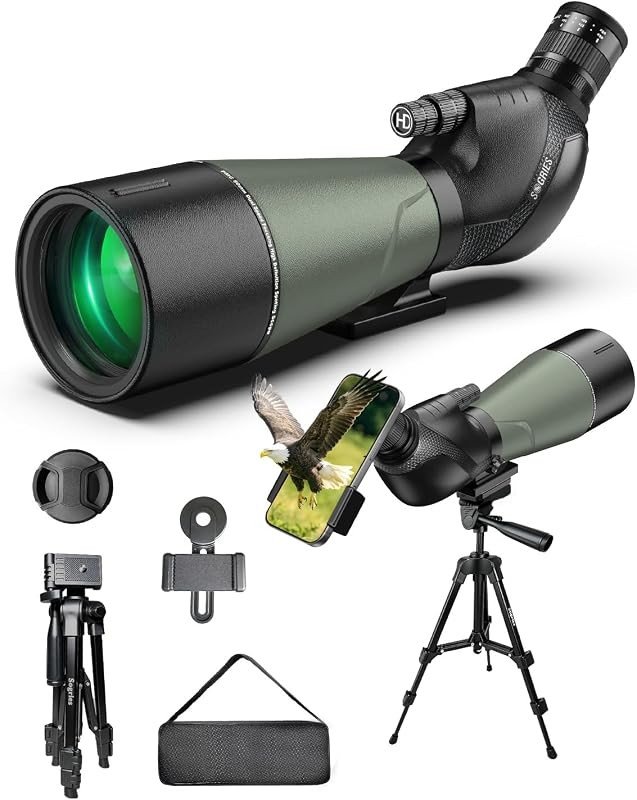
This HD 20-60×80 spotting scope features a detachable standard 1.25-inch eyepiece interface. Its precision dual focus system allows you to make rapid coarse changes and refined focus adjustments. Full Broadband Multi-Coating ensures bright, distortion-free views in misty morning marshes.
Key Features That Stand Out
- ✓ 20-60x magnification with 86.4-48.2 ft/1000 yds field of view
- ✓ BAK4 prism and Full Broadband Multi-Coating (FBMC) for dim dawn lighting
- ✓ Detachable standard 1.25″ eyepiece interface for custom ocular options
- ✓ Smooth dual focus knobs and twist-extendable eyecups for glasses wearers
- ✓ Nitrogen-purged waterproof construction with protective rubber armor
Why We Recommend It
The detachable 1.25-inch ocular design provides excellent flexibility for astronomy or custom eyepieces. Twist eyecups give glasses wearers complete comfort without field loss. Dual focus dials make tracking active birds seamless.
Best For
Eyeglass wearers and wetland birders who need fine-focus control and interchangeable eyepieces.
Pros and Cons
Pros:
- Standard 1.25-inch detachable eyepiece mount
- Dual focus knobs allow rapid, exact focusing
- Twist eyecups accommodate glasses wearers
- Full broadband multi-coating for low-light clarity
Cons:
- Detachable ocular requires care to keep dust out
- Narrower field of view at full 60x zoom
7. Celestron Hummingbird ED 56mm Spotting Scope
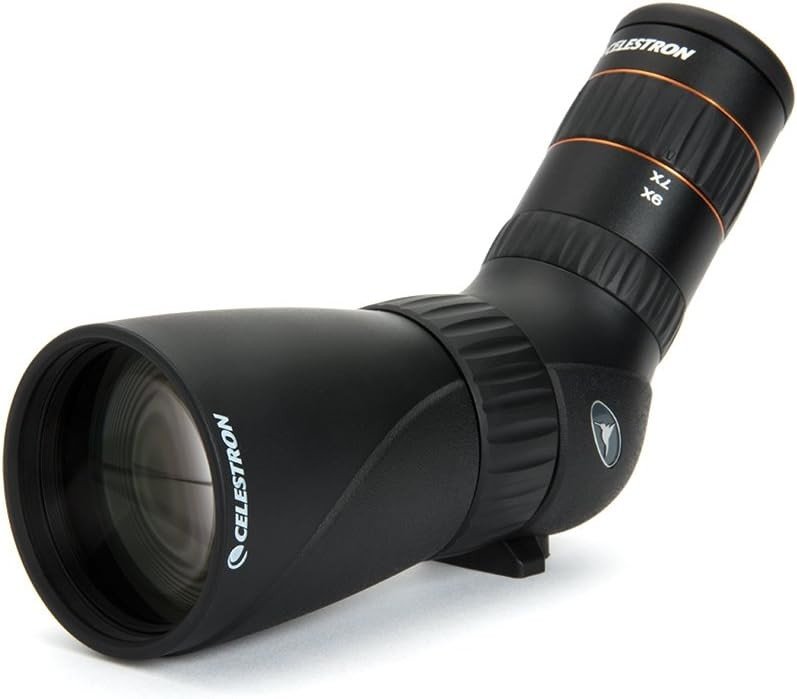
The Celestron Hummingbird ED is an ultra-compact micro spotting scope engineered for high mobility. It fits straight into a coat pocket or small belt pack without weighing you down. ED glass optics ensure vivid color correction while bridging the gap between binoculars and scopes.
Key Features That Stand Out
- ✓ Ultra-compact micro footprint fits easily in a vest pocket or small bag
- ✓ Extra-low Dispersion (ED) lens system providing razor-sharp color correction
- ✓ 9-27x zoom range offering versatile scanning power
- ✓ Impressive 10-foot close focus distance ideal for nearby garden birds
- ✓ Nitrogen-filled waterproof housing built for humid and rainy environments
Why We Recommend It
This is the ultimate travel scope for birders on the move. The close 10-foot focus distance lets you inspect backyard feeders and nearby shrubs with incredible detail. ED glass controls chromatic aberration beautifully.
Best For
Traveling birders, hikers, and backyard watchers wanting pocket-sized mobility.
Pros and Cons
Pros:
- Extremely lightweight and fits in pockets
- ED glass minimizes color fringing
- Short 10-foot close focus distance
- Fully nitrogen-filled and waterproof
Cons:
- 56mm lens gathers less light in deep dusk
- Magnification caps out at 27x
8. Celestron C90 Maksutov Spotting Scope
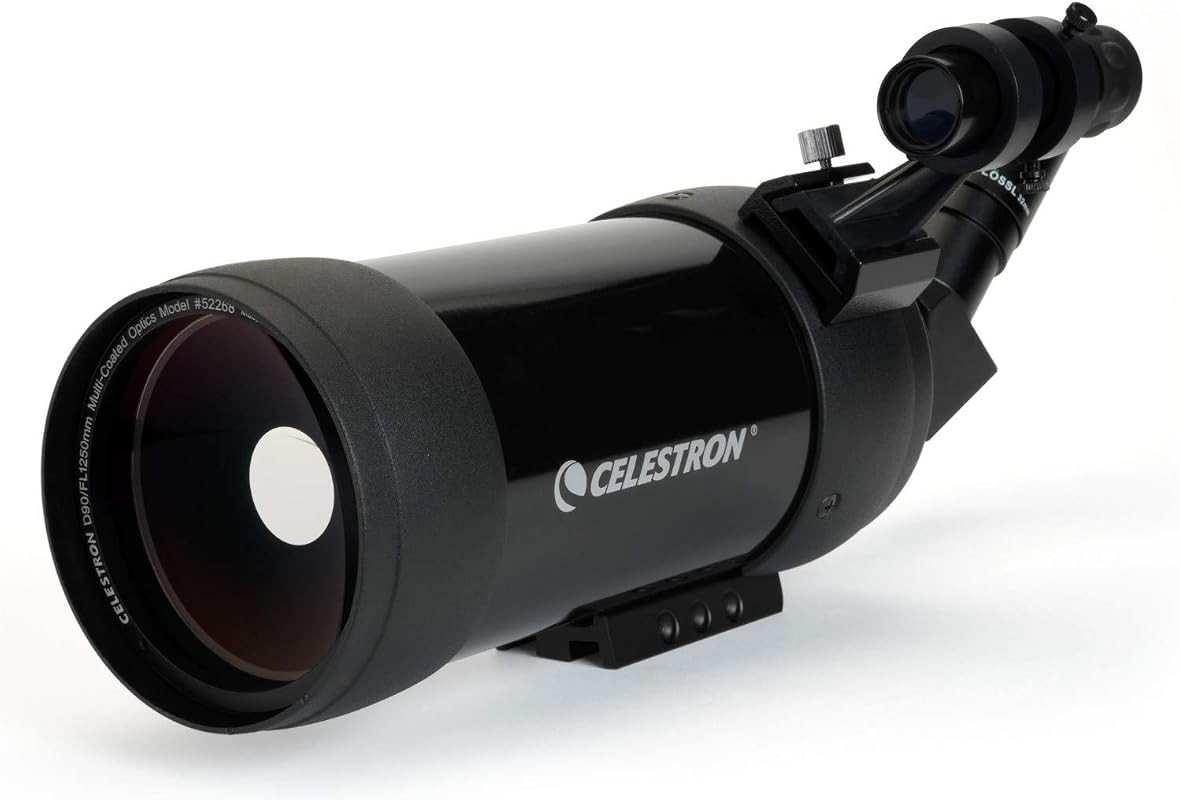
The Celestron C90 uses an advanced folded Maksutov-Cassegrain optical system for serious long-range reach. This design yields a compact barrel while delivering a substantial focal length. It doubles as a sharp telephoto lens for cameras and comes with its own nylon backpack.
Key Features That Stand Out
- ✓ 90mm Maksutov-Cassegrain optical design that folds the light path into a compact barrel
- ✓ Multi-coated optics for bright, high-contrast terrestrial and night-sky viewing
- ✓ Fully camera adaptable to serve as a powerful telephoto lens via optional T-Adapter
- ✓ Included 32mm eyepiece and 45-degree erect image diagonal for natural bird viewing
- ✓ Complete kit with 8×21 finderscope and dedicated nylon backpack
Why We Recommend It
If you love spotting distant birds and observing the moon at night, the C90 handles both tasks easily. The folded optical design keeps the overall length short. The included backpack keeps the setup organized on the trail.
Best For
Dual-purpose observers interested in extreme long-distance birding, photography, and astronomy.
Pros and Cons
Pros:
- Folded optical design provides high power in a short tube
- Direct camera adaptability for telephoto shooting
- Generous 90mm aperture
- Includes dedicated backpack and finderscope
Cons:
- Requires manual finderscope alignment for fast targets
- Fixed focal length requires changing eyepieces to alter zoom
9. Swarovski ATS 80 Spotting Scope

The Swarovski ATS 80 is a world-class optical instrument offering elite edge-to-edge definition. Its premium 80mm objective lens renders feather detail with exceptional resolution and color accuracy. Submersible waterproofing and a wide field of view make it a lifetime birding companion.
Key Features That Stand Out
- ✓ Unmatched clarity via premium 80mm objective lens in low ambient light
- ✓ 20-60x zoom eyepiece providing an expansive 118-66 ft/1000 yds field of view
- ✓ Nitrogen-filled and waterproof down to an impressive depth of 13 feet
- ✓ Generous 17mm eye relief for prolonged observation sessions without eye strain
- ✓ Angled body design optimized for natural neck and head posture
Why We Recommend It
This spotting scope provides breathtaking optical clarity. The wide field of view simplifies finding fast raptors in flight. With 17mm eye relief and 13-foot waterproofing, it offers flawless comfort in extreme conditions.
Best For
Serious birders seeking top-tier optical clarity, extreme weather resistance, and maximum field of view.
Pros and Cons
Pros:
- Exceptional optical resolution and edge-to-edge clarity
- Broad 118-66 ft field of view
- Submersible waterproofing down to 13 feet
- Comfortable 17mm eye relief
Cons:
- Premium optics demand a high investment
- Requires a high-end tripod to reach maximum stability
Best Spotting Scopes For Birding Reddit
Searching for ‘best spotting scopes for birding reddit’? Here is a quick comparison of our top picks. The #1 SVBONY SV28 uses a 70mm lens with a desktop tripod, making it light for family camping. The #2 Falcon 20-60×85 steps up to an 85mm lens with an adjustable full-size tripod for dawn and dusk watching. Meanwhile, the #3 Athlon Optics Forerunner features an 80mm argon-purged chassis and a dual focus system for fast, accurate tracking.
Quick Buying Guide for Best Spotting Scopes For Birding
🏆 Best overall: #1 SVBONY SV28
💰 Best budget: #3 Athlon Optics Forerunner
🎯 Best for low light: #2 Falcon 20-60×85
Which One Should You Pick?
| If you are… | Pick |
|---|---|
| A novice starting out | #1 SVBONY SV28 |
| Watching birds in dim light | #2 Falcon 20-60×85 |
| Tracking fast moving targets | #3 Athlon Optics Forerunner |
| Hiking long distances | #7 Celestron Hummingbird ED 56mm |
Quick Spec Comparison
| Product | Zoom Range | Lens Size | Weather Sealing |
|---|---|---|---|
| #1 SVBONY SV28 | 25-75x zoom | 70mm objective | Waterproof body |
| #2 Falcon 20-60×85 | 20-60x zoom | 85mm objective | Waterproof exterior |
| #3 Athlon Optics Forerunner | 20-60x zoom | 80mm objective | Argon purged waterproof |
| #4 Celestron Ultima 100 | 22-66x zoom | 100mm objective | N/A |
| #5 DiamondEdge 25-75×80 | 25-75x zoom | 80mm objective | Nitrogen filled waterproof |
| #6 HD 20-60×80 | 20-60x zoom | 80mm objective | Nitrogen purged waterproof |
| #7 Celestron Hummingbird ED | 9-27x zoom | 56mm objective | Nitrogen filled waterproof |
| #8 Celestron C90 | N/A | 90mm objective | N/A |
| #9 Swarovski ATS 80 | 20-60x zoom | 80mm objective | Waterproof to 13ft |
What to Look For
- Objective lens size: #4 Celestron Ultima 100 and #2 Falcon 20-60×85 lead, #7 Celestron Hummingbird ED 56mm lags.
- Portability: #7 Celestron Hummingbird ED 56mm and #1 SVBONY SV28 lead, #4 Celestron Ultima 100 lags.
- Focus precision: #3 Athlon Optics Forerunner and #6 HD 20-60×80 lead with dual dials, others lag.
- Waterproof depth: #9 Swarovski ATS 80 leads at 13 feet, others lag.
Before You Buy
- ✓ Check if an adjustable tripod is included in the package.
- ✓ Verify that the objective lens fits your low light requirements.
- ✓ Look for dual focus knobs if you track fast birds.
- ✓ Make sure eye relief accommodates your eyeglasses comfortably.
- ✓ Confirm waterproof sealing if you observe in humid wetlands.
- ✓ Check if your phone or camera needs adapter rings.
Frequently Asked Questions
Q: What magnification do I need for bird watching?
A: A zoom range of 20x to 60x is ideal for most birders. It gives you a broad field of view at lower power for finding birds, and higher magnification to inspect distant field marks.
Q: Why is objective lens size important?
A: The objective lens gathers light. Larger lenses like 80mm or 85mm allow brighter images in dim dawn or dusk conditions, though they add extra weight to your pack.
Q: Should I choose an angled or straight spotting scope?
A: Angled spotting scopes are popular for birding because they allow comfortable viewing when looking up into trees and can be easily shared among people of different heights.
Investing in the best spotting scopes for birding elevates your outdoor outings, letting you enjoy close-up views of plumage, behavior, and distant species. Review the choices above, select the scope that aligns with your observation habits, and upgrade your birding kit today!