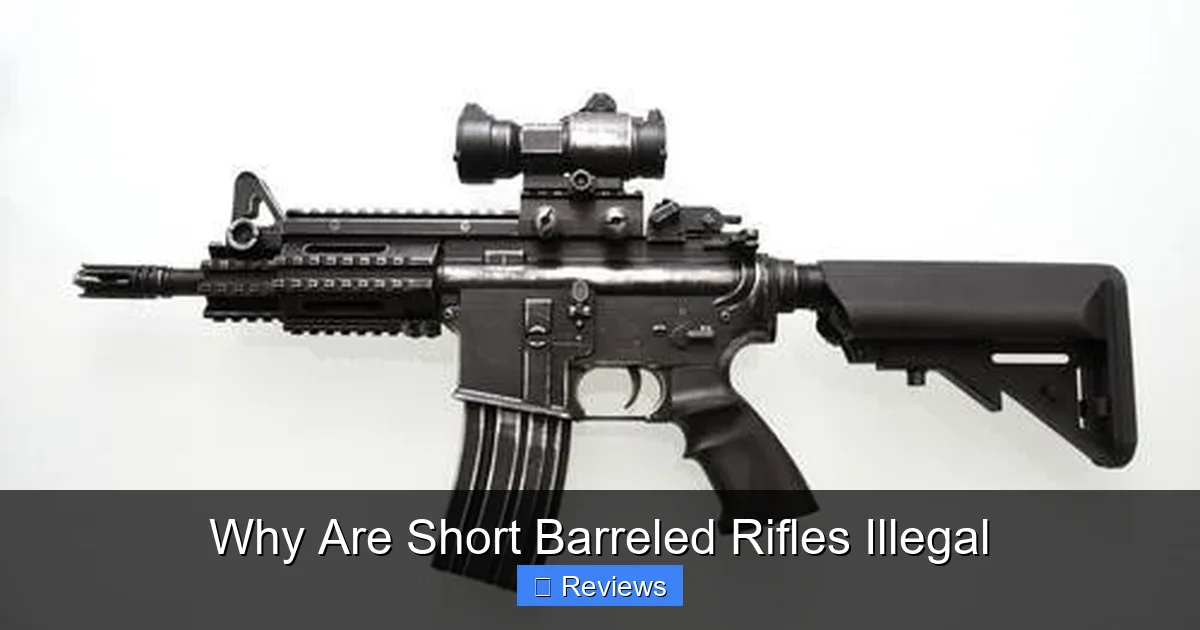
Short barreled rifles (SBRs) are illegal at the federal level without proper registration due to the National Firearms Act (NFA) of 1934. This law, enacted during the Prohibition era, aimed to control specific firearms perceived as dangerous or easily concealable, including SBRs. To legally own a short barreled rifle, one must undergo a rigorous application process with the ATF, pay a tax stamp, and comply with all federal and state regulations.
Ever found yourself scrolling through gun forums or watching videos online and come across these really cool, compact rifles? Perhaps you’ve seen an AR-15 that looks a bit shorter than usual, almost like a pistol, but clearly still a rifle. These are often what we call Short Barreled Rifles, or SBRs for short. They look super handy and practical for certain situations, but then you hear whispers of them being “illegal” or requiring some kind of special permission.
It’s enough to make your head spin, right? You might wonder, “Why are short barreled rifles illegal?” Is it about the power? Is it about accuracy? Is it some arbitrary rule? The truth is, the legality of short barreled rifles is a common point of confusion for many firearm enthusiasts, both new and experienced. It’s not as simple as “yes” or “no” and understanding the nuances requires a little journey into history and federal law. So, let’s clear up the confusion and dive deep into why short barreled rifles are regulated the way they are.
In this article, we’re going to explore the definition of an SBR, the historical context that led to their regulation, the specific laws that govern them, and most importantly, how you can legally own one if you choose to. We’ll also touch on some common misconceptions and the serious penalties for non-compliance. Our goal is to make this complex topic easy to understand, so you can navigate the world of firearms confidently and legally.
Key Takeaways
- NFA of 1934: The primary reason short barreled rifles are illegal without special permission is the National Firearms Act (NFA) of 1934, which regulates certain classes of firearms through taxation and registration.
- Definition of an SBR: A rifle with a barrel less than 16 inches or an overall length less than 26 inches is federally classified as a short barreled rifle (SBR), subjecting it to NFA regulations.
- Historical Context: SBRs were regulated due to their perceived association with organized crime during the Prohibition era, similar to machine guns and sawed-off shotguns, despite modern understanding of their actual utility.
- Legal Ownership Process: Owning a short barreled rifle legally requires an extensive application process with the ATF (Form 1 for making, Form 4 for transferring), a $200 tax stamp, and a background check, in addition to complying with state and local laws.
- Penalties for Non-Compliance: Illegal possession of a short barreled rifle can lead to severe federal penalties, including substantial fines and long prison sentences, highlighting the critical importance of following the law.
- Distinction from AR Pistols: AR pistols, while compact, are legally distinct from short barreled rifles if they lack a stock and are designed to be fired with one hand, making them exempt from NFA SBR regulations unless modified.
Quick Answers to Common Questions
What is the minimum legal barrel length for a rifle without NFA registration?
The minimum legal barrel length for a rifle to not be classified as a short barreled rifle (SBR) under the National Firearms Act (NFA) is 16 inches.
Can I convert my standard rifle into a short barreled rifle?
Yes, you can convert a standard rifle into a short barreled rifle, but you must first obtain an approved ATF Form 1 (“Application to Make and Register a Firearm”) and pay the $200 tax stamp *before* making any modifications that would classify it as an SBR.
Are AR pistols considered short barreled rifles?
No, AR pistols are generally not considered short barreled rifles if they are manufactured as pistols and lack a traditional rifle stock, even if they have a short barrel. They are designed to be fired with one hand.
What is a “tax stamp” in relation to SBRs?
A “tax stamp” is a $200 federal tax paid to the Bureau of Alcohol, Tobacco, Firearms and Explosives (ATF) when registering or transferring a National Firearms Act (NFA) item like a short barreled rifle. It serves as proof of legal registration.
Why did the National Firearms Act (NFA) specifically target short barreled rifles?
The NFA specifically targeted short barreled rifles due to their perceived concealability and maneuverability, which lawmakers in the 1930s associated with criminal activity by gangsters and outlaws, similar to sawed-off shotguns and machine guns.
📑 Table of Contents
Understanding Short Barreled Rifles (SBRs)
Before we can talk about why short barreled rifles are illegal, we need to know exactly what one is. The term “short barreled rifle” isn’t just a casual description; it’s a very specific legal definition under federal law. Getting this definition right is the first crucial step in understanding the regulations.
What Defines an SBR?
The core of the definition comes from the National Firearms Act (NFA) of 1934, which we’ll discuss in detail shortly. According to the NFA, a short barreled rifle is a rifle that has:
- A barrel length less than 16 inches, OR
- An overall length less than 26 inches.
It’s important to note that it’s an “OR” situation. If your rifle meets either of those criteria, it’s considered an SBR. This applies even if you start with a standard rifle and modify it, for example, by cutting down the barrel. Once that barrel dips below 16 inches, or the overall length shrinks past 26 inches, you’ve created a short barreled rifle in the eyes of the law, and you better have the proper paperwork in advance.
The “Why” Behind Short Barrels
So, why would someone even want a short barreled rifle? It’s not just for aesthetics. Short barreled rifles offer several practical advantages:
- Maneuverability: A shorter rifle is much easier to move around in confined spaces, like inside a vehicle, in a home defense scenario, or dense brush. This is a big draw for law enforcement and military personnel, and also for civilians who prioritize home defense.
- Compactness: They are simply easier to store and transport. A compact rifle takes up less space in a gun safe, backpack, or vehicle.
- Weight Reduction: A shorter barrel often means less weight, making the firearm less fatiguing to carry and handle over long periods.
These practical benefits are why many people are drawn to short barreled rifles. However, these same characteristics were also part of the reason they became regulated, as we’ll soon see.
The National Firearms Act (NFA) of 1934
To truly understand why short barreled rifles are illegal without specific registration, we have to go back in time to the 1930s and examine a landmark piece of legislation: the National Firearms Act (NFA) of 1934. This act fundamentally changed how certain types of firearms are regulated in the United States.
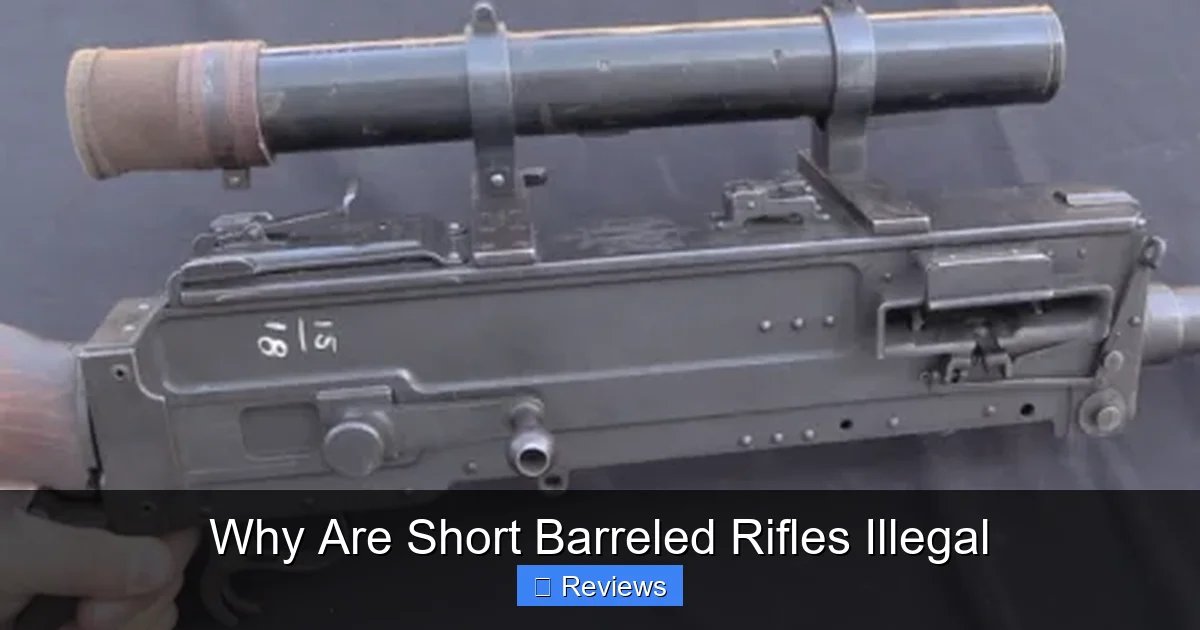
Visual guide about Why Are Short Barreled Rifles Illegal
Image source: forgottenweapons.com
Birth of Gun Control as We Know It
The 1930s were a tumultuous time in American history. The Great Depression had gripped the nation, and organized crime was rampant, largely fueled by the Prohibition era. Gangsters like Al Capone, John Dillinger, and Bonnie and Clyde were using powerful, often concealable firearms to commit violent crimes, grabbing headlines and instilling fear across the country.
In response to this wave of crime, the federal government sought ways to crack down on the weapons favored by these criminals. President Franklin D. Roosevelt’s administration pushed for legislation to control what they perceived as unusually dangerous firearms. The NFA was Congress’s answer, and it wasn’t just about general gun control; it specifically targeted certain weapons.
What the NFA Regulated
The NFA didn’t ban firearms outright. Instead, it imposed a rigorous system of taxation and registration on specific categories of weapons. The idea was to make these particular firearms so expensive and cumbersome to obtain that they would be out of reach for the average criminal. The categories regulated by the NFA include:
- Machine guns (fully automatic firearms)
- Silencers (now commonly called suppressors)
- Destructive devices (bombs, grenades, certain large-bore firearms)
- Short-barreled shotguns (SBSs – shotguns with a barrel less than 18 inches or overall length less than 26 inches)
- Any Other Weapons (AOWs – a catch-all category for unusual firearms, often designed to be concealed)
- And, of course, short barreled rifles (SBRs)
So, when you ask, “Why are short barreled rifles illegal without specific permission?” the simplest answer is: because the NFA says so. They are lumped in with a group of firearms deemed by Congress in 1934 to be inherently more dangerous or suitable for criminal activity.
The Intent Behind the Regulation
The intent behind regulating short barreled rifles and the other NFA items was primarily two-fold: taxation and control. By requiring a hefty tax stamp (initially $200, which was a fortune in the 1930s) and federal registration, the government aimed to track these specific firearms and make them harder for criminals to acquire. It wasn’t about the raw power of the firearm, but rather its perceived utility in crime—specifically, the ability to be easily concealed while still delivering significant firepower, which was seen as a major threat by law enforcement at the time. This historical context is vital for understanding why short barreled rifles are treated differently than standard rifles.
The Specifics: Why SBRs Are Singled Out
It might seem odd that barrel length is such a critical factor in determining legality. After all, a rifle with a 16-inch barrel can shoot the same bullet as one with a 14-inch barrel, and often with similar power at typical ranges. So, why are short barreled rifles illegal without the NFA paperwork?
Perceived Criminal Utility
The main reason short barreled rifles were singled out was their perceived utility to criminals. In the 1930s, the “sawed-off shotgun” was a notorious weapon used by gangsters for its devastating close-quarters power and ease of concealment. Lawmakers applied similar reasoning to rifles. A standard rifle is long and cumbersome, making it difficult to hide on one’s person. However, a rifle with a short barrel, especially if it could be easily disassembled or was inherently compact, could be concealed under a coat or in a small bag. The thinking was that this made it an ideal weapon for surprise attacks or for use in committing violent felonies where discretion was needed.
It wasn’t about the intrinsic danger of the rifle itself, but rather the combination of rifle firepower with enhanced concealability and maneuverability. This perception, whether entirely accurate or not, heavily influenced the creation of the NFA and its regulation of the short barreled rifle.
Historical Misconceptions
It’s fair to say that some of the reasoning behind the NFA’s categories was based on perceptions and anecdotal evidence from the era, rather than rigorous ballistic or tactical analysis. The image of the “Tommy Gun” or the sawed-off shotgun, or a compact rifle used by outlaws, shaped public and political opinion. The focus wasn’t on the capabilities of the firearm for sporting or self-defense but on its potential for misuse by a specific type of criminal.
Today, while the technology of firearms has advanced significantly, the legal framework from 1934 still largely applies. The definition of a short barreled rifle remains fixed, even if modern understandings of firearm effectiveness or criminal behavior have evolved.
Not About Power, But Portability
It’s crucial to understand that the NFA’s regulation of short barreled rifles isn’t primarily about the power or lethality of the round fired. A standard AR-15 with a 16-inch barrel fires the same 5.56mm cartridge as an AR-15 with a 10.5-inch barrel. In fact, shorter barrels can sometimes result in reduced muzzle velocity and increased muzzle blast compared to longer barrels. The emphasis of the NFA was, and still is, on the *portability* and *concealability* that a shorter barrel or overall length provides.
This distinction is key to answering why short barreled rifles are illegal without special permission: it’s not because they are inherently more powerful or accurate, but because their compact nature was historically deemed a higher risk for criminal use.
Navigating the Legal Landscape: Owning an SBR Legally
So, if you’re interested in owning a short barreled rifle, don’t despair! It is absolutely possible to do so legally, but it requires understanding and meticulously following the federal and state laws. This isn’t a casual purchase; it’s a commitment to a detailed legal process.
The NFA Process: Form 1 vs. Form 4
There are two primary ways to legally acquire a short barreled rifle, each with its own application form:
- Form 1 (ATF Form 5320.1): “Application to Make and Register a Firearm”
- This form is used when you, as an individual, trust, or corporation, plan to *make* a short barreled rifle from a non-NFA firearm (like turning a pistol or a rifle with a longer barrel into an SBR by adding a stock or shortening the barrel).
- You must submit this form *before* you actually make the SBR. You cannot possess an unregistered short barreled rifle at any point during this process. This means you must have an approved Form 1 from the ATF before you begin any modification that would classify your firearm as an SBR.
- Form 4 (ATF Form 5320.4): “Application for Tax Paid Transfer and Registration of Firearm”
- This form is used when you are *transferring* an already-made and registered short barreled rifle from a dealer (who is known as an NFA dealer) or another private individual (if allowed in your state).
- The SBR must remain with the dealer or seller until your Form 4 is approved by the ATF.
Both processes involve submitting fingerprints, a photograph (for individuals), and a rigorous background check. The waiting times for approval can vary greatly, often ranging from several months to over a year, depending on ATF processing volumes.
The Tax Stamp
Regardless of whether you’re making or transferring a short barreled rifle, you’ll need to pay a one-time federal tax of $200 for each NFA item. This is commonly referred to as the “tax stamp.” Once your application is approved, the ATF sends back a physical stamp, which serves as your proof of payment and registration. Keep this document safe!
Trusts and Corporations
Many individuals choose to register their short barreled rifles (and other NFA items) through a gun trust or a corporation. There are several advantages to this:
- Flexibility for Shared Use: Multiple trustees or members of the corporation can legally possess and use the SBR, whereas with individual registration, only the registered individual can possess it.
- Succession Planning: A trust provides a clear plan for what happens to the NFA items upon your death, avoiding potential legal complications for your heirs.
- No Chief Law Enforcement Officer (CLEO) Signature (Historically): For a long time, trusts and corporations allowed applicants to bypass the requirement for a local CLEO signature. While the rules have changed, requiring CLEO notification for all applicants, trusts still offer other benefits.
Setting up a trust or corporation requires legal assistance to ensure it’s done correctly and complies with all relevant laws.
State-Specific Laws
It’s absolutely vital to remember that federal law is not the only law. Even if the ATF approves your application for a short barreled rifle, your state or local laws might still prohibit them entirely. Some states are very restrictive, while others align more closely with federal regulations. Always check your state’s laws before starting the NFA process. Ignorance of the law is never an excuse.
Consequences of Illegal SBR Possession
This is perhaps the most serious part of understanding why short barreled rifles are illegal without the proper paperwork. The penalties for illegal possession of an unregistered SBR are severe and can have life-altering consequences. This is not a situation where you want to “oops” your way into trouble.
Federal Penalties
Possession of an unregistered short barreled rifle is a federal felony. The penalties can include:
- Imprisonment: Up to 10 years in federal prison.
- Fines: Up to $250,000.
- Loss of Rights: A felony conviction will result in the loss of your right to own any firearms for the rest of your life, not just NFA items.
These are not minor slaps on the wrist. Federal law enforcement agencies, like the ATF, take NFA violations very seriously. The complex nature of the NFA means that mistakes can be costly, which is why understanding “why are short barreled rifles illegal” is so important.
State Penalties
On top of federal charges, you could also face state-level charges if your state has its own laws regarding short barreled rifles or illegal firearm possession. State penalties can vary widely but can add to the severity of the punishment, potentially leading to additional prison time and fines. It’s a double-whammy you absolutely want to avoid.
The Importance of Compliance
The bottom line is that if you intend to own a short barreled rifle, you must comply with every step of the legal process. There are no shortcuts. Start the process, wait for approval, and only then proceed with making or acquiring your SBR. Any deviation could lead to dire legal consequences. Responsible gun ownership means knowing and following the law to the letter.
Common Misconceptions and FAQs
Because the world of NFA items can be complex, many myths and misunderstandings have popped up over the years, especially concerning short barreled rifles. Let’s tackle a few common ones to provide even more clarity.
SBRs vs. AR Pistols: A Critical Distinction
This is perhaps the biggest area of confusion. An “AR pistol” often looks very similar to a short barreled rifle: it’s an AR-platform firearm with a barrel under 16 inches. However, an AR pistol is *not* an SBR, and therefore not subject to NFA regulations, *if* it meets certain criteria:
- It must be manufactured and intended to be fired with one hand. This means it cannot have a traditional rifle stock.
- It must originally be manufactured as a pistol. You cannot take a rifle and simply remove the stock to turn it into a pistol; that would likely create an illegal SBR.
The distinction lies in its original classification and features. An AR pistol, by definition, is a pistol, even if it uses rifle cartridges. An SBR is a rifle that has been shortened. This difference is why you see so many “pistol” variants of ARs on the market that have short barrels but don’t require a tax stamp. However, be extremely careful not to accidentally convert an AR pistol into an SBR by attaching a stock without prior ATF approval.
What About Stabilizing Braces?
Stabilizing braces are attachments designed to assist in firing a pistol with one hand by stabilizing it against the shooter’s forearm. For years, these braces allowed users to have the compact form factor of a short barreled rifle without falling under NFA regulations, as long as they were attached to a pistol (not a rifle) and not “shouldered” like a stock. However, the legal landscape surrounding pistol braces has been highly dynamic.
The ATF has gone back and forth on the issue. Most recently, in 2023, the ATF issued a rule that effectively treated many firearms equipped with stabilizing braces as short barreled rifles, requiring owners to register them as NFA items or make other modifications. However, this rule has faced numerous legal challenges and injunctions. The legal status of braced pistols is currently in flux, with ongoing court cases. It’s a prime example of why firearm owners must stay informed about changes in federal regulations. Always consult current ATF guidance and legal counsel regarding pistol braces.
The “Why Not Just Make it Legal?” Argument
Many proponents of Second Amendment rights argue that the NFA’s regulation of short barreled rifles is outdated and unnecessary. They point out that a short barrel doesn’t make a rifle inherently more dangerous than a standard one, and that criminals will always find ways to acquire weapons regardless of the law. They advocate for removing SBRs from the NFA list, streamlining the process, or repealing parts of the NFA entirely.
On the other hand, those who support the NFA argue that its regulations, including those on short barreled rifles, are a necessary tool for public safety, helping to keep dangerous and easily concealable firearms out of the hands of criminals. This is a highly politicized debate with strong arguments on both sides, reflecting fundamental differences in how people view firearm ownership and government regulation.
Understanding these different perspectives helps to explain why the NFA, and the regulations on short barreled rifles, have remained in place for nearly a century, despite ongoing calls for reform.
Conclusion
So, why are short barreled rifles illegal without special permission? It boils down to a specific federal law, the National Firearms Act of 1934, which was enacted during a very different time in American history. This law classified SBRs, alongside other specific firearms, as items requiring special registration and a tax stamp due to their perceived potential for criminal misuse, largely because of their compact size and concealability.
While the NFA’s definitions and requirements might seem complex or even arbitrary today, they are the law of the land. For anyone interested in owning a short barreled rifle, understanding this history and the precise legal pathway is not just a suggestion—it’s an absolute necessity. The process involves meticulous paperwork with the ATF, paying a federal tax, and crucially, adhering to all state and local laws, which can vary significantly.
Illegal possession of a short barreled rifle carries severe federal penalties, including substantial fines and lengthy prison sentences. This underscores the importance of exercising extreme caution and diligence. Whether you agree with the NFA or not, responsible gun ownership means knowing and strictly following all applicable laws to ensure your safety and freedom. Stay informed, stay compliant, and enjoy your firearms responsibly.
Frequently Asked Questions
What federal law makes short barreled rifles illegal without special permission?
The National Firearms Act (NFA) of 1934 is the federal law that regulates short barreled rifles (SBRs), classifying them as NFA items. This means they require special registration with the ATF and a $200 tax stamp for legal ownership and transfer.
Is it possible to own a short barreled rifle legally in the United States?
Yes, it is absolutely possible to own a short barreled rifle legally in the United States. However, it requires following a strict federal application process with the ATF, obtaining an approved tax stamp, and ensuring compliance with all state and local laws, which may have their own restrictions.
What is the difference between a short barreled rifle (SBR) and a pistol with a brace?
Traditionally, a short barreled rifle (SBR) is a rifle with a barrel under 16 inches or overall length under 26 inches, requiring NFA registration. A pistol with a brace was designed to be fired one-handed and was not subject to NFA rules. However, the legal status of braced pistols is currently subject to ongoing litigation and regulatory changes, making it a complex area.
What are the penalties for possessing an unregistered short barreled rifle?
Possessing an unregistered short barreled rifle is a serious federal felony. Penalties can include up to 10 years in federal prison, substantial fines up to $250,000, and the permanent loss of all firearm ownership rights.
Do I need to inform local law enforcement if I apply for an SBR?
Yes, under current ATF regulations, all applicants for NFA items, whether individuals, trusts, or corporations, are required to notify their Chief Law Enforcement Officer (CLEO) of their application. This is a notification requirement, not an approval requirement from the CLEO.
Why are short barreled rifles considered more dangerous than standard rifles by law?
Legally, short barreled rifles are not necessarily considered more powerful or lethal. Instead, the NFA of 1934 focused on their compact size and perceived ease of concealment, which lawmakers at the time associated with a higher potential for criminal misuse, similar to how sawed-off shotguns were viewed.