The legality of assault rifles in the U.S. is a deeply complex issue, primarily rooted in the Second Amendment’s protection of the right to bear arms. This constitutional right, interpreted by the Supreme Court, combined with specific legal definitions differentiating civilian semi-automatic firearms from military-grade weapons, forms the bedrock of why these rifles are legal. The legislative history, varying state laws, and robust arguments from proponents further contribute to their continued legality, despite ongoing national debates and calls for stricter controls.
The question “Why are assault rifles legal?” is one that sparks intense debate, deep emotions, and widespread confusion across the United States. It’s a question heard in living rooms, on news channels, and in the halls of government, often following tragic events involving these firearms. For many, the very idea of such powerful weapons being available to civilians is perplexing, while for others, it’s a fundamental constitutional right.
To truly understand why assault rifles are legal in America, we must embark on a journey through constitutional law, historical context, legislative decisions, and the nuanced definitions that often get lost in the public discourse. This isn’t a simple question with a single answer; rather, it’s a mosaic of legal interpretations, historical precedents, and deeply held beliefs that shape the unique landscape of gun ownership in the U.S. Let’s peel back the layers and explore the multifaceted reasons behind the legality of these controversial firearms.
Our goal here isn’t to advocate for or against the legality of assault rifles, but rather to shed light on the existing legal framework and the arguments that underpin their current status. We’ll delve into the foundational principles that allow these weapons to be legally owned by civilians, examining the “whys” from a purely informational perspective. So, if you’ve ever wondered about the nuts and bolts of this complex issue, let’s explore why assault rifles are legal, dissecting the key components that define this challenging debate.
Key Takeaways
- Second Amendment Protection: The U.S. Constitution’s Second Amendment is widely interpreted to protect an individual’s right to bear arms, a fundamental reason why assault rifles are legal.
- Legal Definitions Matter: Civilian “assault rifles” are typically semi-automatic firearms, legally distinct from the fully automatic military weapons often depicted, influencing their legality.
- Supreme Court Rulings: Landmark cases like Heller and McDonald affirmed the individual right to possess firearms for self-defense, underpinning challenges to potential bans.
- Expired Federal Ban: The federal Assault Weapons Ban of 1994 expired in 2004, and Congress has not renewed it, contributing to the broader legality of these weapons nationwide.
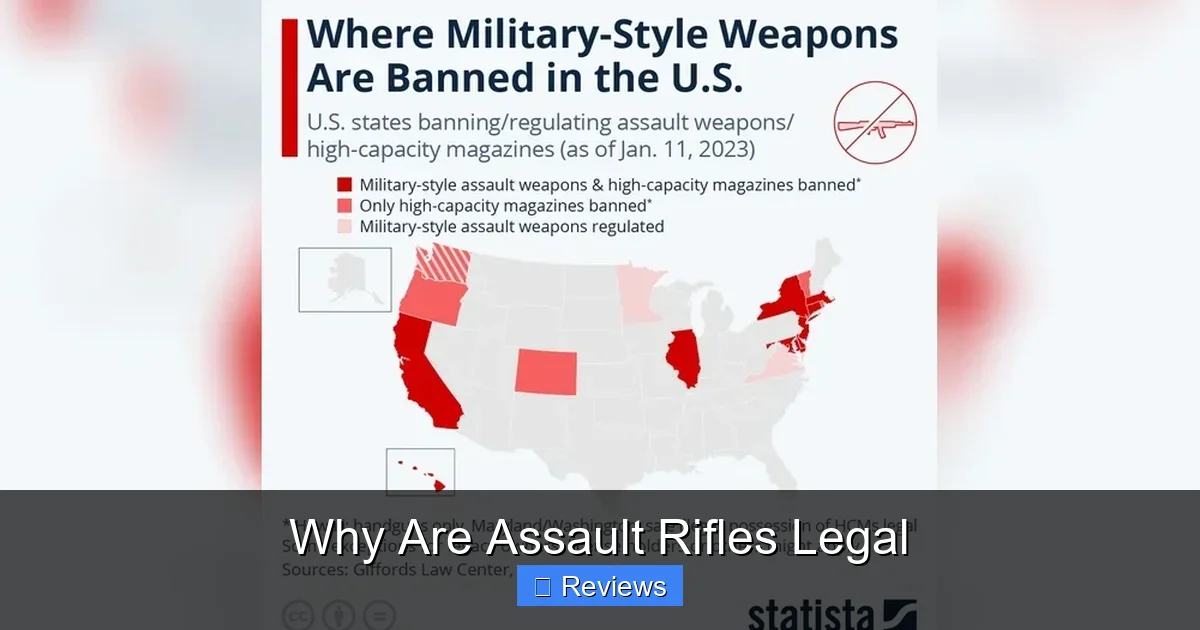
- State-Level Variation: While federally legal in most contexts, individual states have enacted their own bans or restrictions on certain types of semi-automatic rifles, creating a patchwork of laws.
- Arguments for Legality: Proponents cite self-defense, sport, hunting, and constitutional rights as reasons why assault rifles should remain legal for responsible citizens.
- Ongoing National Debate: The question of why assault rifles are legal remains a highly contentious issue, balancing constitutional rights with public safety concerns in an ongoing national conversation.
Quick Answers to Common Questions
Are fully automatic assault rifles legal for civilians?
No, fully automatic “assault rifles” (machine guns) have been heavily restricted for civilian ownership since 1934. Only those manufactured before May 1986 are generally transferable, and they require extensive federal registration, background checks, and tax stamps, making them extremely rare in civilian hands.
What does “semi-automatic” mean in the context of these rifles?
Semi-automatic means that the firearm fires one round each time the trigger is pulled and automatically reloads a new round into the chamber from the magazine, ready to fire again. This is distinct from fully automatic, which continues to fire as long as the trigger is held down.
Did the federal assault weapons ban make all assault rifles illegal?
The federal Assault Weapons Ban of 1994, which prohibited the manufacture and sale of certain semi-automatic firearms with specific cosmetic features, expired in 2004 and was not renewed. It did not ban all “assault rifles” but restricted new sales of certain configurations for a decade.
How does the Second Amendment relate to the legality of assault rifles?
The Second Amendment protects an individual’s right to bear arms. Supreme Court cases like *Heller* and *McDonald* affirmed this right for self-defense, establishing a constitutional basis that makes outright bans on commonly used semi-automatic firearms challenging to implement.
Do all states have the same laws regarding assault rifles?
No, firearm laws vary significantly by state. While there is no federal ban, several states (e.g., California, New York, Connecticut) have enacted their own bans or severe restrictions on certain types of semi-automatic rifles, creating a patchwork of laws across the country.
📑 Table of Contents
- The Second Amendment: The Bedrock of Gun Rights
- Defining “Assault Rifle”: A Critical Distinction
- Historical Context and Legislative Milestones
- Arguments for Legality: Self-Defense, Sport, and Constitutional Right
- The Legislative Landscape: Federal vs. State Laws
- The Ongoing Debate and Future Outlook
The Second Amendment: The Bedrock of Gun Rights
At the heart of why assault rifles are legal in the United States lies the Second Amendment to the U.S. Constitution. Ratified in 1791 as part of the Bill of Rights, it states: “A well regulated Militia, being necessary to the security of a free State, the right of the people to keep and bear Arms, shall not be infringed.” This single sentence has been the subject of centuries of debate, legal challenges, and varying interpretations.
Historical Interpretation and the Militia Clause
For many years, legal scholars and courts debated whether the Second Amendment protected an individual’s right to bear arms or primarily a collective right tied to militia service. This “collective right” view suggested that gun ownership was protected only in the context of serving in a militia. However, this interpretation began to shift significantly in the late 20th and early 21st centuries, providing a clearer path for why assault rifles are legal.
Landmark Supreme Court Rulings
Two pivotal Supreme Court cases solidified the individual rights interpretation, laying the groundwork for the legality of many types of firearms, including semi-automatic rifles often termed “assault rifles.”
- District of Columbia v. Heller (2008): This landmark decision marked a turning point. The Court ruled that the Second Amendment protects an individual’s right to possess firearms for traditionally lawful purposes, such as self-defense in the home, unconnected with militia service. Justice Antonin Scalia, writing for the majority, emphasized that while the “militia” clause announced the purpose, it did not limit the “right of the people” to bear arms. This ruling directly challenged the notion that Washington D.C.’s ban on handguns was constitutional and provided a strong precedent for why assault rifles are legal elsewhere.
- McDonald v. City of Chicago (2010): Two years later, the Supreme Court extended the Heller ruling by incorporating the Second Amendment right to the states through the Fourteenth Amendment’s Due Process Clause. This meant that state and local governments could not infringe upon the individual right to bear arms in the same way the federal government could not. Together, Heller and McDonald established a robust, individually focused Second Amendment right, impacting discussions about why assault rifles are legal nationwide.
These rulings fundamentally shaped the legal landscape, establishing that the Second Amendment protects an individual’s right to own firearms for self-defense. While these decisions acknowledged that the right is not unlimited and reasonable regulations are permissible, they created a high bar for outright bans on common types of firearms, which often includes semi-automatic rifles.
Defining “Assault Rifle”: A Critical Distinction
Visual guide about Why Are Assault Rifles Legal
Image source: gunsafesecurity.com
One of the most crucial elements in understanding why assault rifles are legal is grappling with their definition. The term “assault rifle” itself is highly contentious and often misunderstood, leading to much of the public’s confusion. In common parlance and media, “assault rifle” often conjures images of military weapons capable of rapid, sustained fire. However, the legal and technical definitions are significantly different for civilian firearms.
Military vs. Civilian Firearms: Key Differences
A true military “assault rifle” is typically defined as a selective-fire rifle, meaning it can switch between semi-automatic (one shot per trigger pull) and fully automatic (continuous firing with a single trigger pull) or burst fire. These fully automatic weapons have been heavily restricted for civilian ownership since the National Firearms Act (NFA) of 1934. To own a fully automatic weapon today, civilians must navigate a complex federal registration process, extensive background checks, and pay a significant tax stamp, and only those manufactured before May 1986 are generally transferable. This is why true, fully automatic “assault rifles” are exceedingly rare in civilian hands and are not generally why assault rifles are legal for the average person.
“Assault Weapon” Bans and Cosmetic Features
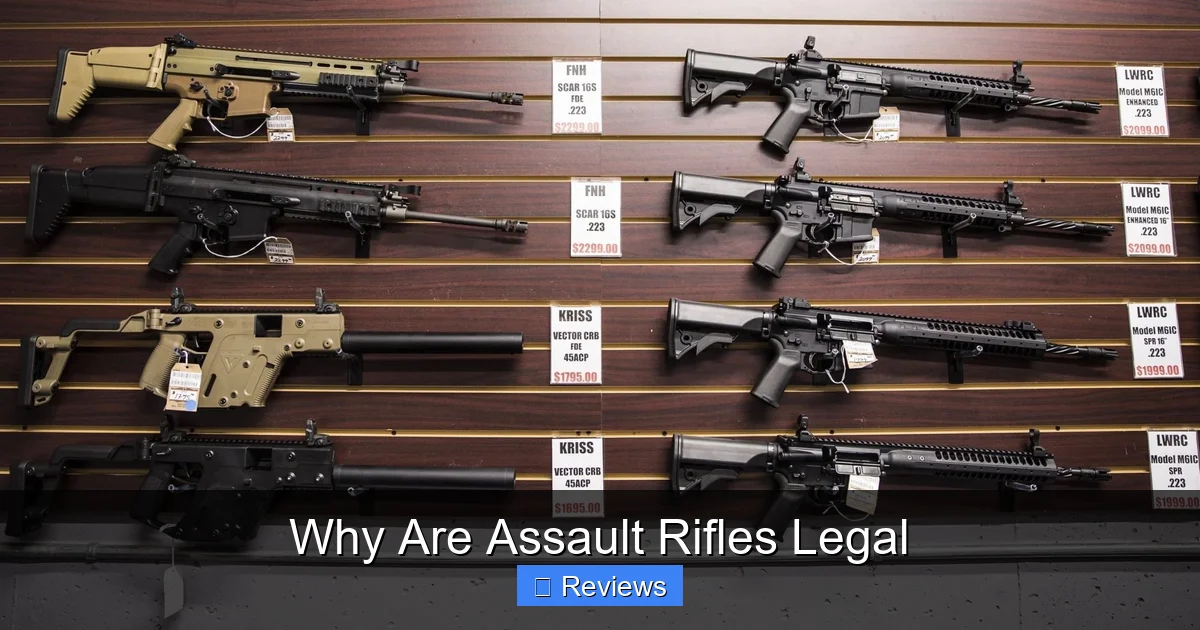
When we discuss “assault rifles” in the context of civilian legality, we are almost always referring to semi-automatic rifles that share certain cosmetic characteristics with military-style firearms. These features might include:
- A pistol grip
- A collapsible or folding stock
- A bayonet mount
- A flash hider or muzzle brake
- A grenade launcher attachment (rarely found or legal)
The term “assault weapon” as used in legislation (like the expired federal ban or current state bans) refers to these semi-automatic firearms that possess a specific combination of these features. Critically, these weapons fire only one round per trigger pull, just like many common hunting rifles or handguns. Their internal mechanics are essentially the same as other semi-automatic firearms that are not typically labeled “assault weapons.” The “assault” label often refers more to their appearance and military aesthetic than to their fundamental operating mechanism or firepower. This distinction is vital for understanding why assault rifles are legal for civilian purchase.
The argument made by proponents of their legality is that banning firearms based on cosmetic features rather than their functional capability is arbitrary and ineffective. They contend that a semi-automatic rifle, regardless of its “military look,” functions identically to other semi-automatic rifles that are not targeted by such bans, making the distinction largely about perception rather than inherent danger. This definitional nuance is a cornerstone of why assault rifles are legal in many jurisdictions.
Historical Context and Legislative Milestones
Understanding why assault rifles are legal also requires a look back at the historical availability of firearms in the U.S. and key legislative actions (or inactions) over the past century.
A History of Firearm Availability
The Second Amendment was adopted in a time when citizens commonly owned firearms for self-defense, hunting, and militia service. Throughout much of American history, various types of firearms, including repeater rifles and early semi-automatics, were largely unrestricted. The idea of widespread civilian gun ownership, including rifles that could be used for defense or sport, is deeply ingrained in American culture.
The National Firearms Act of 1934 (NFA)
The first major piece of federal gun control legislation, the NFA, was enacted during the Prohibition era in response to organized crime. This act specifically targeted highly dangerous weapons like machine guns, short-barreled rifles and shotguns, and silencers. It didn’t ban them outright but imposed strict registration, taxation, and approval requirements. As a result, fully automatic weapons became extremely difficult and expensive for civilians to own, distinguishing them from the semi-automatic rifles we often discuss today when asking why assault rifles are legal.
The Gun Control Act of 1968 (GCA)
Following a wave of assassinations in the 1960s, the GCA regulated interstate firearm commerce, prohibiting certain individuals (e.g., felons, minors) from owning guns and requiring serial numbers on all firearms. It also broadened the scope of restricted destructive devices but largely left semi-automatic rifles unaddressed, cementing their status as generally legal firearms.
The Federal Assault Weapons Ban of 1994
Perhaps the most direct answer to “why are assault rifles legal” involves the legislative history of attempts to ban them. In 1994, Congress passed the Violent Crime Control and Law Enforcement Act, which included a provision known as the Federal Assault Weapons Ban (AWB). This ban prohibited the manufacture for civilian use of certain semi-automatic firearms defined by specific cosmetic features (e.g., pistol grips, bayonet lugs, flash suppressors) and high-capacity magazines (those holding more than 10 rounds). The ban was a temporary measure with a “sunset” clause, meaning it was designed to expire after ten years unless renewed.
When the ban expired in September 2004, Congress did not renew it. The reasons for this non-renewal were complex, including political shifts, intense lobbying efforts by gun rights organizations, and debates over the ban’s effectiveness. With the expiration of this federal ban, the legality of these semi-automatic firearms was largely restored at the federal level, unless individual states chose to maintain or enact their own bans. This lack of a current federal prohibition is a primary reason why assault rifles are legal in most parts of the country today.
Arguments for Legality: Self-Defense, Sport, and Constitutional Right
Beyond the legal and historical framework, specific arguments are consistently put forth by proponents of gun rights to explain why assault rifles are legal and should remain so. These arguments often center on constitutional principles, practical applications, and personal liberty.
Self-Defense and Equalizing Force
A core argument for the legality of semi-automatic rifles, particularly those with features often associated with “assault weapons,” is self-defense. Proponents argue that these firearms are effective tools for protecting oneself and one’s family, especially against multiple threats or in situations where an individual might be outmatched by an attacker. The high capacity magazines and ease of use are cited as critical advantages in defensive scenarios. The idea is that citizens should have access to effective tools to defend themselves, and for many, why assault rifles are legal comes down to this fundamental right.
Sport Shooting and Hunting
While often overshadowed by their defensive use, semi-automatic rifles are also widely used in various shooting sports. Competitions like 3-Gun (which involves pistol, rifle, and shotgun) often feature these types of rifles due to their accuracy, reliability, and modularity. Similarly, some hunters use these rifles, particularly for varmint control or hunting larger game, where their accuracy and capacity can be beneficial. These activities contribute to the perception of these firearms as legitimate tools for recreation and sport, further supporting arguments for why assault rifles are legal.
Constitutional Right and Personal Liberty
For many gun owners, the right to own firearms, including semi-automatic rifles, is seen as a fundamental liberty protected by the Second Amendment. They believe that restricting access to these “common” firearms infringes upon their constitutional rights and represents government overreach. The argument often extends to the idea that responsible citizens should not be penalized or disarmed due to the actions of criminals. They contend that the issue isn’t the weapon itself but the individual who misuses it, and restricting law-abiding citizens’ access does not address the root causes of violence. This philosophical stance heavily influences why assault rifles are legal and fiercely defended.
“Common Use” Doctrine and Precedent
The Supreme Court in *Heller* also touched upon the “common use” doctrine, suggesting that firearms “in common use for lawful purposes” are generally protected by the Second Amendment. Because semi-automatic rifles are widely owned by millions of Americans for self-defense, sport, and hunting, proponents argue they fit squarely within this “common use” category, making them constitutionally protected and justifying why assault rifles are legal.
The Legislative Landscape: Federal vs. State Laws
The answer to “why are assault rifles legal” is not uniform across the entire country; it’s a patchwork of federal, state, and sometimes local regulations. While the Second Amendment and Supreme Court rulings provide a broad framework, individual jurisdictions have the power to enact their own, often stricter, laws.
Federal Non-Prohibition
As discussed, there is currently no federal ban on “assault weapons.” This means that unless a state or local jurisdiction has specifically prohibited them, semi-automatic rifles with military-style features are generally legal to purchase, own, and sell under federal law. Federal law focuses more on the *type* of firearm (e.g., fully automatic weapons, short-barreled rifles, silencers under the NFA) and *who* can own firearms (e.g., prohibiting felons, domestic abusers). The absence of a federal ban is a significant part of why assault rifles are legal.
State-Level Variations and Bans
Many states, however, have taken different approaches. Some states have enacted their own “assault weapon” bans, mirroring or expanding upon the expired federal ban. For example, states like California, New York, Massachusetts, Connecticut, Hawaii, Maryland, New Jersey, and Illinois, along with Washington D.C., have implemented various forms of bans or severe restrictions on certain semi-automatic rifles defined by their cosmetic features or magazine capacity. In these states, while federally legal, why assault rifles are legal becomes a moot point for residents, as state law prohibits them.
Other states have more permissive gun laws, adhering closely to the federal framework and the individual rights interpretation of the Second Amendment. In these states, it is generally legal to purchase and own a wide variety of semi-automatic rifles, provided the individual passes a federal background check and meets age requirements. The differing state approaches highlight the ongoing tension between constitutional rights and public safety concerns, demonstrating why assault rifles are legal in some places and not others.
The Role of Background Checks
It’s important to remember that for all federally licensed firearm dealers (FFLs), a background check through the National Instant Criminal Background Check System (NICS) is required for the sale of any firearm, including semi-automatic rifles. This system checks for disqualifying factors such as felony convictions, domestic violence restraining orders, and certain mental health adjudications. While private sales in some states may not require background checks, all FFL sales do, aiming to prevent prohibited individuals from acquiring firearms.
The Ongoing Debate and Future Outlook
The question of why assault rifles are legal is not static; it is continually challenged and re-evaluated within American society. The debate is deeply entrenched in political discourse, public opinion, and legal challenges.
Calls for Stricter Regulations
Following mass shootings, there are often renewed calls for universal background checks, red flag laws, and, significantly, a reinstatement of a federal assault weapons ban. Proponents of stricter gun control argue that these types of semi-automatic rifles, designed for military applications, have no place in civilian hands due to their capacity for rapid and widespread casualties. They point to the high casualty counts in mass shootings where these firearms were used as evidence that why assault rifles are legal needs to be rethought. They also emphasize that the Second Amendment, while important, can and should be balanced against the need for public safety.
Defense of Gun Rights
Conversely, gun rights advocates consistently oppose such measures, arguing that they infringe upon the Second Amendment rights of law-abiding citizens. They contend that banning specific types of firearms based on cosmetic features is ineffective, as criminals will always find ways to acquire weapons. Instead, they often advocate for addressing underlying issues like mental health, improving school security, and stricter enforcement of existing laws. They strongly assert that why assault rifles are legal is enshrined in fundamental rights, and that restrictions punish the innocent without deterring the guilty.
The Path Forward
The future legality of semi-automatic rifles in the U.S. will continue to be shaped by Supreme Court decisions, legislative actions at both federal and state levels, and the ongoing push and pull of public opinion. Legal challenges to existing state bans, as well as potential new legislative efforts, mean that the question “why are assault rifles legal” will likely remain a central point of contention for years to come.
In conclusion, the legality of assault rifles in the United States is a complex issue woven into the fabric of the nation’s legal and cultural history. It’s rooted in the Second Amendment’s protection of individual gun ownership, clarified by Supreme Court interpretations. The key distinction between military automatic rifles and civilian semi-automatic “assault weapons” is crucial for understanding the current legal status. The expiration of the federal ban, coupled with diverse state laws, creates a varied legal landscape. Ultimately, why assault rifles are legal comes down to a blend of constitutional interpretation, specific legal definitions, legislative history, and deeply held beliefs about self-defense and liberty, all set against a backdrop of persistent national debate.
Frequently Asked Questions
What is the primary legal reason why assault rifles are legal in the U.S.?
The primary legal reason stems from the Second Amendment of the U.S. Constitution, which protects an individual’s right to keep and bear arms. Landmark Supreme Court decisions, particularly *District of Columbia v. Heller* (2008), affirmed this right for self-defense, making it challenging to implement outright bans on commonly used firearms, including many semi-automatic rifles.
What is the difference between an “assault rifle” and an “assault weapon” in legal terms?
A true “assault rifle” is typically a military-grade weapon capable of selective-fire (fully automatic or burst fire), which is heavily restricted for civilians. An “assault weapon,” as defined in many laws, refers to semi-automatic firearms that share certain cosmetic features (like a pistol grip or collapsible stock) with military rifles, but they only fire one round per trigger pull.
How did the expiration of the federal Assault Weapons Ban impact their legality?
The federal Assault Weapons Ban of 1994 prohibited the manufacture and sale of certain semi-automatic firearms and high-capacity magazines for civilian use. When it expired in 2004 and was not renewed by Congress, it removed the federal prohibition, allowing these firearms to be legally sold and owned in states where no individual state ban existed.
Are background checks required for purchasing an assault rifle?
Yes, any firearm purchased from a federally licensed firearm dealer (FFL), including semi-automatic rifles, requires the buyer to pass a background check through the National Instant Criminal Background Check System (NICS). This check screens for disqualifying factors such as felony convictions or domestic violence restraining orders.
What are the common arguments made by proponents for why assault rifles are legal?
Proponents often argue that these rifles are protected under the Second Amendment for self-defense purposes, providing an effective means to protect oneself and family. They are also used for sport shooting and hunting, and many view their ownership as a fundamental aspect of personal liberty and a deterrent against potential government overreach.
Do other countries have similar laws regarding assault rifles?
No, gun laws vary significantly worldwide. Many developed countries have much stricter gun control laws, often including outright bans or severe restrictions on civilian ownership of semi-automatic rifles that resemble military firearms. The U.S. approach to firearm legality, including for assault rifles, is largely unique among developed nations.