The M16 rifle wasn’t the sole creation of one person but a collaborative journey. While Eugene Stoner is widely credited as the primary designer for his revolutionary AR-15 concept at ArmaLite, its transformation into the M16 involved significant contributions from Colt Manufacturing, the U.S. military, and numerous engineers. Understanding who invented the M16 rifle means appreciating this rich, multi-layered history, from its innovative lightweight design to its controversial early deployment and eventual global impact.
Few firearms hold as much historical weight, cultural impact, and enduring recognition as the M16 rifle. From the jungles of Vietnam to modern-day battlefields, this rifle has been an iconic symbol of military might and technological advancement. But have you ever stopped to wonder, “who invented the M16 rifle?” It’s a question that seems straightforward, yet its answer is anything but simple. Like many great innovations, the M16 wasn’t the product of a single mind working in isolation. Instead, it emerged from a fascinating confluence of genius, corporate maneuvering, military necessity, and relentless evolution.
The journey to understand who invented the M16 rifle takes us back to the mid-20th century, a time of rapid technological change and shifting military doctrines. It’s a story populated by brilliant engineers, ambitious companies, and high-stakes decisions that would shape the future of infantry combat. If you’re ready to dive deep into the origins of one of the most famous rifles ever made, let’s peel back the layers and discover the true narrative behind its creation.
Key Takeaways
- Eugene Stoner is the primary designer: Stoner, working for ArmaLite, conceptualized and designed the AR-10 and its smaller, lighter successor, the AR-15, which would later become the M16.
- ArmaLite developed the initial concept: The AR-15 was developed by ArmaLite, a division of Fairchild Engine and Airplane Corporation, focusing on lightweight materials and a modular design.
- Colt Manufacturing acquired and commercialized the design: Colt purchased the manufacturing rights for the AR-15 from ArmaLite in 1959, further developing and marketing it to the U.S. military, eventually leading to its adoption as the M16.
- The U.S. military played a crucial role in its evolution: Initial testing and adoption by the U.S. Air Force, followed by widespread deployment in Vietnam, led to critical feedback and subsequent design improvements (e.g., M16A1).
- Many individuals and companies contributed: While Stoner laid the foundational design, numerous engineers, ballistic experts, military officials, and manufacturers contributed to the M16’s development, production, and refinement over decades.
- The M16’s invention was a process, not a single event: The story of who invented the M16 rifle is less about a eureka moment and more about a continuous process of innovation, adaptation, and improvement across different entities and time periods.
- Controversies shaped its early life: Initial problems in Vietnam, often due to improper ammunition and lack of cleaning protocols, created a challenging reputation that spurred rapid design changes and operational adjustments.
Quick Answers to Common Questions
Who is primarily credited with designing the M16 rifle?
Eugene Stoner, while working for ArmaLite, is primarily credited with designing the AR-15, which later became the M16 rifle.
What was the predecessor to the AR-15/M16?
The AR-10, also designed by Eugene Stoner, was the predecessor to the AR-15/M16, featuring many of the same innovative design principles but chambered in .308 Winchester.
Which company first manufactured the M16 under its official designation?
Colt’s Manufacturing Company acquired the rights to the AR-15 design and manufactured it for the U.S. military under the M16 designation.
What caliber ammunition does the M16 primarily use?
The M16 primarily uses 5.56x45mm NATO ammunition, a high-velocity, small-caliber round.
What was one major issue with the M16’s early deployment in Vietnam?
One major issue was frequent jamming and malfunctions, largely due to incorrect propellant powder in the ammunition, lack of chrome-lined chambers, and insufficient cleaning supplies/training.
📑 Table of Contents
The Visionary – Eugene Stoner and ArmaLite
When you ask who invented the M16 rifle, one name rises above all others: Eugene Stoner. Stoner was a brilliant firearms designer who worked for ArmaLite, a division of the Fairchild Engine and Airplane Corporation. ArmaLite was established in 1954 with the explicit goal of developing revolutionary firearms, moving away from traditional designs and embracing new materials and manufacturing techniques. Stoner was their chief design engineer, and his innovative approach would lay the groundwork for what would become the M16.
The AR-10: Predecessor to a Legend
Before the M16, there was the AR-10. Stoner’s work on the AR-10 in the mid-1950s was groundbreaking. He aimed to create a lightweight, gas-operated rifle chambered in the powerful .308 Winchester (7.62x51mm NATO) cartridge. The AR-10 showcased many of the features that would later define the M16: a straight-line stock design to reduce muzzle climb, lightweight aluminum receivers, composite plastic furniture, and an innovative direct impingement gas system. This system routed gas directly from the barrel to cycle the bolt carrier group, eliminating many moving parts and reducing weight. Stoner’s philosophy was to design a rifle that was lighter, more ergonomic, and easier to manufacture than existing military rifles.
While the AR-10 saw limited adoption by a few international militaries, it didn’t win the U.S. military contracts it sought. However, the foundational design principles and engineering brilliance were undeniable. It was clear that ArmaLite and Stoner were onto something significant, and the experience gained with the AR-10 would prove invaluable for the next iteration.
From AR-10 to AR-15 – The Birth of a Legend
The U.S. Army, while testing the AR-10, expressed interest in a smaller, lighter rifle that would fire a high-velocity, small-caliber projectile. They wanted something that could replace existing infantry rifles and machine guns, providing soldiers with greater ammunition capacity and reduced weight. This directive was a game-changer for Stoner and ArmaLite.
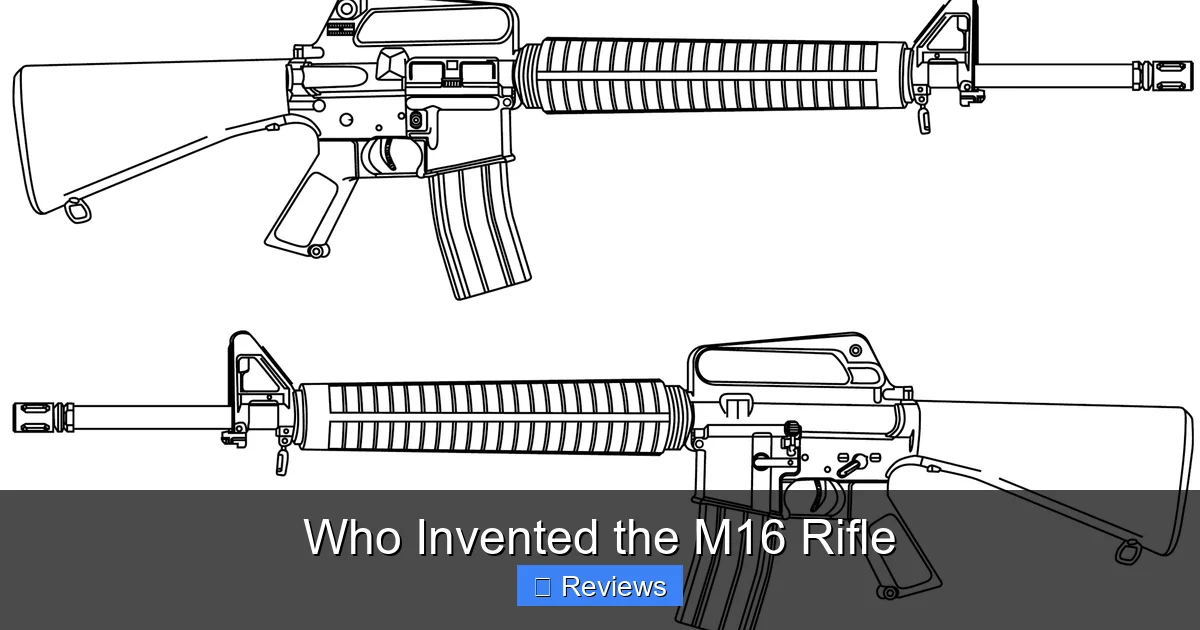
Visual guide about Who Invented the M16 Rifle
Image source: drawingdatabase.com
The Development of the AR-15
Responding to the Army’s requirements, Eugene Stoner, along with fellow engineers Robert Fremont and Jim Sullivan, began scaling down the AR-10 design. The result was the AR-15, introduced in 1958. This new rifle was chambered for the .223 Remington cartridge (which would later evolve into the 5.56x45mm NATO). The AR-15 retained all the innovative features of the AR-10: the direct impingement gas system, modular design, lightweight aluminum and polymer construction, and the distinctive carry handle sight assembly.
The .223 cartridge, while smaller, was designed to produce high velocities, resulting in excellent terminal ballistics at closer ranges and reduced recoil, making the rifle easier to control and enabling faster follow-up shots. This was a radical departure from the prevailing military philosophy of large, powerful cartridges. The AR-15 was remarkably light, weighing only around 6.5 pounds unloaded, a significant reduction compared to the M14 it aimed to replace.
So, if you’re asking who invented the M16 rifle, it’s essential to understand that Stoner and his team at ArmaLite created the AR-15, the direct ancestor. They perfected the core design principles that make the M16 what it is today.
Colt’s Acquisition and Military Adoption
Despite its revolutionary design, ArmaLite, being a small company, lacked the production capacity and marketing reach to mass-produce the AR-15 for military contracts. Fairchild, ArmaLite’s parent company, decided to sell the rights to the AR-15. This is where Colt’s Manufacturing Company enters the story.
Colt Buys the Rights
In 1959, Colt purchased the manufacturing and marketing rights to the AR-15 from ArmaLite for a relatively modest sum. This acquisition was a pivotal moment in the rifle’s history. Colt, with its long-standing reputation and vast manufacturing capabilities, was perfectly positioned to bring the AR-15 to the forefront of military consideration.
Colt immediately began marketing the AR-15 aggressively to various military branches and international buyers. They made minor modifications to the design, primarily for manufacturing efficiency, but the core Stoner design remained intact. Colt’s efforts were greatly aided by General Curtis LeMay, then Chief of Staff of the U.S. Air Force, who was highly impressed by the AR-15 during a demonstration. LeMay championed the rifle, eventually leading to the Air Force’s adoption of the AR-15 in 1962, designating it the M16.
The Vietnam War and Widespread Adoption
The exigencies of the Vietnam War further accelerated the M16’s adoption. Secretary of Defense Robert McNamara pushed for standardization and modernization across the services. After rigorous, and at times controversial, testing against the existing M14 rifle, the M16 was eventually adopted by the U.S. Army and Marine Corps in the mid-1960s. This marked its official transition from the AR-15 to the M16, a designation that would become synonymous with the conflict.
So, while Eugene Stoner invented the AR-15, Colt Manufacturing was instrumental in turning it into the M16 and getting it into the hands of U.S. servicemen. It was a complex partnership, with ArmaLite providing the ingenious design and Colt providing the industrial muscle and military connections.
The Early Challenges and Controversies
The story of who invented the M16 rifle and its subsequent journey isn’t without its dark chapters. The initial deployment of the M16 in Vietnam was plagued by severe reliability issues, leading to widespread controversy and a crisis of confidence among troops.
Jamming and Malfunctions in the Field
Soldiers reported that the M16 frequently jammed, often at the most critical moments, leading to fatalities. These issues were not inherent flaws in Stoner’s original design but rather a combination of critical missteps by the military and ammunition manufacturers:
- Incorrect Propellant Powder: The original AR-15 was designed to use IMR (Improved Military Rifle) stick powder. However, the military, seeking cost savings, switched to a different ball powder for its ammunition, which burned dirtier and at a higher pressure, leading to increased fouling and accelerated wear on parts.
- Lack of Chrome Lining: Stoner had initially recommended chrome-lining the rifle’s chamber and bore for enhanced durability and easier cleaning, especially in humid environments. To save costs, this feature was omitted from the initial M16 production. Without it, the rifles quickly fouled in Vietnam’s harsh, humid climate, leading to failures to extract spent casings.
- Absence of Cleaning Kits and Training: The M16 was initially marketed as a “self-cleaning” rifle, leading the military to issue it without cleaning kits or proper cleaning instructions. Soldiers, used to maintaining their M14s, were caught off guard by the M16’s different maintenance requirements.
- Forward Assist Controversy: Stoner’s original design did not include a “forward assist” mechanism. He believed that if a round didn’t seat properly, it was best to eject it. However, the Army insisted on adding a forward assist to the M16 for “positive chambering,” a feature that some argued only exacerbated jamming issues when soldiers forced a fouled round into the chamber.
Congressional Hearings and Improvements
The escalating problems led to congressional hearings in 1967. These investigations exposed the failures in communication, testing, and production. As a direct result, significant changes were implemented:
- The M16’s chamber and bore were chrome-lined.
- Improved ammunition with proper propellant was issued.
- Cleaning kits were standardized and issued with every rifle.
- Extensive training on the M16’s maintenance was conducted.
These modifications led to the M16A1 variant, which largely resolved the reliability issues and restored confidence in the rifle. This period highlights that the “invention” of the M16 wasn’t just about its initial design, but also about the ongoing process of refinement and adaptation driven by real-world combat experience.
Evolution and Enduring Legacy
The M16 rifle, initially a source of controversy, evolved into one of the most reliable and influential military rifles in history. Its modular design allowed for continuous upgrades and adaptations, ensuring its relevance for decades.
Variants and Modernization
After the M16A1, several significant variants emerged:
- M16A2: Introduced in the mid-1980s, the M16A2 incorporated lessons learned from combat and training. It featured a heavier barrel for improved accuracy and sustained fire, a redesigned handguard, a new adjustable rear sight, and replaced the fully automatic firing mode with a 3-round burst. This variant also introduced the 5.56x45mm NATO SS109/M855 cartridge, which had better penetration capabilities.
- M16A3/A4: The M16A3 (a full-auto variant mostly used by special operations forces) and M16A4 (a burst-fire variant) introduced flat-top receivers with Picatinny rails. This allowed for easy mounting of optics, lights, lasers, and other accessories, dramatically increasing the rifle’s versatility and adaptability to various mission requirements.
The M4 Carbine and Beyond
Perhaps the most significant evolution of the M16 platform is the M4 Carbine. Developed in the 1990s, the M4 is a shorter, lighter version of the M16A2, featuring a collapsible stock and a shorter barrel. Its compact size makes it ideal for close-quarters combat, vehicle crews, and special operations forces. The M4 has largely replaced the M16 as the primary service rifle for many U.S. combat troops, although M16 variants remain in service, particularly with support personnel and for longer-range engagements.
The M16/AR-15 platform has become a global standard, influencing firearms design worldwide. Its direct impingement gas system, modularity, and use of lightweight materials have been emulated and adapted by countless manufacturers. The AR-15, the civilian semi-automatic version, is also one of the most popular rifles in the United States, illustrating the enduring legacy of Eugene Stoner’s original design.
Conclusion
So, who invented the M16 rifle? The most accurate answer is that it was a complex, multi-stage process involving several key players. It began with the singular genius of Eugene Stoner at ArmaLite, who conceived and designed the revolutionary AR-10 and its lightweight, small-caliber successor, the AR-15. Stoner’s vision for a modular, high-tech infantry rifle laid the indispensable foundation.
However, the AR-15 wouldn’t have become the iconic M16 without Colt Manufacturing Company. Colt acquired the rights, invested in its production, and, critically, championed its adoption by the U.S. military. The subsequent challenges faced during its initial deployment in Vietnam, though tragic, led to crucial improvements spearheaded by the military and arms manufacturers, transforming it into the reliable weapon system it is today.
In essence, “who invented the M16 rifle” is a story of innovation, collaboration, perseverance, and adaptation. It’s a testament to the fact that even the most revolutionary designs require a village to nurture, refine, and ultimately, bring them to global prominence. The M16 stands as a powerful example of how a brilliant initial concept can evolve through diverse contributions to leave an indelible mark on history.
Frequently Asked Questions
Was the M16 designed specifically for the Vietnam War?
While the M16 saw its most extensive initial deployment and became iconic during the Vietnam War, its original design (as the AR-15) predates significant U.S. involvement in the conflict. The war did, however, accelerate its widespread adoption and subsequent improvements.
What does “AR” stand for in AR-15?
“AR” in AR-15 stands for “ArmaLite Rifle,” referring to the company that originally designed and developed it. It does not stand for “assault rifle.”
Did Eugene Stoner profit significantly from the M16’s success?
Eugene Stoner was a salaried employee of ArmaLite when he designed the AR-15. While he received royalties from a later design for Colt, he generally did not directly profit from every M16 produced in the same way an independent inventor might, as ArmaLite sold the rights to the design.
Why did the U.S. military switch from the M14 to the M16?
The U.S. military switched to the M16 due to its lighter weight, reduced recoil (allowing for better controllability and full-auto fire), increased ammunition capacity per soldier, and innovative use of lightweight materials, which were seen as advantages in modern combat doctrine.
Is the M16 still used by the U.S. military today?
Yes, variants of the M16, such as the M16A4, are still in service with the U.S. military, particularly with support units and some combat arms. However, the M4 Carbine, a shorter derivative, has largely replaced the M16 as the primary infantry rifle for frontline troops.
Are civilian AR-15s the same as military M16s?
No, civilian AR-15s are not the same as military M16s. While they share the same foundational design and many parts, civilian AR-15s are semi-automatic only, meaning they fire one round per trigger pull. Military M16s are capable of selective fire (full-automatic or three-round burst).