The concept of bolt action rifles was first invented in the mid-19th century, with the Prussian Dreyse Needle Gun in 1841 marking a pivotal moment. However, the modern, metallic cartridge-firing bolt action rifle, as we largely recognize it today, truly gained prominence and refinement through designs by inventors like Paul Mauser starting in the 1870s, becoming a dominant force in military and hunting firearms worldwide.
Have you ever held a classic bolt action rifle? There’s something undeniably special about the solid feel of the wood stock, the cold steel of the barrel, and the satisfying “clack-clack” as you cycle the bolt. It’s a mechanism that has shaped wars, put food on tables, and won countless shooting competitions. But if you’ve ever stopped to wonder, “When were bolt action rifles invented?” – you’re about to embark on a fascinating journey through firearms history.
The bolt action isn’t just a type of rifle; it’s a testament to human ingenuity, evolving from rudimentary designs to highly sophisticated precision instruments. It represents a pivotal moment in firearm development, bridging the gap between slow, single-shot muzzleloaders and the rapid-fire wonders of today. Understanding its origins helps us appreciate not only the mechanics but also the immense impact these firearms had on society, warfare, and sport.
So, let’s pull back the curtain and explore the remarkable story of when bolt action rifles were invented, tracing their lineage from early experimental models to the iconic designs that defined an era. Get ready to dive into the world of inventors, militaries, and the technological leaps that made the bolt action rifle an enduring legend.
Key Takeaways
- Early Inception: The first truly functional bolt action rifle was the Prussian Dreyse Needle Gun, invented by Johann Nikolaus von Dreyse in 1841, though it used a paper cartridge and a unique “needle” firing pin.
- French Contribution: France’s Chassepot rifle, adopted in 1866, refined the bolt action design, significantly improving gas sealing and accuracy over the Dreyse, showcasing incremental progress.
- Metallic Cartridge Revolution: The widespread adoption of self-contained metallic cartridges in the 1870s was crucial, allowing bolt action rifles to achieve higher pressures, reliability, and ease of use, moving away from older paper or percussion systems.
- Paul Mauser’s Influence: Paul Mauser’s rifle designs, particularly from the 1870s onwards (e.g., Mauser 1871, Gewehr 98), were instrumental in perfecting the modern bolt action mechanism, setting standards for safety, reliability, and precision that are still emulated today.
- Smokeless Powder Impact: The invention of smokeless powder in the late 19th century further revolutionized bolt action rifles, enabling smaller calibers, flatter trajectories, and higher velocities, solidifying their military dominance.
- Military Dominance: Bolt action rifles were the primary service rifles for militaries worldwide from the late 19th century through both World Wars, prized for their accuracy, reliability, and powerful ammunition.
- Enduring Legacy: While largely replaced by semi-automatic and automatic weapons in military roles, bolt action rifles remain highly popular for hunting, target shooting, and precision sports due to their inherent accuracy and mechanical simplicity.
Quick Answers to Common Questions
When was the first bolt action rifle invented?
The first practical bolt action rifle, the Dreyse Needle Gun, was invented by Johann Nikolaus von Dreyse in Prussia, with its official adoption by the Prussian army in 1841.
Which country first adopted the bolt action rifle for military use?
Prussia was the first country to widely adopt a bolt action rifle for military use, with the Dreyse Needle Gun in 1841.
What major innovation helped the bolt action rifle become more effective?
The widespread adoption of self-contained metallic cartridges in the 1870s significantly enhanced the bolt action rifle’s effectiveness by improving reliability, gas sealing, and allowing for higher pressures.
Who was a key figure in perfecting the modern bolt action design?
Paul Mauser was a pivotal figure in perfecting the modern bolt action design, with his rifles from the 1870s onwards establishing many enduring features.
Are bolt action rifles still used today?
Yes, bolt action rifles are still widely used today, particularly for hunting, sport shooting, and precision target applications due to their inherent accuracy and reliability.
📑 Table of Contents
The Pre-Bolt Action Era: Setting the Scene
To truly appreciate the bolt action rifle, we first need to understand what came before it. Imagine a battlefield in the early to mid-19th century. Soldiers were typically armed with muzzleloading muskets. These firearms were slow, cumbersome, and incredibly inefficient.
Muzzleloaders: Slow and Smoky
Muzzleloaders required a soldier to pour gunpowder down the barrel, then ram a projectile (often a round ball) on top, followed by a wadding. This was a tedious, multi-step process that took a trained soldier anywhere from 15 to 30 seconds to load and fire a single shot. The process was even slower and more difficult when lying down, in wet conditions, or under pressure in battle. Reloading often meant standing exposed, making soldiers vulnerable to enemy fire.
Accuracy was also a significant issue. Most military muskets were smoothbore, meaning the inside of the barrel was smooth, not rifled. While rifled barrels existed, they were more complex to load and clean, so smoothbores remained standard for mass armies. This meant muskets were largely effective only at very close ranges, often less than 100 yards, relying on massed volleys to be effective.
The Need for Speed and Efficiency
As military tactics evolved and technology progressed, the demand for a faster, more reliable, and more accurate firearm became pressing. Inventors across Europe were experimenting with various breech-loading designs – guns that could be loaded from the rear of the barrel, rather than the front. This was the critical first step towards anything resembling a modern rifle, paving the way for the answer to the question, “When were bolt action rifles invented?”
The Genesis of the Bolt Action: Early Concepts and Innovators
The concept of a movable breech that could be opened and closed to load a cartridge from the rear was not new, but making it reliable, safe, and robust enough for military use was the real challenge. It’s here that we encounter the true pioneers.

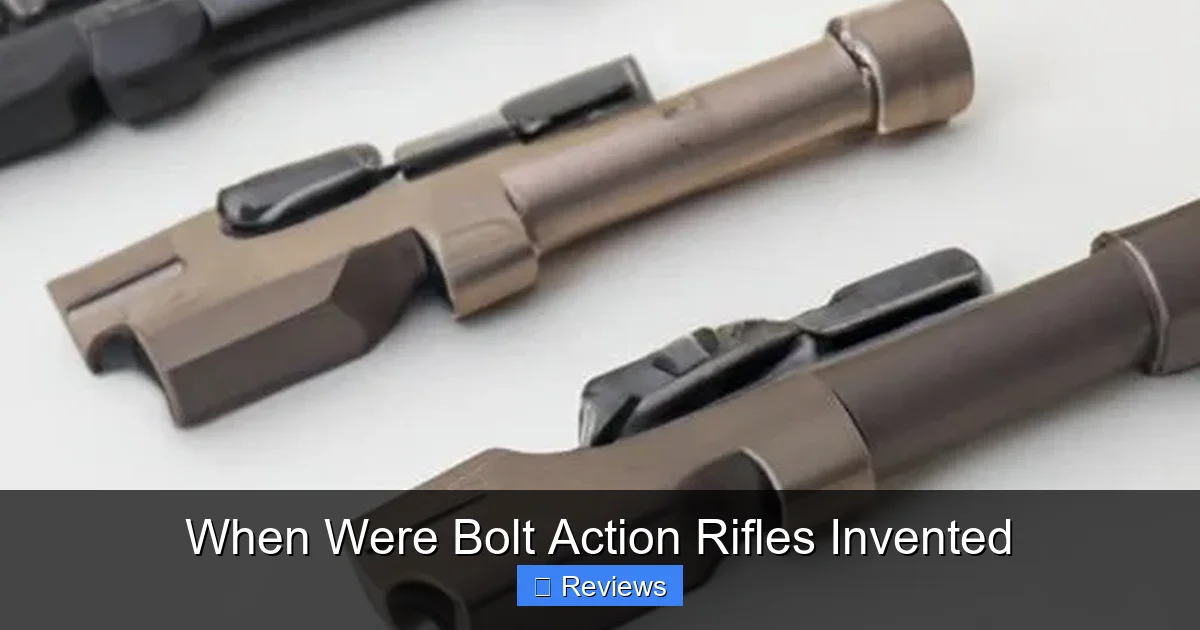
Visual guide about When Were Bolt Action Rifles Invented
Image source: lihpao.com
Johann Nikolaus von Dreyse and the Needle Gun
The absolute earliest contender for “when were bolt action rifles invented” points directly to Prussia in the 1830s. Johann Nikolaus von Dreyse, a German gunsmith, developed what would become known as the Dreyse Zündnadelgewehr – the “Needle Gun.” His initial designs date back to 1836, and it was officially adopted by the Prussian army in 1841.
This was revolutionary. The Dreyse was the first true military bolt action rifle. It used a long, slender firing pin (the “needle”) that pierced a combustible paper cartridge to strike a primer located at the base of the bullet. This unique design ignited the charge from the front, rather than the rear, ensuring the bullet was pushed more efficiently down the barrel. The bolt itself was a rotating cylinder that moved back and forth to open and close the breech, extracting the spent cartridge components, and inserting a new one. It was crude by today’s standards, but profoundly effective for its time.
The Dreyse Needle Gun gave Prussian soldiers a massive advantage. They could load and fire much faster than their muzzleloading opponents, and critically, they could do so lying prone, offering greater protection. This speed and tactical flexibility were famously demonstrated in the Austro-Prussian War of 1866, where the Needle Gun’s superiority was undeniable.
The French Chassepot and Its Improvements
Not to be outdone, other nations quickly sought to develop their own breech-loading rifles. France responded with the Fusil modèle 1866 Chassepot, named after its inventor Antoine Alphonse Chassepot. Adopted in 1866, the Chassepot was a significant improvement over the Dreyse.
While still using a paper cartridge and a similar “needle” firing system, the Chassepot featured a much more advanced bolt design with a rubber ring on the bolt head. This ring created a superior gas seal upon firing, preventing propellent gases from escaping backwards into the shooter’s face (a common issue with the Dreyse). This made the Chassepot more powerful, more accurate, and more reliable, albeit also a bit more complex. It showed the ongoing refinement of the bolt action principle, even before the advent of metallic cartridges.
Refinement and the Rise to Prominence
While the Dreyse and Chassepot showed the world the potential of the bolt action, they were still somewhat transitional designs. The real evolution came with the widespread adoption of self-contained metallic cartridges and the genius of designers like Paul Mauser.
Paul Mauser’s Enduring Legacy
When you ask, “When were bolt action rifles invented?” and want to know about the modern form, you inevitably arrive at Paul Mauser. Beginning in the 1870s, the German Mauser brothers, Paul and Wilhelm, began designing rifles that would set the standard for generations. Their Mauser Model 1871, adopted by the newly unified German Empire, was a single-shot, metallic cartridge-firing bolt action rifle that represented a monumental leap forward.
The Mauser 1871 established many features that are still central to bolt action design today: a strong, reliable bolt with a sturdy locking mechanism, an efficient extractor, and the ability to handle powerful metallic cartridges safely. The beauty of Mauser’s designs lay in their robust construction, simple operation, and remarkable accuracy. They were built like tanks and performed like precision instruments.
Later Mauser designs, such as the iconic Gewehr 98 (Model 1898), would add crucial elements like a staggered-column internal box magazine and the famous “controlled-feed” extractor, which ensures reliable feeding and extraction under almost any condition. This action became the blueprint for countless military and sporting rifles worldwide and is still considered one of the strongest and most reliable bolt actions ever created. If you own a modern bolt action hunting rifle, chances are its design owes a debt to Mauser.
The Krag-Jørgensen and American Adoption
While Mauser was making waves in Germany, other nations were also refining their own bolt action designs. The Krag-Jørgensen rifle, developed in Norway, was another significant example. Adopted by the United States as their service rifle in 1892 (the M1892 Krag-Jørgensen), it featured a unique side-loading magazine that allowed cartridges to be added one at a time without opening the bolt. This was a clever design for its time, though it was eventually deemed less robust and slower to reload fully compared to the Mauser’s stripper-clip loading system.
The Krag’s service in the Spanish-American War, particularly against Spanish soldiers armed with Mauser 1893 rifles, highlighted some of its shortcomings, eventually leading the US to adopt the Mauser-derived M1903 Springfield.
Britain’s Lee-Enfield: A Magazine Marvel
Another hugely influential bolt action rifle came from Great Britain: the Lee-Enfield. Adopted in various iterations from 1895 (Lee-Metford) to the legendary Short Magazine Lee-Enfield (SMLE) No. 1 Mk III and later No. 4 Mk I, this rifle distinguished itself with its exceptionally smooth bolt throw and a large 10-round detachable box magazine. This high capacity and rapid cycling capability made the Lee-Enfield one of the fastest-firing military bolt actions ever devised, a crucial advantage in the trenches of World War I.
The Lee-Enfield’s “cock-on-closing” bolt design and powerful mainspring allowed for incredibly quick follow-up shots, making it a formidable weapon in the hands of trained infantrymen. It truly cemented the bolt action as the dominant military rifle of the early 20th century.
The Cartridge Revolution and Smokeless Powder
The evolution of the bolt action rifle was inextricably linked to advancements in ammunition technology. Without these breakthroughs, the bolt action might never have achieved its full potential.
From Paper to Metallic Cartridges
As mentioned earlier, early bolt actions like the Dreyse and Chassepot used paper cartridges. While an improvement over muzzleloading, these had limitations: they were susceptible to moisture, could tear, and didn’t provide a perfect gas seal, leading to lost power and dirty actions. The real game-changer was the widespread adoption of the self-contained metallic cartridge.
These cartridges, typically brass cases containing the projectile, propellant, and primer all in one unit, revolutionized firearms. They were waterproof, robust, and most importantly, they expanded upon firing to create a perfect seal within the chamber. This meant more consistent power, less gas leakage, and far greater reliability. The transition to metallic cartridges, occurring broadly in the 1870s and 1880s, allowed bolt action rifles to handle higher pressures and become truly reliable workhorses.
The Game-Changing Power of Smokeless Powder
Another monumental shift occurred with the invention of smokeless powder in the late 19th century (around 1884 by Paul Vieille in France). Before this, firearms used black powder, which produced enormous clouds of white smoke upon firing, obscuring the battlefield, fouling the rifle quickly, and leaving behind a corrosive residue.
Smokeless powder, as its name suggests, produced very little smoke. But its advantages went far beyond visibility. It was significantly more powerful than black powder by weight, allowing for smaller, faster bullets. This led to rifles chambered in new, smaller calibers like 8mm Lebel, .30-06, and .303 British. These cartridges offered flatter trajectories, greater range, and higher velocities, making bolt action rifles even more effective at longer distances and against multiple targets.
The combination of robust bolt action mechanisms, reliable metallic cartridges, and powerful smokeless powder truly launched the bolt action rifle into its golden age, dominating military arsenals for decades after its initial invention.
Why the Bolt Action Dominated
Given the long, intricate journey of when bolt action rifles were invented, it’s clear they became indispensable for good reasons. Their characteristics made them the undisputed kings of the battlefield and the hunting grounds for a significant period.
Precision, Power, and Reliability
At its core, the bolt action mechanism is incredibly simple and robust. This simplicity translates directly into reliability. With fewer moving parts than semi-automatic or automatic firearms, there’s less to break or jam. This was a critical factor in harsh environments, from the mud of World War I trenches to the unforgiving wilderness of a hunting expedition.
Furthermore, the bolt action’s design, with a strong, locked breech, is inherently conducive to accuracy. The bolt creates a consistent chambering of the round and a solid lock-up, minimizing vibration and movement when the shot is fired. This allows for greater precision, making bolt action rifles the preferred choice for sharpshooters, snipers, and anyone who demands pinpoint accuracy.
The strength of the bolt action also allowed it to handle powerful cartridges, generating high muzzle velocities and excellent stopping power – essential for both military engagements and taking down large game.
Military Supremacy
From the late 19th century through World War I and World War II, bolt action rifles like the Mauser K98k, Lee-Enfield, Mosin-Nagant, and Springfield M1903 were the standard issue firearms for infantrymen worldwide. Their combination of reliability, accuracy, and power made them the best tools available for mass armies. Even as semi-automatic designs began to emerge, the bolt action’s proven track record, ease of manufacture, and lower cost often kept it in service for longer.
Imagine a soldier in a foxhole, relying on their rifle to survive. The ability to load and fire quickly, knowing the rifle won’t jam in crucial moments, was paramount. The bolt action provided that confidence, making it the backbone of infantry forces for half a century.
Enduring Appeal for Hunters and Sport Shooters
Even with the advent of modern semi-automatic rifles, the bolt action continues to thrive in the civilian market. For hunters, the bolt action offers unparalleled accuracy and the ability to chamber a wide variety of powerful cartridges suitable for everything from varmints to dangerous game. Its reliability in adverse conditions and simplicity of operation are highly valued in the field.
For target shooters and precision sport enthusiasts, the bolt action is often the only choice. Its inherent accuracy, combined with minimal moving parts during firing, allows for exceptional consistency. Many of the most accurate rifles in the world, capable of hitting targets at extreme distances, are meticulously crafted bolt actions.
The Modern Bolt Action Rifle
So, we’ve explored when were bolt action rifles invented and their historical dominance. But where do they stand today?
Evolution in Materials and Manufacturing
While the fundamental operating principle of the bolt action has remained remarkably consistent since Mauser’s designs, modern manufacturing techniques and materials have allowed for continued evolution. Today’s bolt actions often feature advanced synthetic stocks that are lighter and more weather-resistant than traditional wood, stainless steel barrels for increased durability and corrosion resistance, and precision machining that was unthinkable in the 19th century.
Modern triggers are also far superior, offering crisp, light pulls that enhance accuracy. Many bolt actions now come with integral Picatinny rails for easy mounting of optics, a stark contrast to the iron sights of yesteryear.
Precision Shooting and Customization
The modern bolt action is particularly beloved in the world of precision shooting. From long-range benchrest competitions to tactical precision rifle series, custom bolt actions are built to incredibly tight tolerances. Shooters can choose from a vast array of aftermarket components – different barrels, stocks, triggers, and optics – to tailor their rifle exactly to their needs. This level of customization allows enthusiasts to squeeze every last bit of accuracy out of the timeless bolt action design.
From the battlefield to the hunting blind, from target ranges to survival kits, the bolt action rifle remains a relevant and respected firearm. Its journey from an experimental Prussian “needle gun” to a modern precision tool is a testament to its robust design and adaptability.
So, the next time you hear that satisfying click of a bolt action cycling, remember the long and storied history behind it. Remember Dreyse, Mauser, and all the innovators who answered the question, “When were bolt action rifles invented?” with their ingenuity, shaping not just firearms, but the course of history itself. The bolt action rifle is more than just a gun; it’s a living legend, continuing to prove its worth and capture the imaginations of shooters around the globe.
Frequently Asked Questions
What distinguished the Dreyse Needle Gun from earlier firearms?
The Dreyse Needle Gun was revolutionary because it was a breech-loading bolt action rifle, allowing for much faster loading from the rear rather than the muzzle. It also featured a unique “needle” firing pin that ignited a primer within a combustible paper cartridge.
How did the Chassepot rifle improve upon the Dreyse’s design?
The French Chassepot rifle, while still using a similar “needle” system, incorporated a superior rubber gas seal on its bolt. This significantly improved gas efficiency and accuracy, making it a more powerful and cleaner-shooting weapon than the Dreyse.
Why was the metallic cartridge so important for bolt action rifles?
Metallic cartridges provided a completely self-contained, waterproof unit for propellant, projectile, and primer, greatly increasing reliability and safety. Crucially, they expanded upon firing to create an excellent gas seal, allowing for higher pressures and more consistent performance compared to older paper cartridges.
What role did Paul Mauser play in the history of bolt action rifles?
Paul Mauser’s designs, particularly from the 1870s and 1890s, perfected the bolt action mechanism, introducing features like robust locking lugs, efficient extractors, and strong, reliable actions. His designs set the global standard for military and sporting bolt action rifles for over a century.
How did smokeless powder affect bolt action rifle development?
Smokeless powder, invented in the late 19th century, was far more powerful and cleaner-burning than black powder. It allowed bolt action rifles to be chambered in smaller, faster, and more accurate calibers with flatter trajectories, dramatically increasing their effective range and military utility.
Are bolt action rifles still relevant in modern militaries?
While semi-automatic and automatic rifles have largely replaced bolt actions as standard infantry weapons, bolt action rifles remain highly relevant in specialized military roles. They are still widely used by snipers and designated marksmen due to their unparalleled accuracy and reliability at long ranges.