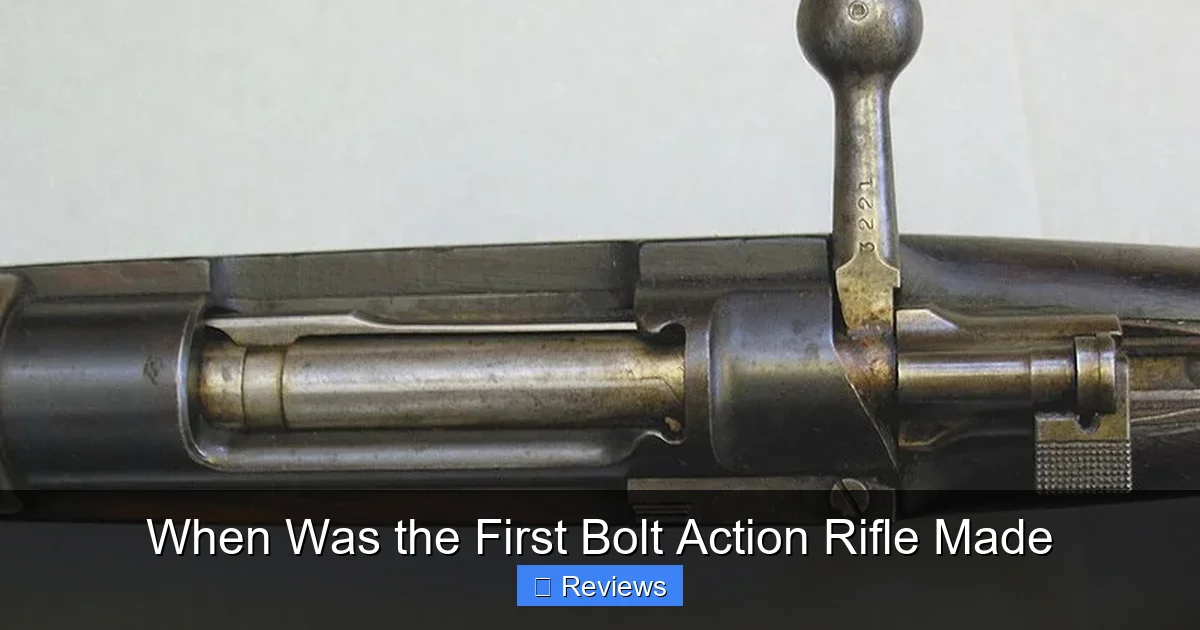
The groundbreaking invention of the first bolt action rifle is largely credited to Johann Nikolaus von Dreyse, who developed his revolutionary “Zündnadelgewehr” (needle gun) in 1836. This pivotal design introduced a rotating bolt mechanism that allowed for rapid breech-loading, fundamentally changing firearm technology and military tactics. Dreyse’s innovation marked the true beginning of the modern bolt action system we recognize today, setting the stage for centuries of firearm evolution.
When Was the First Bolt Action Rifle Made
Have you ever held a modern bolt action rifle, felt the smooth, satisfying action of the bolt, and pondered its origins? It’s a mechanism so reliable and precise that it has dominated battlefields, hunting grounds, and target ranges for well over a century. But where did this ingenious design come from? Pinpointing the exact moment when the first bolt action rifle was made can be a bit like tracing a complex river to its source – there are many contributing streams, but one main flow stands out as the true beginning.
For centuries, soldiers and hunters alike grappled with the slow, cumbersome process of loading firearms from the muzzle. Imagine the chaos of a battlefield or the urgency of a hunting situation, trying to pour powder, ram a ball, and then a wad down a barrel, all while under pressure! The sheer inefficiency and slowness of this method meant a constant drive for a faster, more effective loading system. This relentless quest for speed and reliability ultimately paved the way for one of the most significant advancements in firearm technology: the bolt action rifle.
Today, we’re going to embark on a fascinating journey back in time. We will explore the brilliant minds and groundbreaking inventions that led to the creation of the very first bolt action rifle made, uncovering its profound impact and how it forever changed the world of firearms. Get ready to discover a story of innovation, military secrets, and engineering genius that shaped history.
Key Takeaways
- Origin: The first bolt action rifle is widely attributed to Johann Nikolaus von Dreyse’s “Zündnadelgewehr” (needle gun), invented in 1836.
- Innovation: Dreyse’s design introduced a rotating bolt that sealed the breech, allowing for much faster reloading compared to existing muzzle-loaders.
- Unique Cartridge: A key feature was its use of a combustible paper cartridge, ignited by a needle-like firing pin that pierced through the powder to reach the primer at the base of the bullet.
- Military Impact: Adopted by the Prussian army in 1841, the Dreyse rifle gave them a significant tactical advantage, famously demonstrated during the Austro-Prussian War (1866).
- Rapid Evolution: While Dreyse’s was the first, subsequent bolt action designs quickly improved with the advent of metallic cartridges, stronger locking mechanisms, and repeating magazine systems, notably by Mauser and Lee-Enfield.
- Enduring Legacy: The fundamental principles of the bolt action system developed by Dreyse persist in modern sporting, hunting, and military sniper rifles due to their inherent accuracy, reliability, and versatility.
- Historical Significance: The invention of the first true bolt action rifle marked a pivotal moment, shifting military and civilian firearm design away from muzzle-loading forever.
Quick Answers to Common Questions
Question 1: Who is credited with inventing the first bolt action rifle?
The invention of the first bolt action rifle is widely credited to Johann Nikolaus von Dreyse of Germany.
Question 2: When was Dreyse’s bolt action rifle developed?
Dreyse finalized his revolutionary “Zündnadelgewehr” (needle gun) design in 1836.
Question 3: What was unique about the Dreyse needle gun’s firing mechanism?
Its unique feature was a long, needle-like firing pin that pierced through a combustible paper cartridge and gunpowder to ignite a primer located at the base of the bullet.
Question 4: What military first widely adopted the Dreyse rifle?
The Prussian military recognized its potential and secretly adopted the Zündnadelgewehr in 1841, using it to great effect in the Austro-Prussian War of 1866.
Question 5: What major advancement significantly improved bolt action rifles after Dreyse’s invention?
The widespread adoption of self-contained metallic cartridges was a game-changer, making bolt actions more reliable, weather-resistant, and powerful, leading to designs like the Mauser and Lee-Enfield.
📑 Table of Contents
- The Dawn of Breech-Loading: Setting the Stage for Innovation
- Johann Nikolaus von Dreyse and the Zündnadelgewehr (Needle Gun)
- Early Rivals and Adaptations: The Global Race for Superiority
- Refinement and Evolution of the Bolt Action: Towards Modernity
- The Enduring Legacy of the Bolt Action Rifle
- Conclusion
The Dawn of Breech-Loading: Setting the Stage for Innovation
Before we dive into the specific invention of the bolt action, it’s crucial to understand the firearm landscape that preceded it. For hundreds of years, the vast majority of guns were muzzle-loaders. This meant you had to pour loose gunpowder down the barrel, then insert a bullet (and often a patch or wad), and finally use a ramrod to push everything down to the breech. It was an incredibly slow process, especially problematic on horseback, in wet weather, or when trying to reload from a prone position. The limitations were obvious and frustrating.
Early Innovations and Challenges in Firearm Design
Inventors throughout history understood these limitations. Long before the first bolt action rifle was made, many individuals experimented with “breech-loading” firearms, where the ammunition could be inserted directly into the rear (breech) of the barrel. Early attempts involved hinged breeches, removable chambers, or sliding blocks. While these ideas held considerable promise, they often struggled with a critical problem: gas leakage. When a firearm fires, immense pressure builds up inside the barrel. If the breech isn’t perfectly sealed, hot, corrosive gas escapes backward. This was not only dangerous for the shooter but also severely reduced the bullet’s velocity and accuracy. Effectively sealing the breech, while still allowing for quick reloading, was the engineering Everest of its time. Many early breech-loaders were either too complex, too weak, or simply leaked too much gas to be practical for widespread military adoption or general use. The world waited for a truly revolutionary breech-loading mechanism.
The Context for a New Mechanism: Demand Meets Capability
By the early 19th century, several factors converged to create the perfect environment for a breakthrough. Metallurgy was steadily improving, allowing for stronger and more precisely machined firearm components. The ongoing Industrial Revolution was also making precision manufacturing more achievable on a larger scale. Furthermore, cartridge technology was evolving. While early cartridges were often just simple paper packets containing powder and a ball, the concept of a self-contained ammunition unit was gaining traction. These collective advancements created the ideal conditions for a truly revolutionary firearm design to emerge – one that would directly lead to the first bolt action rifle made and forever alter firearm development.
Johann Nikolaus von Dreyse and the Zündnadelgewehr (Needle Gun)
The undisputed champion in the quest to develop the first bolt action rifle made is Johann Nikolaus von Dreyse, a brilliant German gunmaker. His invention wasn’t merely an improvement; it was a complete paradigm shift in firearm technology. In 1836, after years of development and refinement, Dreyse finalized a design that would forever change the face of warfare and shooting: the “Zündnadelgewehr,” or “needle gun.”
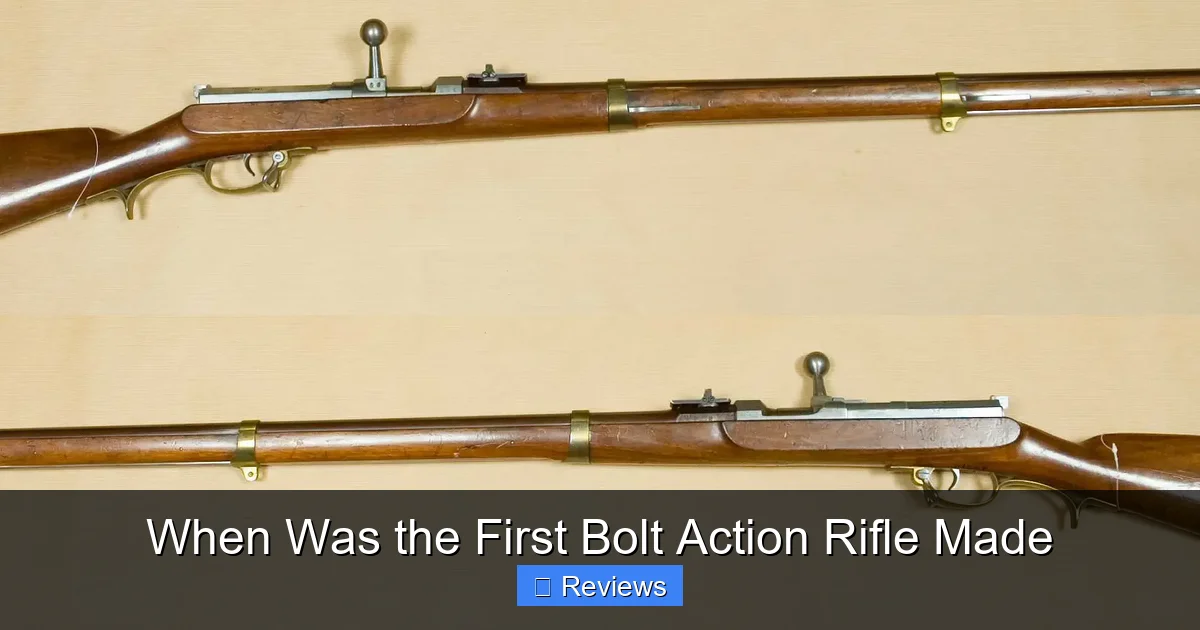
Visual guide about When Was the First Bolt Action Rifle Made
Image source: guntrack.io
Dreyse’s Revolutionary Design (1836): The First True Bolt Action
Dreyse’s genius lay in his ability to combine several innovative concepts into one cohesive, functional, and revolutionary system. The very core of his rifle was its unique bolt mechanism. Unlike previous breech-loaders, Dreyse’s design featured a rotating cylinder (the bolt) that, when pushed forward and then rotated into position, securely locked into place, effectively sealing the breech. This ingenious rotating and locking action was the defining characteristic of the first bolt action rifle made. It provided the gas seal and mechanical strength that other early breech-loaders lacked. Imagine holding the rifle: you’d pull the bolt handle up, then pull the entire bolt rearward to expose the chamber (though early versions didn’t automatically eject casings, the breech was opened). You’d then insert a fresh cartridge, push the bolt forward, and finally rotate the handle down to lock it securely. This sequence of actions was incredibly fast compared to any muzzle-loading rifle, allowing a soldier to fire multiple shots in the time it took an enemy to fire just one.
The Needle Gun’s Unique Mechanics and Cartridge
What truly made the Zündnadelgewehr unique, beyond its groundbreaking bolt, was its innovative cartridge and firing mechanism. Dreyse designed a special combustible paper cartridge that contained the bullet, the gunpowder, and crucially, a percussion cap primer located at the very base of the bullet itself, rather than at the base of the cartridge. When the trigger was pulled, a long, thin “needle-like” firing pin (hence the name “needle gun”) was propelled forward. This needle pierced through the paper cartridge and the gunpowder, igniting the primer directly behind the bullet. This “inside ignition” system had several advantages. It ensured a more central ignition of the powder charge, potentially leading to more consistent combustion and better ballistic performance for the time. While the combustible paper cartridges were not without their flaws—they could be fragile, susceptible to moisture, and left more residue than later metallic cartridges—the overall system was a massive leap forward. It conclusively demonstrated the practicality of a true bolt action system, firmly securing its place in history as the first bolt action rifle made.
Military Adoption and Unprecedented Secrecy
The Prussian military immediately recognized the immense strategic potential of Dreyse’s invention. After rigorous testing and several refinements, the Zündnadelgewehr was officially adopted in 1841 as the “Light Percussion Rifle M/41.” For years, its existence and technical details were kept a closely guarded military secret, allowing Prussia to develop and equip its army with this superior weapon without other nations knowing the full extent of its revolutionary capabilities. The secrecy paid off handsomely and dramatically. In the decisive Austro-Prussian War of 1866, Prussian soldiers, armed with their Dreyse needle guns, could lie prone, reload, and fire significantly faster than their Austrian counterparts, who were still largely equipped with slower muzzle-loading Lorenz rifles. This overwhelming tactical advantage allowed the Prussians to deliver devastatingly rapid fire, contributing significantly to their swift victory. The war unequivocally showcased the power of the first bolt action rifle made and its profound impact on modern combat tactics and outcomes.
Early Rivals and Adaptations: The Global Race for Superiority
Once the cat was out of the bag regarding the astounding effectiveness of the Dreyse needle gun, other nations across Europe scrambled to develop their own bolt action designs or adapt existing firearms. The race was on to refine the concept, overcome its inherent limitations, and build even better, more powerful military rifles. The groundbreaking idea of the first bolt action rifle made had set a new, unassailable standard for military small arms.
Chassepot and Other European Designs in Pursuit
France, for example, quickly responded to the Prussian threat by developing the Chassepot rifle, which was officially adopted in 1866. While still utilizing a paper cartridge and a similar needle ignition system, the Chassepot represented a significant improvement over the Dreyse in several key ways. It featured a much more robust bolt and, critically, a superior gas seal, achieved through a cleverly designed rubber obturator (seal) on the bolt head. This meant dramatically less gas leakage, leading to higher velocities, increased accuracy, and greater safety for the shooter. The Chassepot clearly demonstrated that even the groundbreaking first bolt action rifle made could be rapidly improved upon, pushing the boundaries of what was possible in firearm design.
Other major European powers, including Great Britain, Russia, and Austria, also began intense experimentation with various breech-loading and bolt action systems. The Snider-Enfield in Britain, for instance, converted existing Enfield muzzle-loaders into breech-loaders using a hinged block system. This was a crucial transitional step towards full bolt action rifles. These rapid developments underscored a universal understanding among military strategists that muzzle-loaders were unequivocally obsolete and that the future belonged to breech-loading, and specifically, bolt action designs.
The American Perspective: Springfield and Sharps Innovations
Across the Atlantic, the United States was also actively exploring breech-loading technology, albeit with a slightly different developmental focus. The American Civil War (1861-1865) saw limited but impactful use of early breech-loaders such as the Sharps rifle and carbine, famous for their dropping block mechanisms. These firearms were particularly excellent for cavalry units due to their superior speed of loading compared to standard muzzle-loaders, though they weren’t true bolt actions in the same sense as the Dreyse. Post-Civil War, the U.S. Army adopted the “trapdoor” Springfield rifle, which involved converting existing muzzle-loaders to fire new metallic cartridges. While effective and cost-efficient, it was not a bolt action either. The U.S. would later fully embrace true bolt action designs, but their initial focus was on metallic cartridge conversions, showcasing a distinct path of innovation heavily influenced by the immediate practicality of war and existing armaments. Nonetheless, the profound impact of the first bolt action rifle made resonated globally, spurring innovation even in different directions.
Refinement and Evolution of the Bolt Action: Towards Modernity
The Dreyse needle gun, while revolutionary as the first bolt action rifle made, was far from perfect. Its combustible paper cartridge was notably susceptible to moisture and damage, and its elongated needle firing pin could break, requiring field replacement. The real subsequent leaps forward for the bolt action design came with incredible advancements in ammunition technology and continued mechanical design improvements.
The Advent of Metallic Cartridges: A Game Changer
Perhaps the single biggest improvement that propelled the bolt action rifle into its modern and dominant form was the widespread adoption of the self-contained metallic cartridge. Invented by various individuals but popularized by designs from pioneers like Flobert and Pauly, metallic cartridges solved a multitude of problems simultaneously. They provided a robust, waterproof, and completely gas-tight seal for the breech, and they conveniently housed the primer, powder, and bullet in a single, durable brass casing. This innovation entirely eliminated the fragile paper cartridge and the need for a long firing pin to pierce through powder to ignite the primer. Rifles like the French Gras (1874) and the German Mauser Model 1871 were among the first widely adopted military bolt actions specifically designed from the ground up to utilize metallic cartridges. These new rifles were far more reliable, easier to load, and considerably more powerful than their needle gun predecessors. The metallic cartridge truly unlocked the full, enduring potential of the bolt action system that began with the first bolt action rifle made.
Improving Locking Mechanisms for Strength and Safety
Initially, most bolt actions, including the Dreyse, typically used a relatively simple rotating bolt that locked directly into the receiver. As cartridges became progressively more powerful, especially with the introduction of smokeless powder, engineers quickly realized the critical need for stronger, more secure locking mechanisms to safely contain the immensely increased pressures generated during firing. This led directly to the development of locking lugs – stout projections expertly machined onto the bolt body that engage with corresponding recesses within the receiver. Multiple locking lugs, most commonly two positioned at the front of the bolt, quickly became the industry standard, making the bolt action incredibly strong, durable, and inherently safe. These crucial improvements were vital not only for shooter safety but also for allowing rifles to handle more potent smokeless powder propellants, which revolutionized ballistics in the late 19th century. The significant evolution from the relatively simple locking of the first bolt action rifle made to the sophisticated, multi-lug systems of legendary designs like the Mauser 98 or Springfield 1903 demonstrated a continuous and relentless drive for unparalleled strength, reliability, and precision.
From Single Shot to Repeating Rifles: The Magazine Revolution
Initially, most bolt actions, including Dreyse’s pioneering design, were single-shot firearms. Each shot fired required manually loading a new cartridge into the chamber. However, the next logical and inevitable step in their evolution was to integrate a reliable magazine system that would feed multiple rounds into the chamber automatically as the bolt was cycled. Early attempts included tubular magazines (like those famously found in Winchester lever actions) or rudimentary box magazines. Influential designs such as the Mauser Model 1889 and the iconic Mauser 98, along with the British Lee-Metford and Lee-Enfield rifles, pioneered the widespread use of integral box magazines that allowed for quick, multi-shot firing without the need to individually load each cartridge. This powerful combination of a strong, robust bolt action, reliable metallic cartridges, and an efficient magazine system created the quintessential military rifle that absolutely dominated the early 20th century. From the very first bolt action rifle made to these formidable repeating firearms, the evolution was breathtakingly rapid and profoundly impactful.
The Enduring Legacy of the Bolt Action Rifle
From its groundbreaking beginnings with Johann Nikolaus von Dreyse’s needle gun in 1836, the bolt action rifle has proven to be one of the most enduring, versatile, and influential firearm designs in all of history. Even with the later advent of highly efficient semi-automatic and automatic firearms, the bolt action continues to hold a highly significant and irreplaceable place in the world of shooting.
Dominance in Warfare and Sporting Fields
For well over a century, the bolt action rifle stood as the primary military long arm for most major world powers. Both World War I and World War II were fought predominantly with legendary bolt action rifles such as the German Mauser K98k, the British Lee-Enfield, the Russian Mosin-Nagant, and the American Springfield 1903 – all direct descendants of the fundamental principles laid down by the first bolt action rifle made. Their legendary reliability, robustness, and accuracy were simply unmatched for the period. Today, while general military infantry roles have largely shifted to faster-firing semi-automatic rifles, the bolt action remains the undisputed king of precision. Modern sniper rifles, demanding extreme accuracy over vast distances, almost exclusively utilize bolt action mechanisms. Their inherent mechanical simplicity, rigidity, and fewer moving parts make them incredibly consistent and stable platforms for surgical precision shooting. Similarly, in the popular realms of hunting, competitive target shooting, and various sport shooting disciplines, the bolt action is universally celebrated for its unwavering accuracy, powerful chambering options, and often elegant, classic design.
Modern Applications and Continuous Design Evolution
Modern bolt action rifles continue to evolve and impress. Manufacturers constantly innovate with new, lightweight materials, advanced modular chassis systems, incredibly crisp and adjustable triggers, and cutting-edge barrel technologies. You can find them chambered in everything from tiny, fast varmint cartridges to tremendously powerful magnum calibers designed for the largest, most dangerous game. The core principle, however, remains remarkably consistent with that of the first bolt action rifle made: a robust, manually operated mechanism that efficiently cycles ammunition and securely locks the breech for each shot. Whether you’re a competitive shooter striving for sub-MOA groups, a dedicated hunter pursuing game in challenging environments, or simply an enthusiast appreciating firearm history, the bolt action rifle stands as a testament to brilliant, timeless engineering. Its journey from a closely guarded Prussian military secret to a globally recognized icon is a compelling story of continuous innovation and unwavering, fundamental design excellence.
Conclusion
The question of “when was the first bolt action rifle made” leads us directly to the genius of Johann Nikolaus von Dreyse and his groundbreaking Zündnadelgewehr of 1836. This remarkable invention fundamentally reshaped firearm technology and military tactics, offering an unprecedented combination of speed and efficiency in reloading that changed everything. Dreyse’s foresight and engineering skill introduced the core concept of the rotating bolt, a mechanism that would prove enduringly influential.
While Dreyse’s needle gun was the pioneer, it courageously laid the essential foundation for an incredible century and a half of continuous innovation. From its early reliance on combustible paper cartridges to the eventual widespread adoption of robust metallic ones, from relatively simple locking to advanced multi-lug strength, and from single-shot operation to efficient repeating magazine systems, the bolt action rifle continuously adapted and dramatically improved. Its legacy is not merely historical; it remains an active and vitally important part of modern shooting sports, hunting, and highly specialized military roles today. The spirit and core design principles of the first bolt action rifle made continue to thrive, a powerful testament to its enduring design excellence and profound impact on the world.
Frequently Asked Questions
How did the first bolt action rifle improve upon earlier firearms?
The first bolt action rifle, Dreyse’s needle gun, significantly improved loading speed by allowing ammunition to be inserted from the breech rather than the muzzle. This meant soldiers could reload faster, often while prone, giving them a significant tactical advantage over traditional muzzle-loaders.
Was the Dreyse needle gun the only early bolt action rifle?
While Dreyse’s was the first widely adopted military bolt action, other inventors also experimented with similar breech-loading mechanisms around the same time. However, Dreyse’s design was the most complete, functional, and influential for its era, truly setting the standard for future bolt action development.
What was the main limitation of the original Dreyse rifle?
A primary limitation of the original Dreyse rifle was its reliance on a combustible paper cartridge, which could be fragile, susceptible to moisture, and produced more fouling in the barrel. Additionally, the long, thin needle firing pin had a tendency to break after repeated use, requiring field replacement.
How did metallic cartridges change the bolt action rifle?
Metallic cartridges revolutionized the bolt action by providing a stronger, more reliable, and completely waterproof seal for the breech against gas leakage. They also enabled the use of higher pressures and more powerful smokeless powders, leading to greater accuracy and range, and simpler, more robust firing pin designs.
Are bolt action rifles still used in modern military forces?
Yes, absolutely. While general infantry now typically uses semi-automatic rifles, bolt action rifles remain indispensable for military snipers and designated marksmen due to their exceptional accuracy, robust reliability, and simpler mechanics which contribute to superior precision at long ranges.
Why are bolt action rifles so popular for hunting and sport shooting?
Bolt action rifles are highly valued in hunting and sport shooting for their inherent accuracy, remarkable durability, and versatility to handle powerful cartridges. Their strong, simple, and reliable design makes them ideal for demanding outdoor conditions and competitive precision shooting disciplines where consistency is key.