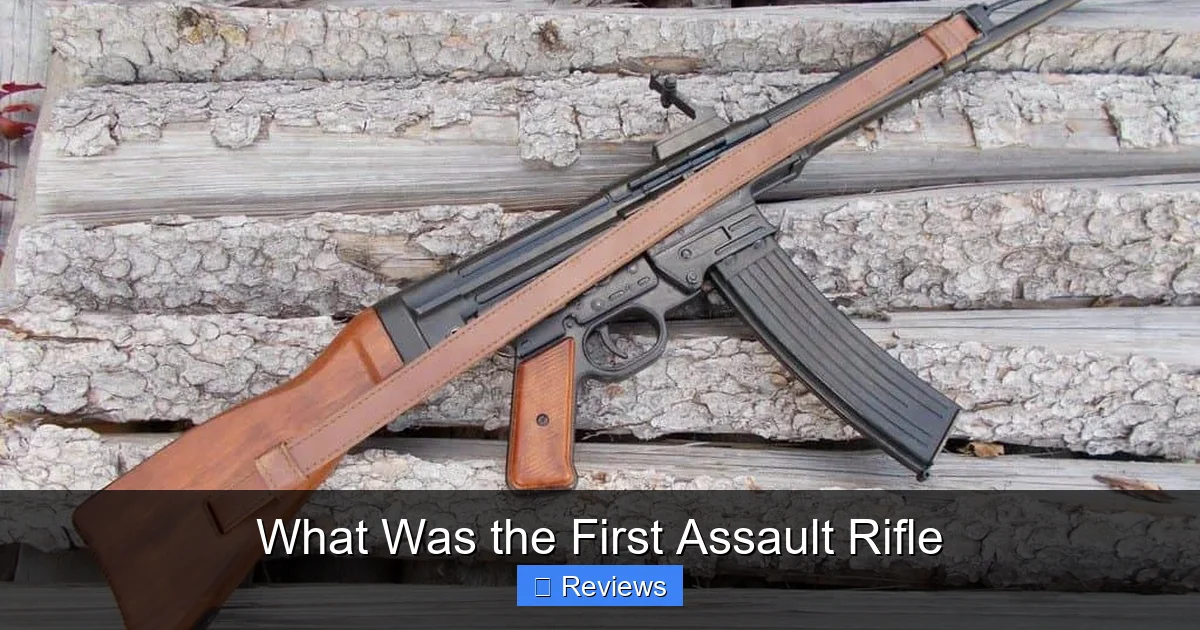
The quest to identify what was the first assault rifle leads us to a pivotal moment in World War II. It was the German Sturmgewehr 44 (StG 44), developed in response to the need for a weapon bridging the gap between submachine guns and rifles. This groundbreaking firearm introduced the intermediate cartridge, selective fire, and a detachable magazine, fundamentally reshaping infantry combat and inspiring countless modern weapon designs.
Have you ever wondered about the origins of modern firearms? Specifically, what was the first assault rifle? It’s a question that often sparks lively debate among history buffs and firearms enthusiasts alike. The term “assault rifle” itself can be quite loaded, sometimes misunderstood, and often applied broadly to many different types of firearms. But when we strip away the myths and focus on the technical definitions, a clear answer begins to emerge from the tumultuous backdrop of World War II.
Before the mid-20th century, soldiers typically carried either a full-power bolt-action rifle, effective at long distances but slow to fire, or a submachine gun, great for close quarters but lacking range and punch. There was a significant gap in between. Military strategists and engineers dreamed of a single weapon that could offer the best of both worlds: controllable automatic fire, respectable range, and sufficient stopping power. This dream weapon, once realized, would redefine infantry combat forever. The journey to discover what was the first assault rifle is a fascinating tale of innovation born out of necessity, changing how wars would be fought.
So, let’s embark on this historical investigation. We’ll cut through the noise, look at the precise criteria that define an assault rifle, examine the contenders that came close, and ultimately pinpoint the true pioneer that forever changed the landscape of battlefield technology. Understanding what was the first assault rifle not only satisfies a historical curiosity but also provides crucial context for the evolution of weaponry that continues to influence defense and security today.
Key Takeaways
- Defining the Assault Rifle: A true assault rifle combines three key features: an intermediate power cartridge, selective fire capability (semi-automatic and automatic), and a detachable, high-capacity magazine.
- The StG 44’s Pioneering Role: The German Sturmgewehr 44 (StG 44), developed during World War II, is widely recognized by military historians and firearms experts as the world’s first true assault rifle.
- Revolutionary Cartridge: Its development was centered around the 7.92x33mm Kurz (short) cartridge, which offered a manageable balance of power and controllability, bridging the gap between pistol rounds and full-power rifle cartridges.
- Wartime Necessity: The StG 44 emerged from Germany’s need for a more versatile infantry weapon, effective at ranges beyond a submachine gun but more controllable than a full-power automatic rifle.
- Lasting Legacy: The StG 44’s innovative design principles directly influenced post-war firearms, most notably inspiring the development of the iconic AK-47 and establishing the template for modern infantry rifles.
- Bridging the Gap: It effectively filled the tactical niche between the close-quarters submachine gun and the longer-range, less controllable battle rifle, forever changing infantry tactics and combat effectiveness.
Quick Answers to Common Questions
Question 1: What are the three key characteristics that define a true assault rifle?
An assault rifle is defined by its use of an intermediate power cartridge, its selective fire capability (semi-automatic and automatic), and its detachable, high-capacity magazine.
Question 2: Which weapon is widely recognized as the first assault rifle?
The German Sturmgewehr 44 (StG 44), developed during World War II, is widely recognized as the world’s first true assault rifle.
Question 3: What was the revolutionary cartridge developed for the StG 44?
The revolutionary cartridge developed for the StG 44 was the 7.92x33mm Kurz (short), an intermediate power round that balanced range and controllable recoil.
Question 4: Did Adolf Hitler initially support the development of the StG 44?
No, Adolf Hitler initially opposed the StG 44 (then known as MP43/44) fearing it would complicate logistics, but later approved it after receiving positive combat reports and even named it “Sturmgewehr.”
Question 5: How did the StG 44 influence the development of the AK-47?
While mechanically distinct, the StG 44’s success demonstrated the effectiveness of the intermediate cartridge and selective-fire concept, providing a strong conceptual influence for Mikhail Kalashnikov’s design of the AK-47.
📑 Table of Contents
Defining the Assault Rifle: More Than Just a Name
To truly understand what was the first assault rifle, we first need to agree on what an “assault rifle” actually is. The term itself, “Sturmgewehr” (storm rifle or assault rifle), was coined by Adolf Hitler during World War II. However, the technical definition used by military and firearms experts is much more precise. It’s not just about how a gun looks or even its name; it’s about its core functional characteristics. There are three primary criteria that a firearm must meet to be classified as a true assault rifle.
The Intermediate Cartridge Revolution
This is arguably the most critical factor. Before the assault rifle, military rifles typically fired full-power cartridges, like the .30-06 Springfield or 7.92x57mm Mauser. These rounds were powerful, capable of accurately hitting targets hundreds of yards away, sometimes even further. However, their recoil was significant, making automatic fire from a shoulder-fired weapon extremely difficult to control and mostly impractical. Submachine guns, on the other hand, fired pistol cartridges (like 9mm or .45 ACP). These were controllable in automatic fire but lacked range and power beyond close quarters.
An intermediate cartridge bridges this gap. It’s more powerful than a pistol round but less powerful than a full-sized rifle cartridge. This allows for greater accuracy and range than a submachine gun, while still offering manageable recoil for effective automatic fire. Think of it as the ‘Goldilocks’ solution: not too powerful, not too weak, but just right for the typical combat engagements that happen within a few hundred meters.
Selective Fire Capability
Another defining characteristic is selective fire. This means the weapon can switch between different firing modes, typically semi-automatic (one shot per trigger pull) and fully automatic (continuous fire as long as the trigger is held and ammunition is available). Some also include burst fire modes (e.g., three rounds per trigger pull). This versatility allows the soldier to choose the most appropriate mode for the tactical situation, whether it’s precise single shots or a high volume of suppressive fire. Without this selective fire capability, a rifle, even with an intermediate cartridge, would simply be a semi-automatic carbine.
Detachable Magazine Capacity
Finally, a true assault rifle uses a detachable, high-capacity magazine. This allows for quick reloading in combat and provides a significant volume of fire. Older bolt-action rifles often had fixed internal magazines that were loaded slowly with stripper clips. While some early automatic rifles had detachable magazines, the combination with an intermediate cartridge and selective fire is key. Modern assault rifles typically use magazines holding 20, 30, or even more rounds.
Precursors and Near Misses: The Road to Innovation
The concept of a rapid-firing shoulder weapon wasn’t entirely new before World War II. Many countries experimented with automatic rifles, but none quite hit all the marks to be considered what was the first assault rifle. These earlier designs were important steps, showing the military’s desire for increased firepower for individual soldiers.
Visual guide about What Was the First Assault Rifle
Image source: cdn.britannica.com
The Automatic Rifle and LMGs of WWI
During World War I, soldiers often faced static trench warfare, leading to a demand for portable automatic firepower. Weapons like the Browning Automatic Rifle (BAR) in the US, the Chauchat in France, and various light machine guns (LMGs) provided automatic fire. However, these typically fired full-power rifle cartridges, making them difficult to control in sustained automatic fire for an individual soldier without a bipod. They were more akin to light machine guns or squad automatic weapons than personal assault rifles.
One common misconception is that the Russian Fedorov Avtomat (developed around 1916) was what was the first assault rifle. While it was an innovative selective-fire weapon firing an intermediate cartridge (the 6.5mm Arisaka, a foreign round), it was produced in very limited numbers, didn’t use a specially designed intermediate cartridge for its own system, and critically, it wasn’t recognized as establishing a new class of weapon that significantly influenced subsequent designs in the same way the StG 44 did. It was more of an early automatic carbine that briefly saw service.
Early German Experiments (MKb 35, 42)
Interestingly, Germany had been exploring the idea of a lighter, more controllable automatic rifle since the 1930s. They understood the limitations of their standard issue Kar98k bolt-action rifle and the MP40 submachine gun. German military research showed that most combat engagements happened within 400 meters, a range where full-power rifle cartridges were overkill and difficult to master. This led to the development of a brand new, shorter rifle cartridge, the 7.92x33mm Kurz (“short”).
Prototypes like the Maschinenkarabiner (MKb) 35 and MKb 42 (H for Haenel, W for Walther) were direct ancestors. These experimental weapons were selective-fire and designed around the new intermediate cartridge. They were very close, showcasing the concepts that would eventually define what was the first assault rifle. The MKb 42(H), in particular, was a significant step, seeing limited combat trials and proving the effectiveness of the intermediate cartridge concept.
The True Pioneer: The Sturmgewehr 44 (StG 44)
After years of development, trials, and even political interference, the weapon that would firmly establish what was the first assault rifle emerged: the Sturmgewehr 44, or StG 44. Its story is one of innovation, perseverance, and a desperate need for a technological edge in a brutal war.
The Genesis in WWII Germany
By the mid-war period, German infantry found themselves outgunned by Soviet forces, who often used a higher volume of fire from submachine guns and semi-automatic rifles. The German army urgently needed a new weapon. The previous MKb 42 designs, especially the Haenel version designed by Hugo Schmeisser, showed immense promise. However, Hitler initially opposed the idea of a new rifle, fearing it would complicate logistics and divert resources from existing weapon production. He ordered the development to proceed under the guise of an “MP” or submachine gun project, labeling it the MP43.
This clever deception allowed the weapon’s development to continue. Soldiers who tested the MP43 in combat were overwhelmingly positive about its performance. Its ability to provide both controlled semi-automatic fire at moderate ranges and effective automatic fire in close quarters was a game-changer. Reports from the Eastern Front were so favorable that Hitler eventually reversed his decision. Upon seeing its effectiveness firsthand, he not only approved its mass production but also personally christened it the “Sturmgewehr,” or “assault rifle.” This act of naming solidified its place in history and terminology.
The 7.92x33mm Kurz Cartridge
At the heart of the StG 44’s revolutionary design was its unique ammunition: the 7.92x33mm Kurz. This cartridge was crucial. It provided about two-thirds the recoil energy of the full-power 7.92x57mm Mauser round, making it much easier to control during automatic fire. Yet, it still had significantly more power and a longer effective range than the 9mm pistol cartridge used in submachine guns. The Kurz cartridge enabled the StG 44 to be effective up to 300-400 meters, covering the vast majority of infantry engagement distances. This balance of power and controllability is the very essence of an intermediate cartridge and a key reason why the StG 44 is considered what was the first assault rifle.
Combat Effectiveness and Soldier Feedback
The StG 44 was first deployed in significant numbers on the Eastern Front, where it quickly earned the respect of German soldiers. They found it offered a tremendous advantage in firepower. An individual soldier could now lay down suppressive fire, engage targets at medium range with accuracy, and switch to automatic for devastating effect in close-in fighting. The 30-round detachable magazine meant fewer reloads and more continuous engagement. Soldiers found it ergonomic, relatively lightweight for its capabilities, and reliable in the harsh conditions of combat. Its performance unequivocally demonstrated the superiority of the assault rifle concept.
Hitler’s Role and Name Change
As mentioned, the journey of the StG 44 to mass production was not straightforward. It was initially designated the MKb 42(H), then renamed MP43, then MP44, all to circumvent Hitler’s direct order against a new rifle. When field reports from the Eastern Front confirmed the weapon’s exceptional performance, Hitler personally intervened. In late 1944, he not only embraced the weapon but also bestowed upon it the propagandistically potent name “Sturmgewehr 44” (Assault Rifle 44). This name stuck, and the concept it represented would soon sweep across the globe, fundamentally altering military small arms development. The StG 44 had proven beyond doubt what was the first assault rifle and how effective such a weapon could be.
The StG 44’s Legacy and Influence
Even though Germany lost World War II, the StG 44’s impact was profound and long-lasting. It didn’t win the war for Germany, but it certainly set a new standard for infantry weapons. The StG 44 was far more than just another gun; it was a conceptual leap that would inspire generations of firearm designers. The question of what was the first assault rifle becomes less about a single weapon and more about the birth of a category that would dominate military arsenals.
Inspiring Post-War Designs
After the war, the victorious Allied powers, particularly the Soviet Union and the United States, meticulously studied captured StG 44s. They were immensely impressed by its innovative design and the effectiveness of the intermediate cartridge concept. The realization that most combat occurred at ranges where a full-power rifle round was excessive, and a pistol round insufficient, became a widely accepted military doctrine. This paradigm shift directly led to the development of new intermediate cartridges and, subsequently, new infantry rifles based on the principles established by the StG 44.
The Kalashnikov Connection
Perhaps the most famous descendant of the StG 44’s philosophy is the Soviet AK-47. While the AK-47 is mechanically distinct and was independently designed by Mikhail Kalashnikov, it undeniably drew inspiration from the StG 44’s core concept: an intermediate cartridge (the 7.62x39mm Soviet), selective fire, and a detachable magazine, all housed in a robust, mass-producible package. Kalashnikov himself acknowledged the StG 44’s influence as a proof of concept. The AK-47, which would become the most prolific assault rifle in history, owes a significant debt to the German pioneer, solidifying the StG 44’s claim as what was the first assault rifle.
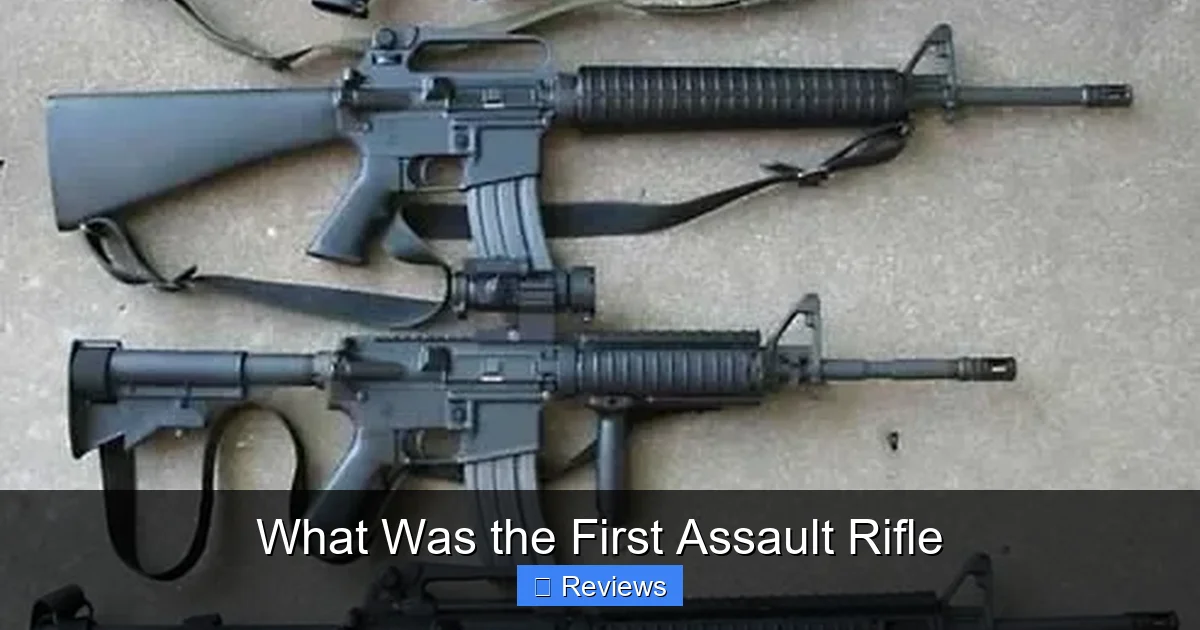
The success of the StG 44 and then the AK-47 prompted other nations to follow suit. The United States eventually adopted the 5.56x45mm NATO intermediate cartridge and the M16 rifle, which, while aesthetically and mechanically different, adheres to the same fundamental principles pioneered by the StG 44. This shift towards intermediate cartridges and selective-fire weapons became a global standard, proving the enduring legacy of what was the first assault rifle.
A New Era of Infantry Tactics
The introduction of the assault rifle, starting with the StG 44, changed how infantry operated. Soldiers could now lay down effective suppressive fire, engage multiple targets more rapidly, and carry more ammunition due to the lighter weight of intermediate cartridges. This increased individual firepower meant smaller squads could be more effective, and tactics shifted from precise long-range marksmanship (though still important) to a greater emphasis on volume of fire and close-to-medium range engagement. The StG 44 didn’t just introduce a new weapon; it ushered in a new era of infantry combat doctrine.
Beyond the StG 44: Modern Interpretations and Misconceptions
While the StG 44 holds the historical title of what was the first assault rifle, the design has evolved tremendously. Modern assault rifles are lighter, more modular, and often feature advanced optics and accessories. However, their core principles remain the same, a testament to the StG 44’s foundational design.
The Modern Assault Rifle Standard
Today, the assault rifle is the standard issue weapon for most armies around the world. From the American M4 carbine to the Russian AK-74, the German HK416, and the Israeli Tavor, all adhere to the intermediate cartridge, selective fire, and detachable magazine criteria. They are designed for versatility, allowing soldiers to engage effectively in various environments, from open fields to urban combat. The lessons learned from the StG 44 continue to inform current military small arms design and procurement.
Civilian “Assault Weapons” vs. Military Assault Rifles
It’s important to briefly address a common point of confusion: the difference between a military “assault rifle” and what are often called “assault weapons” in civilian contexts. A true military assault rifle, like the StG 44, AK-47, or M16, is capable of selective fire (semi-automatic and fully automatic). Civilian “assault weapons,” on the other hand, are typically semi-automatic only versions of firearms that may look similar to military assault rifles. They lack the full-automatic capability that is a defining characteristic of a military assault rifle. The term “assault weapon” is largely a political or legal designation for certain semi-automatic firearms, not a technical one based on military functionality. This distinction is crucial when discussing what was the first assault rifle and its military lineage.
So, there you have it. The journey to understand what was the first assault rifle leads us directly to the ingenuity and desperate circumstances of World War II Germany. The Sturmgewehr 44 wasn’t just another weapon; it was a pivotal moment in firearms history. It synthesized existing ideas with a groundbreaking new cartridge to create a weapon that perfectly met the demands of modern infantry combat. Its influence can be seen in virtually every military rifle designed since, making it a true titan in the annals of weaponry.
The StG 44 proved that a single weapon could effectively bridge the gap between long-range precision and close-quarters firepower, empowering the individual soldier like never before. Its legacy is etched into the design of countless firearms, continuing to shape military tactics and technology today. The next time you see a modern military rifle, take a moment to appreciate the innovation of the StG 44, the true pioneer that answered the question of what was the first assault rifle.
Frequently Asked Questions
What is the meaning of “Sturmgewehr”?
The German word “Sturmgewehr” translates directly to “storm rifle” or “assault rifle.” This term was personally coined by Adolf Hitler when he officially recognized and named the MP43/44 as the StG 44 in 1944.
Why is the Fedorov Avtomat not considered the first assault rifle?
While the Fedorov Avtomat was an early selective-fire weapon that used an intermediate-power cartridge (6.5mm Arisaka), it was produced in very limited numbers, didn’t use a purpose-designed cartridge for its system, and lacked the widespread influence and doctrinal shift that the StG 44 achieved.
How effective was the StG 44 in combat?
The StG 44 was highly effective in combat, particularly on the Eastern Front. German soldiers praised its ability to provide increased firepower, offering both accurate semi-automatic fire at moderate ranges and controllable automatic fire for close-quarters engagements.
Did the StG 44 win the war for Germany?
No, despite its innovative design and effectiveness, the StG 44 was introduced too late and produced in insufficient numbers (around 425,000 units) to significantly alter the outcome of World War II for Germany.
Are modern “assault weapons” the same as military assault rifles?
No, military assault rifles have selective fire capability (semi-automatic and fully automatic). Civilian “assault weapons” are typically semi-automatic only versions of firearms that may share visual characteristics with military models but lack their full-auto function, making them distinct under military classifications.
What cartridge replaced the 7.92x33mm Kurz as the standard intermediate round after WWII?
After WWII, various intermediate cartridges became standard. The two most prominent are the Soviet 7.62x39mm (for the AK-47) and the NATO 5.56x45mm (for the M16/M4 series), both inspired by the StG 44’s pioneering Kurz cartridge.