When asked what rifle did Carlos Hathcock use, the answer primarily points to the Winchester Model 70. This bolt-action rifle, typically in .30-06 Springfield, was his steadfast companion, augmented by a Unertl scope. However, Hathcock famously improvised with a .50 caliber Browning M2 machine gun, transforming it into an unprecedented sniper weapon for specific long-range engagements, showcasing his unparalleled ingenuity and skill beyond just one firearm.
When we talk about legendary snipers, one name almost always comes up: Carlos Hathcock. This Marine Corps sniper, often known as “White Feather,” etched his name into military history with an incredible record during the Vietnam War. His skill, patience, and almost mythical exploits have fascinated generations, leading many to wonder about the tools he used to achieve such remarkable feats. Specifically, the question of “what rifle did Carlos Hathcock use” is one that echoes through countless discussions among firearms enthusiasts, historians, and military buffs.
It’s natural to be curious about the equipment of a master craftsman. For a sniper, the rifle isn’t just a weapon; it’s an extension of their will, a finely tuned instrument of precision. Hathcock’s reputation for extreme accuracy and seemingly impossible shots often makes people believe he must have wielded some kind of super-weapon. But as we’ll discover, the truth is a fascinating blend of classic, reliable firearms, ingenious adaptation, and above all, the unparalleled skill of the man himself.
So, let’s dive deep into the arsenal of Carlos Hathcock. We’ll explore his primary rifle, the optics he favored, and even the surprising, unconventional weapon he adapted for one of his most famous missions. Understanding what rifle Carlos Hathcock used isn’t just about listing gun models; it’s about appreciating the synergy between man and machine, and the enduring legacy of a true American hero.
Key Takeaways
- Primary Rifle: Carlos Hathcock’s most renowned and consistently used rifle was the Winchester Model 70 bolt-action rifle, typically chambered in .30-06 Springfield.
- Iconic Optics: He almost exclusively paired his Winchester Model 70 with an 8x Unertl fixed-power scope, which was a standard issue for Marine snipers of his era.
- The .50 Caliber Innovation: Hathcock famously adapted a M2 .50 caliber Browning machine gun by mounting a scope on it, using it as an ultra-long-range sniper rifle for specific missions, including his famous kill of a Viet Cong general.
- Beyond the Rifle: Hathcock emphasized that the rifle was merely a tool; the true determinant of a sniper’s success was their skill, patience, understanding of ballistics, and mental discipline.
- Ammunition Matters: While the Winchester Model 70 was his platform, Hathcock understood the critical importance of using high-quality, often match-grade, ammunition for maximum accuracy.
- Versatility and Adaptability: His willingness to experiment with and adapt different weapons, like the M2 .50 cal, highlighted his innovative mindset and ability to leverage available resources for mission success.
Quick Answers to Common Questions
What was Carlos Hathcock’s primary sniper rifle?
Carlos Hathcock’s primary sniper rifle was the Winchester Model 70 bolt-action rifle, typically chambered in .30-06 Springfield.
What scope did Carlos Hathcock use on his Winchester Model 70?
Carlos Hathcock almost exclusively used an 8x Unertl fixed-power scope on his Winchester Model 70.
Did Carlos Hathcock ever use a .50 caliber weapon for sniping?
Yes, Carlos Hathcock famously adapted a .50 caliber Browning M2 machine gun for use as an extreme long-range sniper rifle.
What caliber was Hathcock’s primary Winchester Model 70?
Carlos Hathcock’s primary Winchester Model 70 was typically chambered in .30-06 Springfield.
Was Hathcock’s .50 caliber shot a record?
Yes, Carlos Hathcock’s 2,500-yard shot with the adapted .50 caliber M2 machine gun held the world record for the longest confirmed sniper kill for many years.
📑 Table of Contents
- The Legendary Winchester Model 70: Hathcock’s Constant Companion
- Beyond the Winchester: Other Rifles and Early Influences
- The Game-Changer: The .50 Caliber Browning M2 Machine Gun
- Optics and Ammunition: The Crucial Accessories
- The Man Behind the Rifle: Hathcock’s Skill and Philosophy
- Hathcock’s Legacy and Modern Sniper Rifles
- Conclusion
The Legendary Winchester Model 70: Hathcock’s Constant Companion
If there’s one rifle synonymous with Carlos Hathcock, it’s the Winchester Model 70. This wasn’t some exotic, custom-built rifle; it was a commercially available, bolt-action sporting rifle that had earned a stellar reputation for accuracy and reliability long before Hathcock ever shouldered one in combat. For many Marine snipers of that era, the Model 70 was the go-to choice, and Hathcock was no exception.
Why the Winchester Model 70?
The Marine Corps, particularly in the early days of the Vietnam War, didn’t have a dedicated, purpose-built sniper rifle system as we understand it today. Instead, they often relied on commercially available, highly accurate sporting rifles that could be adapted for military use. The Winchester Model 70 fit this bill perfectly. It was known for its “pre-64” controlled-feed action, which was incredibly robust and reliable, ensuring positive feeding and extraction even in harsh combat environments. Its inherent accuracy out of the box made it an ideal candidate for a sniper’s instrument. Hathcock himself reportedly loved the rifle, feeling a strong connection to its design and performance.
Key Features of Hathcock’s Model 70
Most accounts suggest that Hathcock’s Winchester Model 70 was chambered in .30-06 Springfield. This cartridge, while older, was (and still is) a powerful and extremely capable round, known for its flat trajectory and excellent stopping power over long distances. It was also readily available. The rifle itself was a standard production model, likely fitted with a heavier barrel for enhanced accuracy and consistency, as was common for sniper conversions.
Think about it this way: imagine a master chef choosing a high-quality, well-balanced knife. It might not be a space-age utensil, but its fundamental design, materials, and craftsmanship allow the chef to perform at their best. That’s essentially what the Winchester Model 70 was for Hathcock. It was a solid, dependable platform that, in the hands of a master, could achieve extraordinary results.
Beyond the Winchester: Other Rifles and Early Influences
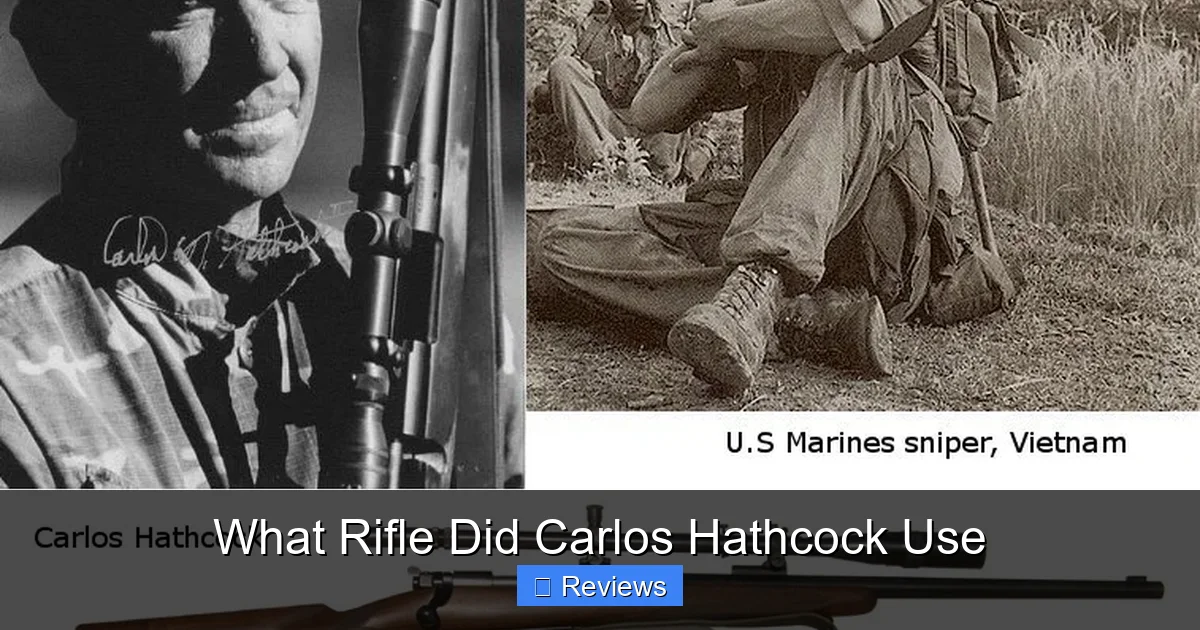
Visual guide about What Rifle Did Carlos Hathcock Use
Image source: cdn.quotesgram.com
While the Winchester Model 70 is undoubtedly the rifle most associated with Hathcock’s legendary career, it’s important to remember that snipers, especially those operating in diverse environments and eras, often train with and utilize a variety of firearms. So, when considering what rifle did Carlos Hathcock use, we should also acknowledge other platforms he might have encountered or deployed.
Early Training and Standard Issue Rifles
Before becoming “White Feather,” Hathcock was a Marine. Like all Marines, he would have been thoroughly trained on standard issue service rifles. This would include the M14 rifle, which was the primary infantry rifle at the outset of the Vietnam War, and later the M16. While not purpose-built sniper rifles, these platforms offered valuable lessons in marksmanship, ballistics, and weapon handling. Snipers often gain their initial precision shooting experience on such rifles, demonstrating superior aptitude that eventually leads them to specialized roles.
The M14, in particular, with its .308 Winchester (7.62x51mm NATO) cartridge, could be surprisingly accurate and was sometimes pressed into service as a designated marksman rifle or even a rudimentary sniper platform. However, it generally didn’t offer the consistent precision of a dedicated bolt-action rifle like the Model 70, especially not over the extreme distances Hathcock was known for.
The Role of Different Firearms
A skilled sniper understands that different missions might call for different tools. While his Winchester was his bread-and-butter, the ability to adapt to other firearms, understand their limitations, and still achieve success is a hallmark of true expertise. This adaptability becomes even more apparent when we look at his most famous unconventional weapon.
The Game-Changer: The .50 Caliber Browning M2 Machine Gun
Here’s where the answer to “what rifle did Carlos Hathcock use” takes a fascinating and unexpected turn. One of Hathcock’s most legendary achievements involved not a traditional rifle, but an adapted .50 caliber Browning M2 machine gun. This wasn’t standard operating procedure by any stretch; it was a testament to Hathcock’s ingenuity, understanding of ballistics, and sheer audacity.
A Sniper’s Unconventional Tool
The M2 Browning is a heavy machine gun, designed for crew-served vehicle mounts, anti-aircraft defense, and general suppressing fire. It fires a massive .50 BMG round, capable of tremendous power and range. Hathcock, however, saw its potential as an extreme long-range precision weapon. He realized that the sheer mass and velocity of the .50 BMG round could maintain accuracy over distances far exceeding what his .30-06 Winchester could reliably achieve.
The Famous “One-Shot Kill” Story
The most iconic story involving the .50 cal is Hathcock’s one-shot kill of a Viet Cong general from an astonishing distance of 2,500 yards (2,286 meters). To achieve this, he took an M2 machine gun, mounted a Unertl telescopic sight on it using duct tape and custom mounts, and fired single shots. Imagine the engineering required on the fly, the ballistic calculations, and the sheer confidence to attempt such a feat with a weapon not designed for it. This wasn’t just using a rifle; it was reinventing its application.
Technical Aspects and Impact
The .50 BMG round offers a much flatter trajectory over extreme distances compared to smaller rifle cartridges, and its energy retention is immense. The challenge was in adapting a heavy, recoil-intensive, belt-fed machine gun into a precision instrument. Hathcock, with his meticulous nature, figured out how to lock down the gun, manage its recoil for single shots, and apply his unparalleled aiming skills. This feat not only solidified his legend but also contributed to the future development of dedicated .50 caliber sniper rifles. It showed the military that extreme long-range precision was achievable and tactically valuable. It truly changed perceptions of what rifle Carlos Hathcock used and what was possible.
Optics and Ammunition: The Crucial Accessories
Asking what rifle Carlos Hathcock used is only part of the equation. A rifle, no matter how accurate, is only as good as its optics and the ammunition fed into it. Hathcock understood this intrinsically, and his choices in these areas were just as critical to his success.
The Unertl Scope: Eyes on the Target
For his Winchester Model 70, Hathcock almost exclusively used an 8x Unertl fixed-power scope. The Unertl was a classic sniper scope of its era, known for its crisp, clear optics and robust construction. It had external adjustments, meaning the elevation and windage knobs were on the outside of the scope tube, directly adjusting the reticle. This design, while perhaps less user-friendly than modern internal adjustment scopes, allowed for very precise adjustments once mastered.
Hathcock’s proficiency with the Unertl was legendary. He could quickly and accurately dial in corrections for wind, range, and mirage, making every shot count. The scope was often mounted in a way that allowed for a wide range of adjustment, crucial for engaging targets at varying distances in the unpredictable jungle environment.
Ammunition Choices: Precision in Every Round
Even the best rifle and scope combination can be undermined by poor ammunition. Hathcock, like all great snipers, understood the importance of consistent, high-quality ammunition. While specific details about the exact match-grade ammunition he used are scarce, it’s understood that Marine snipers of the time were supplied with the best available military-grade ammunition, and often experimented with different lots to find the most accurate batches for their specific rifles.
For a sniper, consistency is key. Every round must fly identically to the last for predictable results. Factors like bullet weight, powder charge, primer consistency, and bullet construction all play a role. Hathcock’s reliance on his Winchester Model 70 in .30-06 meant he was using a cartridge with a long history of precision potential, especially when paired with high-quality bullets.
The Importance of the Complete System
Ultimately, Hathcock’s approach wasn’t just about what rifle Carlos Hathcock used, but about the *complete system*: the rifle, the scope, and the ammunition, all brought together by the skill of the shooter. He knew that each component had to work in harmony for optimal performance. This holistic understanding is a cornerstone of precision marksmanship, whether in the 1960s or today.
The Man Behind the Rifle: Hathcock’s Skill and Philosophy
While we’ve detailed what rifle Carlos Hathcock used, it’s crucial to understand that the rifle was merely a tool. Hathcock himself consistently emphasized that the man behind the gun was infinitely more important than the gun itself. His legendary status was forged not just by his equipment, but by his unparalleled skill, mental fortitude, and deep understanding of his craft.
Training and Discipline: The Foundation of Excellence
Hathcock’s accuracy was not magic; it was the result of relentless training and unwavering discipline. He spent countless hours perfecting his shooting fundamentals: breath control, trigger squeeze, sight alignment, and follow-through. He understood ballistics intimately, factoring in wind, humidity, temperature, and elevation for every shot. His ability to read the wind – often called “dope the wind” – was particularly renowned. He could gauge its speed and direction simply by observing grass, leaves, and even heat mirage, making adjustments that lesser snipers would miss.
Mental Fortitude and Patience
Perhaps even more remarkable than his shooting skill was Hathcock’s mental game. Sniping requires immense patience, often spending days motionless, observing, waiting for the perfect moment. Hathcock famously spent four days crawling hundreds of yards to get a shot at an enemy sniper, a feat of endurance and mental resilience that few could match. He could control his heart rate, breathing, and focus under extreme pressure, transforming himself into an almost zen-like predator.
Adapting to Conditions: The True Mark of a Master
Hathcock operated in the dense jungles, open rice paddies, and mountainous terrain of Vietnam. Each environment presented unique challenges for marksmanship. He mastered camouflage and concealment, becoming virtually invisible to the enemy. His ability to adapt his tactics, equipment, and shooting positions to suit the mission and environment further underscored his expertise. Whether lying in wait for days or executing a seemingly impossible shot with an improvised weapon, Hathcock consistently demonstrated a master’s understanding of his craft. This adaptability is key to understanding what rifle Carlos Hathcock used – or rather, how he *used* whatever rifle was available.
Hathcock’s Legacy and Modern Sniper Rifles
Carlos Hathcock’s impact extends far beyond his operational tours. His experiences, his methodologies, and even the questions surrounding what rifle Carlos Hathcock used, have significantly influenced sniper doctrine and equipment development for decades.
Enduring Influence on Sniper Doctrine
Hathcock, along with other legendary snipers of his era, helped solidify the importance of the sniper in modern warfare. His reports, his experiences, and the sheer effectiveness of his methods highlighted the tactical value of precision fire. This led to a greater emphasis on sniper training, dedicated sniper schools, and the development of specialized sniper equipment within the Marine Corps and other branches of the military. His legacy is etched into every modern sniper’s training regimen.
Evolution of Sniper Rifles
While Hathcock made incredible use of commercially adapted rifles, his exploits, particularly with the .50 caliber, foreshadowed the need for purpose-built sniper systems. Today, military snipers use highly specialized rifles designed from the ground up for extreme accuracy, often incorporating features like free-floated barrels, adjustable stocks, advanced muzzle devices, and sophisticated optics. Rifles like the USMC’s M40 (a Remington 700 variant) or the more modern M107 .50 caliber sniper rifle owe a conceptual debt to pioneers like Hathcock. The understanding of what rifle Carlos Hathcock used and how he pushed their limits directly informed what modern snipers now demand from their equipment.
The True Lesson: It’s the Shooter, Not Just the Rifle
Ultimately, the most important lesson from Hathcock’s career isn’t just about what rifle Carlos Hathcock used, but about the man wielding it. He proved that while good equipment is crucial, it’s the skill, discipline, mental strength, and adaptability of the individual that truly makes a difference. A legendary sniper can achieve extraordinary feats with a well-chosen, reliable rifle, but a mediocre shooter will achieve little, even with the most advanced weapon. Hathcock embodied the principle that the rifle is an extension of the shooter, and his mastery made even a machine gun an instrument of surgical precision.
Carlos Hathcock’s story is a powerful reminder that while we can learn much by dissecting the tools of the trade, the true legend lies in the hands, mind, and spirit of the individual who wields them.
Conclusion
So, what rifle did Carlos Hathcock use? The simple answer is primarily the venerable Winchester Model 70, a robust and accurate bolt-action rifle, typically in .30-06 Springfield, paired with an 8x Unertl scope. But to truly grasp the legend, you must also acknowledge his audacious adaptation of the .50 caliber Browning M2 machine gun for extreme long-range precision.
Hathcock’s choices in firearms weren’t about exotic technology, but about leveraging reliable, accurate platforms and then pushing their capabilities to their absolute limits. His story is a powerful testament to the fact that while equipment is important, the ultimate determinant of success in precision marksmanship is the skill, dedication, and ingenuity of the person behind the trigger. Carlos Hathcock, “White Feather,” remains a towering figure not just for his incredible kill count, but for demonstrating the profound impact a single, highly skilled individual can have, regardless of the specific rifle he held in his hands. His legacy continues to inspire and inform, reminding us that true mastery transcends mere tools.
🎥 Related Video: Carlos Hathcock – The Legendary Vietnam Sniper
📺 Warlogue
shorts #youtubeshorts #ytshort #viral #military Carlos Hathcock is known as the most legendary sniper of the Vietnam War.
Frequently Asked Questions
What made the Winchester Model 70 so effective for Carlos Hathcock?
The Winchester Model 70 was highly regarded for its inherent accuracy, robust “pre-64” controlled-feed action, and reliability. Its solid design provided a stable platform for precision shooting, making it an excellent choice for adaptation into a sniper rifle by the Marine Corps.
How did Carlos Hathcock adapt the .50 caliber machine gun for sniping?
Hathcock famously mounted a Unertl telescopic sight onto a .50 caliber Browning M2 heavy machine gun. He would then load single rounds and fire them precisely, effectively turning the crew-served weapon into an unprecedented long-range precision rifle.
Was the Unertl scope Hathcock used specific to his rifle, or standard issue?
The 8x Unertl scope was a standard issue optical sight for Marine Corps snipers during the Vietnam War. It was known for its clarity and precise external adjustments, making it a reliable choice for the demanding conditions Hathcock operated in.
Did Carlos Hathcock use any other rifles during his service?
While the Winchester Model 70 was his signature rifle, like all Marines, Hathcock would have been trained on and potentially used standard service rifles like the M14. His expertise allowed him to adapt to various firearms, but the Model 70 was his primary precision instrument.
What was the significance of Hathcock’s .50 caliber shot?
Hathcock’s legendary 2,500-yard shot with the adapted .50 caliber M2 machine gun not only set a new world record for confirmed sniper kills but also highlighted the potential of the .50 BMG round for extreme long-range precision, influencing the development of modern .50 caliber sniper rifles.
Beyond the rifles, what was most important to Carlos Hathcock’s success?
Carlos Hathcock consistently stressed that the man behind the rifle was far more important than the weapon itself. His unparalleled success stemmed from his rigorous training, exceptional patience, keen understanding of ballistics, mental discipline, and the ability to adapt to any situation.