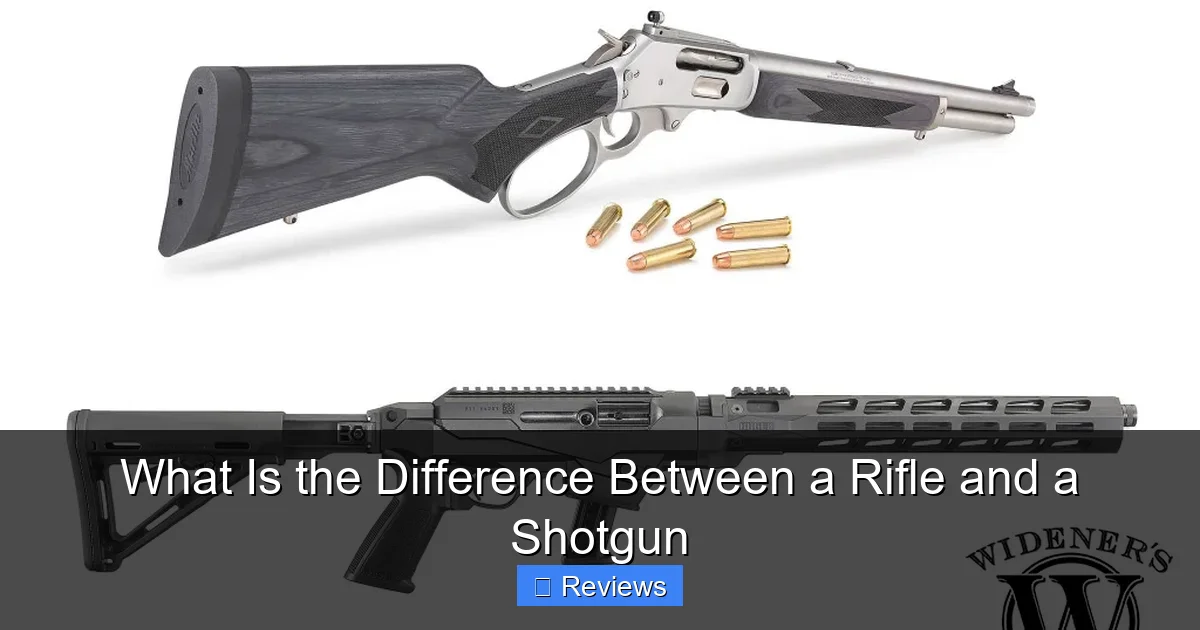
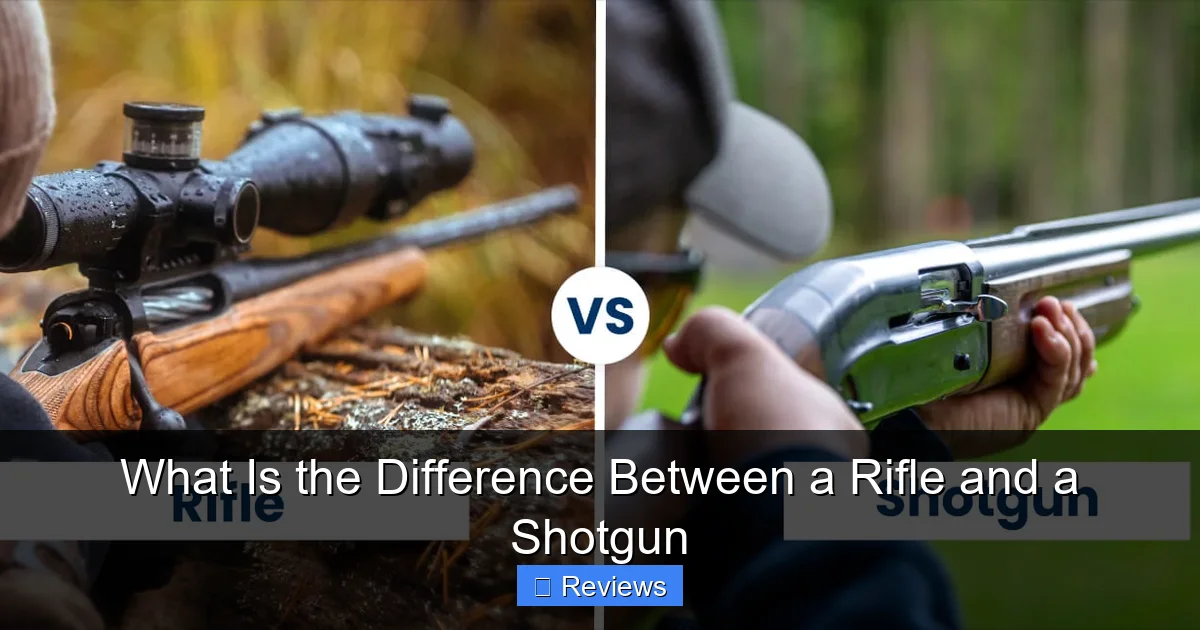
When considering firearms, understanding what is the difference between a rifle and a shotgun is crucial for responsible use. The primary distinction lies in their barrels: rifles feature rifling – spiral grooves that spin the bullet for long-range accuracy, while shotguns have smoothbores designed to fire multiple projectiles (shot) or single slugs at closer ranges. This fundamental difference dictates their ammunition types, effective ranges, and optimal applications for hunting, sport, or defense, making them distinct tools for distinct purposes.
When you’re new to the world of firearms, it’s easy to get a little overwhelmed by all the different types and terms. Two of the most common and often confused firearms are the rifle and the shotgun. Many people use the terms interchangeably, but they are, in fact, incredibly distinct tools designed for very different purposes. Understanding what is the difference between a rifle and a shotgun isn’t just about technical jargon; it’s about appreciating their unique capabilities, ensuring safety, and making informed choices for hunting, sport, or self-defense.
Imagine trying to drive a nail with a screwdriver or screw in a bolt with a hammer. You might eventually get the job done, but it wouldn’t be efficient or effective. The same principle applies here. Both rifles and shotguns are firearms, but they are specialized instruments built from the ground up to achieve specific goals. So, let’s pull back the curtain and explore the fascinating distinctions that set these two venerable firearms apart. By the end of our chat, you’ll have a clear grasp of what makes each one unique and why they’re both invaluable in their own right.
Key Takeaways
- Barrel Design: The most significant difference between a rifle and a shotgun is the barrel. Rifles have “rifling” (spiral grooves) that impart spin to a single projectile, while shotguns have “smoothbore” barrels designed to fire multiple pellets or a single slug without spin.
- Ammunition Types: Rifles fire cartridges containing a single bullet designed for precision. Shotguns fire shotshells, which can contain many small pellets (shot) for a spread pattern or a single large projectile (slug).
- Intended Use: Rifles are engineered for accuracy and effectiveness at long ranges, making them ideal for target shooting, hunting large game, and precision sports. Shotguns are designed for closer-range engagements, excelling in bird hunting, clay target sports, and often home defense due to their spreading shot pattern.
- Accuracy and Range: Rifles offer superior accuracy and extended effective range due to their rifled barrels stabilizing the bullet. Shotguns are typically less accurate with shot at longer distances, relying on pattern density, but can be surprisingly accurate with slugs within their effective range.
- Recoil and Handling: Both firearms can have significant recoil, but it varies greatly by caliber/gauge and design. Rifles are often designed for stable, aimed shooting, while shotguns are built for quicker pointing and engagement of moving targets.
- Legal and Training: While broadly similar, specific legal restrictions, safe handling techniques, and necessary training can vary between rifles and shotguns, emphasizing the need for proper education for both.
Quick Answers to Common Questions
Question 1?
No, absolutely not. Rifle ammunition is designed for a rifled barrel and is generally a much smaller diameter than a shotgun’s bore. Attempting to load rifle ammo into a shotgun is incredibly dangerous and can lead to serious injury or death.
Question 2?
A shotgun is generally better for hunting birds due to its ability to fire a pattern of multiple pellets (shot), which increases the chances of hitting a fast-moving target in the air.
Question 3?
A rifle is significantly better for long-range target shooting because its rifled barrel stabilizes a single bullet, allowing for superior accuracy over hundreds of yards.
Question 4?
Generally, no. Rifles are designed to fire a single projectile (bullet) for precision. Some very specialized rifle rounds exist that might contain multiple projectiles, but this is not their primary design or common use.
Question 5?
Gauge is a unit of measurement specific to shotguns. It refers to the number of lead spheres of that barrel’s diameter that collectively weigh one pound. So, a 12-gauge means 12 lead balls of that bore diameter equal one pound.
📑 Table of Contents
The Defining Feature: Rifling vs. Smoothbore Barrels
At the very heart of understanding what is the difference between a rifle and a shotgun lies their barrel design. This isn’t just a minor detail; it’s the fundamental characteristic that dictates everything else about how each firearm performs. It influences the type of ammunition it fires, its accuracy, and its effective range.
What is Rifling?
If you look down the barrel of a rifle (always ensuring it’s unloaded and pointed in a safe direction, of course!), you wouldn’t see a perfectly smooth tube. Instead, you’d observe a series of spiral grooves cut into the interior surface. This is what we call “rifling.” These grooves aren’t there for aesthetics; they serve a critical mechanical purpose. When a bullet travels down a rifled barrel, these grooves engage with the bullet’s softer outer material, forcing the bullet to spin rapidly on its axis.
Think of it like throwing a football with a perfect spiral. That spin makes the football much more stable in flight, resisting air resistance and external forces that might otherwise send it tumbling off course. For a bullet, this gyroscopic stability is absolutely essential for accuracy, especially over long distances. Without rifling, a bullet would tumble end-over-end, losing accuracy very quickly. The faster the twist rate (how quickly the grooves complete a full rotation), the more stable certain bullet types will be. This precision design is a key aspect of what is the difference between a rifle and a shotgun.
What is a Smoothbore Barrel?
Now, switch your gaze to a shotgun barrel. What you’ll find there is exactly what the name suggests: a “smoothbore.” There are no spiral grooves; the interior surface is entirely smooth from one end to the other. This lack of rifling means that any projectile fired down a shotgun barrel will not be imparted with a spin.
Why would a firearm be designed without rifling? Because shotguns are primarily designed to fire multiple small pellets, known as “shot,” that spread out after leaving the barrel. Imparting a spin to these individual pellets would be counterproductive, as it would cause an erratic and unpredictable pattern. A smoothbore barrel allows the shot to leave in a relatively contained cluster before aerodynamic forces and choke constriction cause it to spread. This fundamental difference in barrel design is paramount when you consider what is the difference between a rifle and a shotgun.
Practical Insight: This core difference means rifles are built for precision with a single projectile, while shotguns are built for a wider area of effect with multiple projectiles, or specific impact with a single, larger slug.
Ammunition Matters: Cartridges vs. Shotshells
Visual guide about What Is the Difference Between a Rifle and a Shotgun
Image source: images.contentstack.io
The unique barrel designs of rifles and shotguns naturally lead to distinct types of ammunition. You can’t put rifle ammunition into a shotgun, and vice versa. Each is engineered to work perfectly with its respective firearm. This distinction in ammunition is another massive piece of the puzzle when discussing what is the difference between a rifle and a shotgun.
Rifle Ammunition: Precision Projectiles
Rifles fire what are generally called “cartridges.” A rifle cartridge is a self-contained unit typically consisting of four main components:
- Bullet: This is the projectile itself, usually made of lead with a copper or brass jacket. Bullets come in a vast array of shapes and sizes, designed for different purposes – from pointed “spitzer” bullets for aerodynamics to hollow-point bullets that expand on impact.
- Casing: A brass, steel, or aluminum cylinder that holds everything together.
- Propellant: Smokeless powder that, when ignited, rapidly burns to produce gases that push the bullet out of the barrel.
- Primer: A small, sensitive explosive charge located at the base of the casing that ignites the propellant when struck by the firing pin.
Rifle cartridges are designed for precision. Each cartridge typically contains a single, carefully crafted bullet. Calibers, like .223 Remington, .308 Winchester, or .30-06 Springfield, refer to the diameter of the bullet and often the specific cartridge design. The exact specifications of a rifle cartridge are meticulously engineered to work with the rifling in a particular rifle’s barrel, optimizing accuracy and performance over distance.
Shotgun Ammunition: Versatility in a Shell
Shotguns, on the other hand, fire “shotshells” or simply “shells.” These are also self-contained units, but their construction and contents are very different from rifle cartridges:
- Hull: Usually a plastic tube with a brass base, holding everything together.
- Shot/Slug: This is the main projectile. Most commonly, shotshells contain many small spherical pellets (shot) made of lead, steel, or bismuth. The size of these pellets varies greatly, from tiny birdshot (like #7 or #8) to much larger buckshot (like #00 or “double-ought”). Alternatively, a shotshell can contain a single, large projectile called a “slug,” which is essentially a heavy, solid bullet.
- Wad: A component (often plastic) that separates the shot from the propellant, protects the barrel, and helps contain the shot pattern.
- Propellant: Similar to rifle cartridges, but formulated for shotgun pressures.
- Primer: Located at the base, ignites the propellant.
Shotguns are measured in “gauge,” not caliber. Gauge refers to the number of lead spheres of that diameter that would make up one pound. So, a 12-gauge shotgun means 12 lead spheres of that barrel’s diameter weigh one pound. The smaller the gauge number, the larger the barrel diameter (e.g., 10-gauge is larger than 20-gauge). This broad array of projectile options is a significant part of what is the difference between a rifle and a shotgun, making shotguns incredibly versatile for varying targets.
Practical Tip: Always double-check your ammunition to ensure it matches your firearm exactly. Putting the wrong ammunition into a firearm can have catastrophic and dangerous consequences.
Intended Use: Precision vs. Pattern
The distinct barrel designs and ammunition types of rifles and shotguns naturally lead them to excel in different scenarios. Their “intended use” is perhaps the most practical way to understand what is the difference between a rifle and a shotgun.
Rifles: For Accuracy and Distance
Rifles are the champions of precision and long-range engagement. Their ability to send a single, stable bullet accurately over hundreds, sometimes even thousands, of yards makes them ideal for:
- Big Game Hunting: For animals like deer, elk, moose, or bear, a rifle’s ability to place a shot precisely into a vital area from a distance is crucial. Different calibers are suited for different sizes of game.
- Target Shooting and Sport: Whether it’s competitive shooting at paper targets, long-range precision shooting, or even casual plinking, rifles are designed for hitting specific, often small, targets.
- Military and Law Enforcement: Snipers and designated marksmen rely on rifles for their accuracy and extended range.
When you need to hit a specific point on a target far away, a rifle is almost always the tool of choice.
Shotguns: For Close-Quarters and Spreading Targets
Shotguns, with their smoothbores and ability to fire multiple pellets, are designed for scenarios where a spreading pattern or rapid target acquisition at closer ranges is advantageous:
- Bird Hunting (Upland and Waterfowl): This is where shotguns truly shine. Firing a cloud of pellets allows hunters to hit fast-moving birds in the air without needing to place a single, precise shot on a tiny target.
- Clay Target Sports: Events like trap, skeet, and sporting clays simulate bird hunting, and shotguns are the only appropriate firearm for these dynamic sports.
- Home Defense: The spreading pattern of buckshot at close ranges can be effective at incapacitating a threat, and the perceived “scatter” effect can sometimes reduce concerns about over-penetration in a dwelling compared to a rifle bullet (though this is a complex topic with many variables).
- Small to Medium Game Hunting (with shot): Hunting rabbits, squirrels, or other small game often uses lighter birdshot loads.
- Deer Hunting (with slugs): In areas where rifles are prohibited for big game hunting, shotguns loaded with slugs can be very effective, though their accurate range is typically limited compared to a rifle.
The versatility of shotgun ammunition, from fine birdshot to heavy slugs, underscores their adaptability, which is a major part of what is the difference between a rifle and a shotgun.
Scenario Examples: If you’re hunting deer in an open field where a 200-yard shot is possible, you’ll reach for a rifle. If you’re in a dense brush area with 50-yard visibility, a shotgun with a slug might be your choice. For pheasant hunting, a shotgun with birdshot is indispensable.
Accuracy, Range, and Power
When evaluating what is the difference between a rifle and a shotgun, it’s essential to consider their performance metrics: accuracy, effective range, and kinetic energy. These aspects are direct consequences of their design and ammunition.
Rifle Performance: Long-Range Precision
The rifled barrel’s ability to stabilize a single bullet means rifles are inherently designed for superior accuracy over considerable distances.
- Accuracy: Modern rifles can achieve accuracy measured in “Minutes of Angle” (MOA), where 1 MOA is roughly 1 inch at 100 yards. Many hunting rifles can consistently achieve 1-2 MOA, meaning they can place shots within a 1-2 inch circle at 100 yards. Precision competition rifles can achieve sub-MOA accuracy.
- Range: Depending on the caliber, rifles can be highly effective out to 300-500 yards for hunting, and specialized long-range rifles can engage targets accurately at 1,000 yards or more.
- Power: Rifle bullets typically travel at very high velocities (2,000-4,000 feet per second) and retain a significant amount of kinetic energy even at long ranges, making them potent for cleanly harvesting large game.
The combination of velocity, stability, and pointed bullet design allows rifles to overcome air resistance and gravity more effectively than most shotgun projectiles. This capability is a core tenet of what is the difference between a rifle and a shotgun.
Shotgun Performance: Effective at Shorter Distances
Shotguns operate on a different principle, prioritizing spread or heavy impact at closer ranges.
- Accuracy (with shot): With birdshot or buckshot, a shotgun’s accuracy is measured by its “pattern” – how densely the pellets land within a certain diameter at a specific distance. This pattern spreads as distance increases, making individual pellet accuracy less relevant. Chokes (constrictions at the end of the barrel) are used to control this spread.
- Accuracy (with slugs): When firing slugs from a smoothbore shotgun, accuracy is respectable but generally not on par with a rifle. A smoothbore shotgun firing slugs might achieve 4-6 inch groups at 50-75 yards. Rifled shotgun barrels (which are like rifle barrels but for shotguns, specifically designed for slugs) can significantly improve slug accuracy, often achieving 2-4 inch groups at 100 yards.
- Range: The effective range of shot (pellets) is relatively short. Birdshot is typically effective out to 30-50 yards, while buckshot might be effective to 50-75 yards. Slugs from a smoothbore shotgun are generally considered effective out to about 75-100 yards, while from a rifled barrel, they can push out to 150-200 yards.
- Power: At close range, shotguns are incredibly powerful. A load of buckshot delivers multiple heavy projectiles, and a slug delivers a single, large, heavy projectile with immense kinetic energy, often exceeding many rifle calibers at very close distances.
Understanding these performance characteristics helps solidify what is the difference between a rifle and a shotgun in practical terms.
Recoil, Handling, and Ergonomics
Beyond the technical specifications, the user experience – how the firearm feels to shoot and handle – is another important differentiator. Recoil and ergonomics play a significant role in comfort, control, and ultimately, effective shooting.
Rifle Recoil and Handling
Rifle recoil can vary dramatically. A small .22LR rifle has almost no perceptible recoil, while a powerful magnum caliber like a .338 Lapua Magnum can have very stout recoil, capable of bruising an unprepared shooter. Generally, rifle recoil is a sharp, rearward push directly into the shoulder.
- Recoil: Dependent on bullet weight, velocity, firearm weight, and caliber. Lighter rifles firing powerful cartridges will have more felt recoil.
- Handling: Rifles are often designed for stable shooting positions – prone, bench rest, or supported standing. Their longer sight radius (distance between front and rear sights) or scope mounting favors deliberate aiming. They are typically held with two hands, one on the grip and one supporting the forestock.
- Ergonomics: Stocks are often designed for a consistent cheek weld to align the eye with sights or optics for precision.
The design promotes slow, deliberate aim and controlled shots.
Shotgun Recoil and Handling
Shotgun recoil can also be substantial, especially with heavy loads like buckshot or slugs from lighter firearms. A 12-gauge shotgun firing a heavy load can deliver a powerful, thumping recoil.
- Recoil: Highly dependent on gauge (12-gauge often has more recoil than 20-gauge), load weight, and firearm weight. It’s often described as a “shove” or “thump.”
- Handling: Shotguns are frequently designed for quick mounting to the shoulder and fast target acquisition, especially for moving targets like birds. The stock and forend shapes facilitate quick pointing. They are also typically held with two hands.
- Ergonomics: Shotgun stocks are often designed to allow for rapid shouldering and natural pointing, with less emphasis on precise cheek weld for optics, as many are pointed rather than precisely aimed.
For the rapid, instinctive shooting often required in hunting moving game or self-defense, a shotgun’s handling characteristics are key elements of what is the difference between a rifle and a shotgun.
Safety Reminder: Proper shooting stance, grip, and recoil management techniques are crucial for safely and comfortably handling both rifles and shotguns. Always wear appropriate hearing and eye protection.
Beyond the Basics: Legality and Training
While the mechanical and functional differences between rifles and shotguns are primary, it’s also worth a quick mention that these differences can sometimes extend to legal and training considerations.
Legal Landscape
Firearm laws vary dramatically by country, state, and even local jurisdiction. While many laws cover “firearms” broadly, some specific regulations might differentiate between rifles and shotguns. For instance, certain jurisdictions might have different restrictions on barrel length, capacity, or types of ammunition depending on whether the firearm is classified as a rifle or a shotgun. Some areas might restrict rifle hunting in dense population zones while allowing shotgun hunting. Always research and understand the specific laws in your area before acquiring or using any firearm.
Training and Skill Development
Because their applications are so different, effective training for a rifle will often differ from effective training for a shotgun. Rifle training will typically emphasize precision marksmanship, breath control, trigger discipline for fine accuracy, and range estimation. Shotgun training, especially for sporting clays or hunting, will often focus on lead (aiming ahead of a moving target), quick mounting, and understanding shot patterns. While basic firearm safety is universal, mastering each type of firearm requires specific skill development tailored to its design and purpose. This is a subtle but important aspect of what is the difference between a rifle and a shotgun for a new shooter.
Conclusion
So, there you have it – a deep dive into what is the difference between a rifle and a shotgun. It’s clear that these aren’t just two names for the same thing; they are fundamentally distinct firearms, each a masterpiece of engineering designed to excel in its specific niche. The rifled barrel of a rifle delivers spinning bullets with unparalleled long-range accuracy, making it the tool of choice for precision shooting and big game hunting. The smoothbore barrel of a shotgun, on the other hand, excels at close to medium range, delivering a spreading pattern of shot or a powerful slug, perfect for bird hunting, clay sports, and many self-defense scenarios.
Understanding these core distinctions – from their barrel designs and ammunition types to their intended uses and performance characteristics – is not just academic. It empowers you to make informed decisions, appreciate the ingenuity behind each design, and most importantly, use these tools safely and effectively for their intended purposes. Whether you’re a seasoned enthusiast or just starting your journey into the world of firearms, knowing the ins and outs of what is the difference between a rifle and a shotgun is a foundational step toward responsible and enjoyable firearm ownership.
🎥 Related Video: How A Shotgun Shell Works 🤔
📺 Zack D. Films
Frequently Asked Questions
Is a shotgun more powerful than a rifle?
It depends on how you define “powerful” and the context. At very close ranges, a shotgun slug or a heavy buckshot load can deliver immense kinetic energy and stopping power. However, rifle bullets typically maintain higher velocities and kinetic energy over longer distances, making them more effective at range.
Can a shotgun be accurate?
Yes, a shotgun can be quite accurate, especially when firing slugs. A smoothbore shotgun with slugs can be effective out to 75-100 yards, and a shotgun equipped with a rifled barrel specifically for slugs can achieve accuracy comparable to some rifles out to 150-200 yards.
What is the biggest difference between a rifle and a shotgun for beginners?
For beginners, the biggest difference lies in their primary application and ammunition. Rifles are for precision aiming at distant, specific targets, using single bullets. Shotguns are generally for closer targets, often moving ones, utilizing a spreading pattern of shot, or a heavy slug for larger, closer targets.
Are shotguns safer for home defense than rifles?
The “safety” aspect in home defense is complex and highly debated. A shotgun loaded with appropriate buckshot might have a reduced risk of over-penetration through multiple walls compared to some rifle rounds, but this is highly dependent on specific ammunition, construction materials, and distances. Both require extensive training for safe and effective use in such scenarios.
Why do rifles have rifling?
Rifles have rifling to impart a spinning motion to the bullet as it travels down the barrel. This spin creates gyroscopic stability, much like a thrown football, preventing the bullet from tumbling and allowing it to fly accurately over much longer distances.
Can I hunt big game with a shotgun?
Yes, you can hunt big game like deer, bear, or wild hogs with a shotgun, provided you use appropriate ammunition (typically slugs) and adhere to local hunting regulations. Shotguns are particularly popular for big game in areas where rifle hunting is restricted due to population density or terrain.