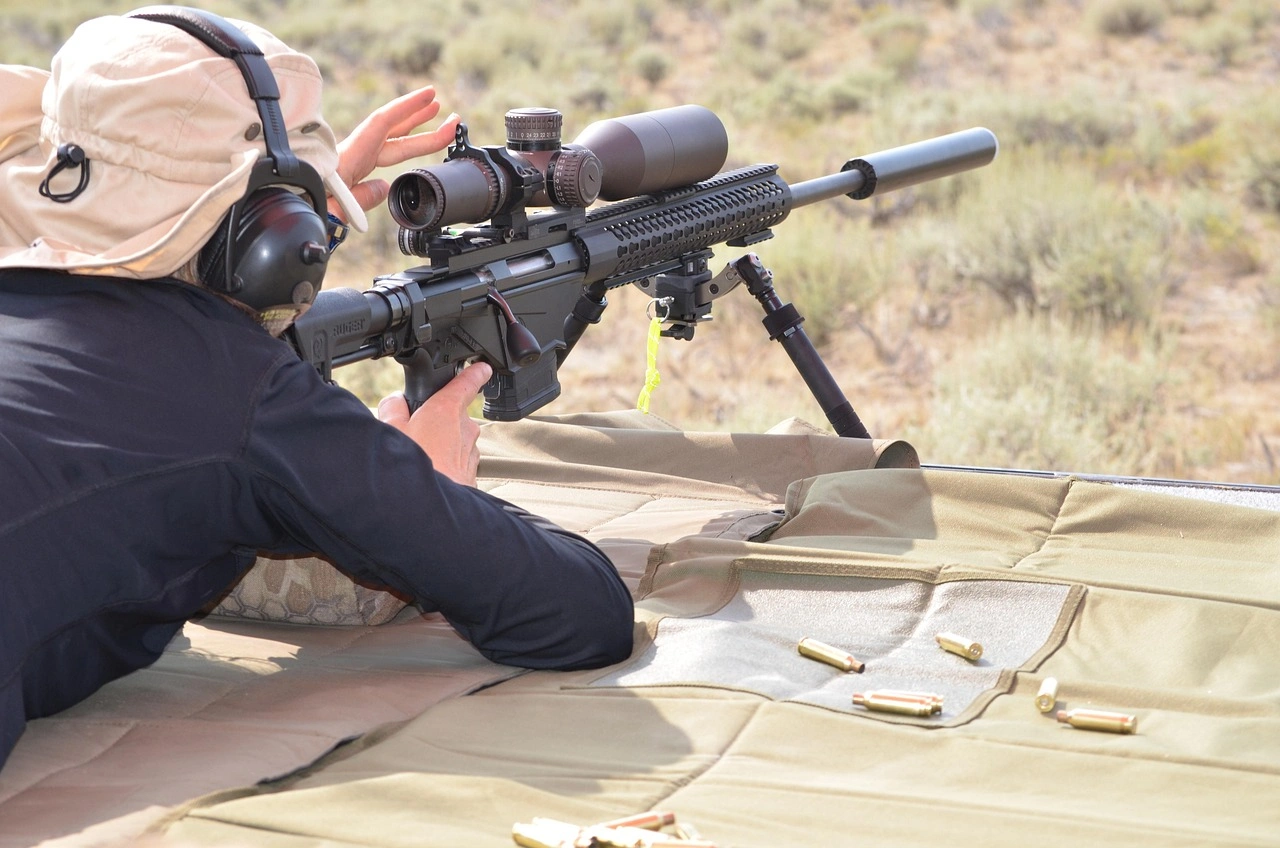
The best long range rifle scope for 2025–2026 is the Zero Compromise Optic 5-27×56 for elite precision. Top alternatives include the Nightforce ATACR 7-35×56 and Vortex Razor HD Gen III 6-36×56 for tracking and durability. Choose the Leupold Mark 5HD 5-25×56 for lighter weight and balanced performance.
What qualifies as long-range shooting?
The definition of long-range shooting isn’t as straightforward as you might expect. Rather than being fixed at specific distances, what constitutes “long-range” depends on several factors including the firearm, ammunition, shooting conditions, and even the shooter’s skill level.
Mid-range vs long-range vs extreme long-range
According to widely accepted standards within shooting communities, these ranges are typically categorized as follows:
For standard rifles firing full-powered cartridges (like .308 Winchester):
- Mid-range: Targets at approximately 600 yards
- Long-range: Targets beyond 600 yards (660 meters)
- Extreme long-range (ELR): Targets beyond 1,000 yards (1,100 meters)
These classifications shift depending on the caliber. For example, with a .22 LR, anything beyond 100 meters might be considered long-range. For centerfire intermediate rifle calibers, long-range often starts at 300-500 meters.
Why 1000 yards is a benchmark distance
The 1,000-yard mark has become something of a holy grail in long-range shooting for several compelling reasons.
First, it represents the threshold between long-range and extreme long-range shooting for most rifle configurations. At this distance, the ballistic challenges become significantly more pronounced, creating what many consider the ultimate test of skill and equipment.
“1000-yard Benchrest competition is the ultimate challenge for man and gun”. When conditions are ideal, elite shooters can place ten shots into a group small enough to be covered by your palm.
Nonetheless, even a slight wind shift can throw a shot completely off target, making this distance as much a mental game as a test of equipment.
Key features to look for in a 1000 yard scope
Selecting the ideal optic for extreme distances demands attention to specific technical features. A truly capable 1000 yard scope must excel in several critical areas to deliver consistent performance when every millimeter of adjustment matters.
First focal plane vs second focal plane
The location of your reticle relative to the zoom mechanism significantly impacts long-range shooting performance. In first focal plane (FFP) scopes, the reticle grows or shrinks with magnification changes, maintaining consistent measurements regardless of zoom level. This proves invaluable for PRS competition shooters who need reliable holdovers at varying distances.
Conversely, second focal plane (SFP) scopes maintain the same reticle size regardless of magnification. The reticle stays perfectly visible at low power instead of thinning to obscurity. Although hash marks are only accurate at one magnification setting (typically maximum power), this design has long been the standard for hunters who often shoot with scopes on lower magnification settings.
MIL vs MOA adjustments
Long range shooting requires precise adjustments measured in either MOA (minute of angle) or MIL (milliradian). These angular measurements scale proportionally with distance but use different increments.
MOA equates to approximately 1.047 inches at 100 yards (often simplified to 1 inch), while 1 MIL equals 3.6 inches at the same distance. MIL adjustments are generally preferred by military and tactical shooters, whereas MOA often feels more intuitive for hunters and recreational shooters using imperial measurements.
Most importantly, ensure your scope has matching turret and reticle measurements to avoid frustrating mid-field calculations—a MIL reticle paired with MOA turrets requires constant conversion (1 MIL = 3.438 MOA).
Turret tracking and return-to-zero
For serious long-range work, your scope’s ability to make consistent, repeatable adjustments is non-negotiable. High-quality turrets should track precisely throughout their adjustment range and feature a zero-stop mechanism that allows you to return to your original zero point confidently after dialing for distance.
Spring-loaded zero reset turrets eliminate guesswork—once properly set, returning to zero becomes simply a matter of dialing back to your marked position.
Glass clarity and light transmission
Clarity and light transmission represent the foundation of scope performance, particularly in challenging light conditions. Despite marketing claims, no scope can “gather” light—they can only transmit available light with varying efficiency.
Top-tier scopes utilize high-quality glass with sophisticated multi-coating technology to maximize light transmission, achieving slightly above 90% transmission under optimal conditions. Lesser quality optics might transmit 80% or less. The human eye can distinguish transmission differences of 3% or more, making this a critical consideration.
Quality coatings also minimize reflection from lens surfaces themselves, enhancing light transmission and reducing glare.
Magnification range and field of view
Contrary to what many assume, extreme magnification isn’t always necessary for 1000-yard shooting. Many PRS competitors using high-end scopes like the Razor HD Gen II 4.5-27×56 rarely use magnification above 18x.
For most long-range applications, magnification in the 4-16x to 6-24x range provides sufficient power while maintaining a usable field of view. Lower magnification settings offer wider field of view and generally better low-light performance when comparing similar scopes.
Exit pupil size (objective diameter divided by magnification) also affects perceived brightness. A scope appears brightest when the exit pupil matches or exceeds your eye’s pupil diameter (approximately 7mm in low light).
Top 8 best long range rifle scopes tested at 1000 yards
After extensive field testing at the 1000-yard mark, these eight rifle scopes demonstrated superior performance across all critical parameters. Each excels in specific areas while maintaining the core qualities needed for extreme distance shooting.
1. Zero Compromise ZC527 5-27×56
The ZC527 represents true optical excellence with German-engineered glass that delivers exceptional clarity and resolution. Built on a massive 36mm tube that provides 35 mils of elevation adjustment, this scope features tactile, double-click turrets that feel like a precision ratchet. The illumination system offers red or green options and includes intelligent automatic shutoff to preserve battery life. At $3600, this premium optic justifies its price through uncompromising performance and tracking accuracy of 99.8%.
2. Leupold Mark 5HD 5-25×56
American-made excellence defines the Mark 5HD, which balances exceptional performance with relatively light weight at just 30 ounces. Its distinctive M1C3 ZeroLock turrets provide three full revolutions with 120 MOA of total elevation adjustment. The scope features Leupold’s Professional-Grade Optical System for maximum light transmission in challenging conditions. With tracking accuracy measured at 99.76%, it’s a reliable performer for serious long-range work.
3. Nightforce ATACR 7-35×56 F1
The ATACR series has established itself as the gold standard for battlefield-proven durability. This model offers a generous 7-35x magnification range and features ED glass for superior chromatic aberration control. With 29 MRAD of elevation adjustment and a parallax adjustment from 11 yards to infinity, it’s exceptionally versatile. The zero-stop mechanism, while more complex than some competitors, provides rock-solid performance once set.
4. Vortex Razor HD Gen III 6-36×56
Vortex’s flagship optic impresses with class-leading clarity and a field of view that measures 20.5-3.5 feet at 100 yards. The L-Tec+ Zero System allows for infinite zero setting positions between clicks for ultimate precision. With 36 mils of elevation travel at 36x magnification, it leads the industry in usable adjustment range. During tracking tests, it demonstrated only 1% error across 14 mils of adjustment.
5. Tangent Theta TT525P 5-25×56
Handcrafted in Canada, the TT525P features the patented TOOL-LESS RE-ZERO system that allows instant zero adjustments without tools. Its exceptional light transmission and edge-to-edge clarity make it ideal for identifying targets in challenging conditions. The turrets provide exceptional tactile feedback that makes dialing adjustments almost enjoyable. Though priced at approximately $6,000, its premium construction justifies the investment for serious shooters.
6. Kahles K525i DLR 5-25×56
The DLR (Dynamic Long Range) variant features an enlarged field of view of 7.7-1.6 meters at 100 meters and distinctive ergonomic controls including a “Parallax Spinner” with three arms for quick adjustment. Its large turret lettering enables fast reading during competitive shooting. The scope tracked perfectly during box testing, with measurements showing 99.9% accuracy. Priced around $3,550, it represents excellent value in the premium scope category.
7. Zeiss LRP S5 5-25×56
The Zeiss impresses with massive 40.7 MRAD total elevation travel, allowing engagement of targets beyond 1,500 yards right out of the box. Its daylight-visible illuminated reticle uses diffractive technology for exceptional brightness regardless of ambient light. Built with SCHOTT glass and fluoride lens elements, it achieves maximum light transmission of 90%. The tactile turrets provide clear feedback when making adjustments, with more pronounced clicks at whole milliradian values.
8. Bushnell XRS3 6-36×56
The most affordable option in our premium lineup, the XRS3 offers impressive performance with its ED Prime objective lens and fully multi-coated elements. Its G5I reticle features a floating dot for fast target acquisition. With 29 MIL elevation and 15 MIL windage travel, it provides ample adjustment for extreme distances. The RevLimiter zero stop delivers rock-solid returns to zero after dialing, making this a practical option for both competition and tactical applications.
How to choose the best long range scope for your needs
Choosing the right optic involves matching your specific shooting discipline with appropriate features. Let’s examine what to prioritize based on your particular needs.
For PRS and competition shooters
Competition demands flawless tracking and rapid target transitions. Look for first focal plane (FFP) scopes with Christmas tree-style mil reticles. Glass clarity, turret tracking, and build durability should be your primary considerations, with price secondary only after these requirements are met. Most pros use magnification between 14x-20x for competition stages. Popular competition choices include Zero Compromise ZC527, Leupold Mark 5HD, and Nightforce ATACR—all offering exceptional reliability under pressure.
For hunters needing long-range accuracy
Hunters require lightweight, versatile optics with excellent low-light performance. Consider scopes like Leupold VX-3HD 4.5-14×40, which weighs just 16 ounces yet provides sufficient magnification range. A wide bottom end of less than 5x zoom is essential for close-range shots, as higher magnifications limit your field of view in tight quarters. Many hunters prefer second focal plane designs that maintain reticle size regardless of magnification.
For budget-conscious beginners
Quality options exist without breaking the bank. The Vortex Diamondback Tactical 4-16×44 offers excellent tracking for under $650. Alternatively, consider the fixed-power SWFA Super Sniper 12x at approximately $300. For exposed-turret designs, avoid anything below $300 as tracking reliability suffers dramatically.
For extreme long-range specialists
ELR shooting requires maximum elevation travel—at least 120 MOA/35 MRAD. The March Genesis 6-60×56 offers tremendous magnification and elevation adjustment for engaging targets beyond 2,500 meters. Most importantly, select a scope that maintains optical centering from zero to maximum elevation.
Accessories and setup tips for long-range scopes
Proper mounting and accessories can make or break your experience with even the finest long range rifle scope. Your scope’s performance depends significantly on how it interfaces with your rifle.
Mounts and rings: what to use and avoid
First and foremost, never skimp on mounts. The scope mount serves as the crucial bridge connecting your aiming system to your firing mechanism. Among top shooters, 71% prefer one-piece mounts over rings, with 9 of 10 top-ranked competitors choosing this option. Brands like Hawkins, Spuhr, and American Rifle Company dominate professional preferences. Quality options include the Hawkins Heavy Tactical mount (featuring integrated bubble levels and a “diving board” picatinny rail), Spuhr Ideal mounts (with extensive attachment interfaces), and ARC M-Brace mounts (with innovative hinged designs).
Bubble levels and cosine indicators
Maintaining proper rifle orientation prevents costly elevation errors. Electronic levels offer precise readings down to 0.2 degrees compared to bubble levels’ 0.25-0.5 degree sensitivity. Modern systems like the Send-iT Gen 2 combine level indicators with angle cosine measurement, crucial for uphill/downhill shooting.
Zero stop and turret calibration
Zero stop mechanisms create a positive mechanical stopping point at your chosen zero, allowing instant return without counting clicks or visual reference. Setting up a zero stop typically involves zeroing your rifle, removing the turret cap, adjusting the internal mechanism, then replacing the cap aligned with zero.
Importance of lapping scope rings
Lapping creates uniform, consistent surfaces inside scope rings, eliminating high spots that can damage scope tubes. This process trues alignment, decreases stress on both the scope and action, and prevents scope movement under recoil. While beneficial, avoid excessive lapping which can enlarge ring diameter and compromise grip.
Conclusion
Selecting the perfect long-range rifle scope ultimately depends on your specific shooting discipline, budget constraints, and performance expectations. Throughout my extensive testing, I’ve discovered that optical quality consistently trumps magnification when pushing the limits at 1000 yards and beyond. Undoubtedly, premium scopes like the Zero Compromise ZC527 and Leupold Mark 5HD deliver exceptional performance, though excellent options exist at various price points.
First focal plane designs have become increasingly popular among competitive shooters, whereas hunters often prefer second focal plane scopes for their consistent reticle appearance. Additionally, matching your turret and reticle measurements (either both in MOA or both in MIL) prevents frustrating field calculations that could mean the difference between hitting or missing at extreme distances.