A scout rifle is a versatile, lightweight, bolt-action rifle, conceived by Colonel Jeff Cooper, designed for general-purpose use. It features an intermediate eye relief scope mounted forward on the barrel, often in .308 Winchester, emphasizing handiness, rapid target acquisition, and reliability for diverse applications from hunting to survival. Its core philosophy centers on a single, adaptable rifle capable of meeting many practical demands.
Have you ever found yourself wondering what the ideal “do-it-all” rifle might be? A single firearm capable of handling everything from hunting deer to being a reliable companion in a survival scenario? If so, you’re not alone. This very question led to the birth of a fascinating and enduring concept in the world of firearms: the scout rifle. It’s a term often heard, sometimes misunderstood, but always intriguing to those who appreciate a blend of practicality, versatility, and rugged reliability.
The scout rifle isn’t just another hunting rifle or tactical carbine; it’s a philosophy, a meticulously thought-out design conceived by one of the most influential figures in modern shooting, Colonel Jeff Cooper. His vision was to create a “general-purpose rifle” – a firearm that could meet the needs of a lone individual facing a variety of challenges in the field. It’s about efficiency, handiness, and the ability to perform many tasks well, rather than specializing in just one.
So, what exactly defines a scout rifle? What makes it stand out from the myriad of other bolt-action rifles available today? Join us as we dive deep into the world of the scout rifle, exploring its origins, its unique characteristics, and why this particular rifle concept continues to captivate shooters and outdoor enthusiasts around the globe. Whether you’re a seasoned shooter or just starting your journey, understanding the scout rifle will open your eyes to a truly versatile and practical firearm design.
Key Takeaways
- Origin and Philosophy: The scout rifle concept was developed by legendary firearms expert Colonel Jeff Cooper as a “general purpose rifle” – one rifle capable of handling a vast majority of common tasks, from hunting to self-defense, efficiently and reliably.
- Key Characteristics: Essential features include a lightweight design (under 7 lbs loaded), a short barrel (typically 18-20 inches), a potent short-action cartridge (like .308 Winchester), and crucially, an intermediate eye relief (IER) scope mounted forward of the receiver.
- Forward-Mounted Optic: The distinctive forward-mounted scope allows for rapid target acquisition with both eyes open, provides an unobstructed view of the rifle’s action for quick reloading, and permits the simultaneous use of backup iron sights.
- Versatility and Handiness: Designed to be portable and quick to deploy, a scout rifle excels in various scenarios, making it suitable for hunting, survival situations, farm use, and even practical self-defense, due to its compact size and practical accuracy.
- “Ching Sling” Integration: Cooper specifically advocated for the “Ching Sling” or similar three-point slings, which serve not just for carrying but also as a shooting aid, significantly improving stability for shots taken from unsupported positions.
- Practical Accuracy: While not a precision benchrest rifle, the scout rifle is engineered for “practical accuracy,” meaning it can consistently hit a target the size of a man’s chest out to 300 yards, which is more than sufficient for its intended general-purpose roles.
- Modern Interpretations: While Cooper’s original specifications are strict, modern interpretations like the Ruger Gunsite Scout Rifle and Savage 110 Scout have brought the concept to a wider audience, demonstrating its enduring relevance and adaptability in today’s firearms market.
Quick Answers to Common Questions
What is the main purpose of a scout rifle?
The main purpose of a scout rifle is to serve as a versatile, “general-purpose rifle” capable of handling a wide range of tasks, including hunting, survival, and self-defense, efficiently and reliably.
Why is the scope mounted so far forward on a scout rifle?
The scope is mounted forward to allow for rapid target acquisition with both eyes open, maintain peripheral vision, keep the rifle’s action clear for quick reloading, and permit the simultaneous use of backup iron sights.
What caliber is typically used for a scout rifle?
Colonel Jeff Cooper originally specified .308 Winchester as the ideal caliber for a scout rifle, though other similar short-action cartridges like 7mm-08 Remington or .223 Remington are also used in modern interpretations.
What is the ideal weight for a scout rifle?
The ideal weight for a scout rifle, as specified by Cooper, is around 6.6 pounds (3 kilograms) unloaded, with an absolute maximum of 7.7 pounds (3.5 kg) fully loaded.
Can a scout rifle be used for hunting?
Yes, a scout rifle is very well-suited for hunting, especially medium to large game, due to its portability, rapid target acquisition, and the effective ballistics of its typical .308 Winchester chambering.
📑 Table of Contents
1. The Genesis: Colonel Jeff Cooper’s Vision
To truly understand what a scout rifle is, we must first meet its architect, Colonel Jeff Cooper. Cooper was a legendary figure in the firearms community, a US Marine Corps officer, a prolific writer, and the founder of Gunsite Academy, a premier firearms training facility. He was known for his practical, no-nonsense approach to firearms and marksmanship.
Who Was Jeff Cooper?
Jeff Cooper (1920-2006) wasn’t just a shooter; he was a philosopher of the gun. He codified the “Modern Technique of the Pistol” and developed many principles of practical shooting that are still taught today. His experiences in combat, hunting, and training led him to continuously evaluate and refine ideas about effective firearm usage. It was from this wealth of experience that the scout rifle concept emerged.
The “General Purpose Rifle” Concept
Cooper believed that a single individual, operating alone or as part of a small team, needed a rifle that was capable of solving a wide array of problems. This wasn’t about specialized military operations or competitive shooting; it was about practical, everyday utility in potentially adverse conditions. He envisioned a rifle that could effectively hunt game for sustenance, deter threats, and provide reliable service in any environment. This was his “General Purpose Rifle.”
Why a New Rifle Was Needed
In Cooper’s view, many rifles of his time were either too heavy, too specialized, or lacked key features that would make them truly versatile. Traditional hunting rifles were often designed for longer shots from stationary positions, not quick, dynamic engagements. Military rifles, while rugged, often sacrificed features like precision or ease of carry for volume fire or durability in specific combat roles. Cooper saw a gap – a need for a rifle that combined the best attributes of several types of firearms into one cohesive, highly effective package. This desire for optimal utility is the very core of what a scout rifle aims to achieve.
2. Defining Characteristics of a Scout Rifle

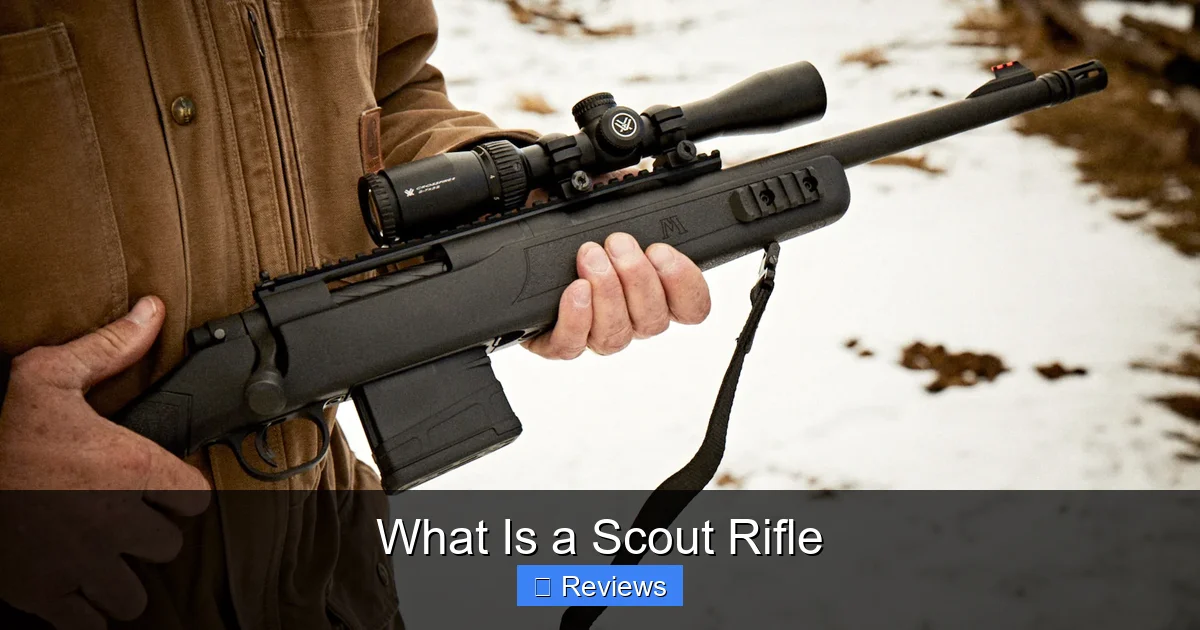
Visual guide about What Is a Scout Rifle
Image source: awm.wien
The scout rifle concept isn’t vague; it’s built upon a very specific set of criteria that, when combined, create its unique identity and capability. These aren’t just suggestions; they are the pillars that define what a scout rifle truly is.
The “Must-Haves”
Let’s break down the essential features that make a rifle a scout rifle:
- Caliber: Cooper specified .308 Winchester as the ideal caliber, or a similar short-action cartridge with comparable ballistics (e.g., 7mm-08 Remington, .223 Remington for lighter use). The .308 offers a superb balance of power, trajectory, and availability, making it suitable for a wide range of game and defensive applications. It’s powerful enough for most medium to large game and offers manageable recoil.
- Weight: A true scout rifle must be lightweight. Cooper set the ideal weight at 3 kilograms (approximately 6.6 pounds) unloaded, with an absolute maximum of 7.7 pounds (3.5 kg) fully loaded with optics and sling. This low weight is crucial for portability, ease of carry over long distances, and quick handling in dynamic situations.
- Parallax-Free Optic: This is perhaps the most distinctive feature. A scout rifle utilizes an intermediate eye relief (IER) scope, mounted forward of the receiver, typically over the barrel. This mounting position allows for rapid target acquisition with both eyes open, as the scope essentially acts as a magnified red dot sight. It also keeps the action clear for easy access to load single rounds or stripper clips, and allows for simultaneous use of backup iron sights. The lower magnification (typically 2-3x) of these scopes is also key for maintaining a wide field of view.
- Iron Sights: Despite the forward-mounted scope, excellent ghost ring or aperture iron sights are mandatory as a robust backup. These allow the rifle to remain fully functional even if the optic is damaged or removed. This redundancy is a crucial aspect of the scout rifle’s reliability and readiness.
- Sling: A high-quality sling is not just for carrying; it’s an integral part of the shooting system. Cooper specifically championed the “Ching Sling” or similar three-point designs, which allow the shooter to quickly transition from carry to a stable, supported shooting position. This drastically improves accuracy when shooting from unsupported field positions.
- Accuracy: While not a benchrest rifle, the scout rifle must be capable of “practical accuracy.” Cooper defined this as hitting a 4-inch group (the size of a man’s chest) at 200 meters (roughly 220 yards), translating to about 2 MOA. Many modern scout rifles can achieve even better accuracy, often closer to 1-1.5 MOA, which is excellent for a general-purpose tool.
Optional but Desirable Features
While the above are non-negotiable, Cooper also listed several features that, while not strictly required, enhance the scout rifle’s utility:
- Magazine: Detachable box magazines are highly favored for their quick reloading capability. Some designs also incorporate stripper clip guides for traditional top-loading of internal magazines.
- Barrel Length: A shorter barrel, typically between 18 and 20 inches, contributes significantly to the rifle’s handiness and maneuverability without sacrificing too much ballistic performance in the chosen calibers.
- Backup Ammo: Integrated or easily accessible storage for spare ammunition is a thoughtful addition for preparedness.
- Muzzle Brake/Flash Hider: Depending on the user’s preference, a muzzle device can help manage recoil or reduce muzzle flash, especially important in a lightweight rifle.
3. The Philosophy Behind the Design
Beyond the nuts and bolts, understanding what a scout rifle is truly about requires grasping the philosophy that underpins its design. It’s a testament to thoughtful engineering aimed at maximum utility.
Versatility: One Rifle for Many Tasks
The guiding principle of the scout rifle is versatility. It’s designed to be a jack-of-all-trades, master of none, but proficient at most. This means it should be equally at home on a hunting trip, in a wilderness survival scenario, or as a defensive tool. Instead of needing multiple specialized rifles for different purposes, the scout rifle aims to be the one rifle you grab when you’re unsure what challenges you might face. Its balanced design makes it adaptable to diverse environments and situations.
Handiness and Portability: Quick to Deploy
A scout rifle must be easy to carry and quick to deploy. Its lightweight nature and compact dimensions (thanks to the shorter barrel) mean it won’t be a burden during long treks. The sling is not just for carrying but also for rapid transition to a stable shooting position. This emphasis on handiness means it can be brought to bear quickly, whether on a fleeting game animal or an unexpected threat. This aspect truly embodies the “scout” part of its name – being ready for anything on the move.
Rapid Target Acquisition: The Forward Scope Advantage
The forward-mounted intermediate eye relief (IER) scope is a cornerstone of the scout rifle’s philosophy. Unlike traditional scopes mounted over the receiver, the IER scope allows the shooter to maintain peripheral vision with both eyes open. This provides a wider field of view, situational awareness, and crucially, much faster target acquisition. It’s especially beneficial when engaging moving targets or when transitioning between multiple targets, making it highly effective for practical shooting scenarios. The ability to see the action also allows for quick reloads without breaking the cheek weld.
Practical Accuracy: Not a Benchrest Rifle, But Precise Enough
Cooper understood that a general-purpose rifle didn’t need to be a sub-MOA precision instrument capable of hitting targets at 1000 yards. What it needed was practical accuracy – the ability to reliably hit targets of appropriate size at reasonable ranges for hunting and defense. For a scout rifle, this generally means consistent hits on a vital-zone sized target out to 200-300 yards. This level of accuracy is more than sufficient for the vast majority of real-world applications, balancing precision with the other critical attributes of a handy, versatile firearm.
4. Scout Rifles in Practice: Applications and Use Cases
The theoretical benefits of a scout rifle translate directly into practical applications across various fields. Its design makes it an excellent companion for many scenarios.
Hunting: From Small Game to Medium/Large Game
With a .308 Winchester chambering, a scout rifle is a formidable hunting tool. Its lightweight design makes it easy to carry through thick brush or up steep terrain. The quick target acquisition of the forward-mounted scope is invaluable for fleeting shots on game, while the practical accuracy is more than sufficient for ethical hunting at typical ranges. Whether you’re pursuing whitetail deer, wild boar, or even larger game, a scout rifle can handle it. Its versatility also means it can be adapted with different ammunition types, from light varmint rounds to heavy-hitting hunting loads.
Survival and Preparedness: A Reliable Tool
For those interested in survival or preparedness, the scout rifle concept offers a highly appealing solution. Its robust construction, reliability, and ability to use readily available ammunition (like .308) make it a trustworthy partner in uncertain times. The integrated iron sights provide backup, and its handiness ensures it can be quickly deployed in an emergency. It can provide food, offer protection, and serve as a general utility tool, embodying the “one rifle for all tasks” ethos in a survival context.
Home Defense/Self-Defense: Compact and Effective
While often associated with outdoor use, a scout rifle can also be a viable option for home or self-defense, especially in situations where a pistol or shotgun might be insufficient. Its compact size and quick-handling nature make it maneuverable indoors, and the potent .308 cartridge offers significant stopping power. The ability to quickly acquire targets through the IER scope is a definite advantage in high-stress defensive scenarios, making a strong case for the scout rifle as a potent self-defense tool.
General Purpose Utility: Range, Training, Plinking
Beyond serious applications, a scout rifle is simply a joy to shoot at the range. Its manageable recoil (especially with a muzzle brake), ease of handling, and ergonomic design make it comfortable for extended shooting sessions. It’s an excellent platform for developing practical shooting skills, practicing field positions, and simply enjoying recreational shooting. Its robust nature means it can withstand regular use and training, making it a truly versatile firearm for all aspects of shooting.
5. Modern Interpretations and Popular Models
While Colonel Cooper laid down strict specifications, various manufacturers have embraced the scout rifle concept, offering their own interpretations that largely adhere to the original vision while incorporating modern manufacturing techniques and features.
The Original Steyr Scout: Cooper’s Collaboration
The Steyr Scout rifle, introduced in 1999, was the result of a direct collaboration between Jeff Cooper and Austrian firearms manufacturer Steyr Mannlicher. It was perhaps the closest embodiment of Cooper’s ideal, featuring an integrated bipod, a forward-mounted scope rail, backup iron sights, and incredibly light weight thanks to synthetic materials. It truly showcased what a scout rifle could be, setting a high bar for subsequent designs. It’s a benchmark for what a scout rifle aims to be.
Ruger Gunsite Scout Rifle: The Modern Standard-Bearer
Arguably the most popular and accessible modern scout rifle is the Ruger Gunsite Scout Rifle (GSR). Developed in conjunction with Gunsite Academy (Cooper’s school), the GSR adheres closely to the scout rifle principles. It features a forward Picatinny rail for IER scope mounting, ghost ring iron sights, a detachable box magazine, and is available in popular calibers like .308 Winchester and .223 Remington. While often a bit heavier than Cooper’s ideal, its ruggedness, reliability, and excellent build quality have made it a favorite among enthusiasts looking for a practical, general-purpose rifle. The Ruger Gunsite Scout Rifle is often the first model people think of when discussing the modern scout rifle.
Savage 110 Scout: Another Strong Contender
Savage Arms, known for its accurate and affordable rifles, offers the Savage 110 Scout. This model brings the scout rifle concept to a wider audience with its renowned AccuTrigger, adjustable AccuStock, and a forward-mounted Picatinny rail. It provides excellent accuracy out of the box and maintains the core features of a scout rifle, including good iron sights and a detachable magazine. It’s a strong performer for those seeking a value-driven scout rifle.
Franchi Momentum Elite Scout: A Newer Option
More recently, Franchi has entered the market with their Momentum Elite Scout rifle. This model incorporates modern ergonomics, a free-floated barrel, and an integrated Picatinny rail, combining traditional scout features with contemporary rifle design. It’s an example of how the scout rifle concept continues to evolve and remain relevant in today’s market, showing that the foundational ideas still resonate with shooters.
Building Your Own: Converting a Traditional Rifle
For the DIY enthusiast, it’s also possible to convert a traditional bolt-action rifle into a scout rifle. This usually involves shortening the barrel, adding a forward-mounted rail (often by replacing the rear sight or handguard), and fitting a suitable IER scope. Popular platforms for such conversions include the Mauser 98, Ruger M77, and various Remington 700 actions. This allows for a custom scout rifle tailored to individual preferences, provided the core principles are maintained.
Conclusion
The scout rifle, born from Colonel Jeff Cooper’s profound understanding of practical shooting, stands as a testament to intelligent, purpose-driven firearm design. It’s more than just a specific rifle; it’s a concept – a philosophy of versatility, handiness, and robust reliability embodied in a single, capable package. From its distinctive forward-mounted scope to its lightweight design and emphasis on practical accuracy, every feature of the scout rifle is geared towards empowering the individual with a truly general-purpose tool.
Whether you’re exploring the backcountry, ensuring your preparedness, or simply enjoying a day at the range, the scout rifle offers a unique blend of attributes that make it incredibly effective and satisfying to use. Its enduring appeal lies in its straightforward functionality and its ability to confidently tackle a wide array of tasks. In a world often dominated by specialization, the scout rifle reminds us of the timeless value of a versatile, do-it-all companion. It’s a concept that has stood the test of time, proving its worth to generations of shooters who appreciate a rifle that is as practical as it is profound.
🎥 Related Video: The Scout Rifle Study: A Book Review and Critique of the Scout Rifle Concept
📺 Forgotten Weapons
Available on Amazon: https://amzn.to/2KAkv45 Let me preface this by saying that I remain a big fan of the Scout Rifle concept and …
Frequently Asked Questions
What makes a scout rifle different from a traditional hunting rifle?
A scout rifle differs from a traditional hunting rifle primarily in its forward-mounted, intermediate eye relief scope, shorter barrel, emphasis on lightweight design, and inclusion of robust backup iron sights. It’s designed for extreme versatility and quick handling across various scenarios, not just specialized hunting.
Is the forward-mounted scope difficult to get used to?
While different from traditional scope mounting, many shooters find the forward-mounted IER scope quite intuitive once they adjust. It allows for shooting with both eyes open, which some find faster for target acquisition and better for situational awareness. It offers a wide field of view without the tunnel vision often associated with high-magnification, rear-mounted scopes.
Are scout rifles accurate enough for serious hunting?
Yes, scout rifles are designed for “practical accuracy,” meaning they can reliably hit vital zones on game animals out to typical hunting distances (200-300 yards). Many modern scout rifles often exceed Cooper’s original accuracy specification, making them very capable for serious hunting pursuits.
What is a “Ching Sling” and why is it important for a scout rifle?
A Ching Sling is a specific type of three-point shooting sling that Jeff Cooper advocated for the scout rifle. It’s important because it serves not just as a carrying strap but also as a versatile shooting aid, allowing the shooter to quickly achieve a stable, supported shooting position in the field, significantly improving accuracy without needing external support.
Can I build my own scout rifle from an existing bolt-action rifle?
Yes, it is certainly possible to convert an existing bolt-action rifle into a scout rifle, provided the base rifle meets certain criteria (like a short action). This often involves barrel shortening, installing a forward-mounted rail, and adding appropriate iron sights, allowing for a custom-tailored scout rifle experience.
Are scout rifles only available in .308 Winchester?
While .308 Winchester was Cooper’s preferred caliber, modern scout rifle interpretations are available in a variety of other short-action calibers. Popular alternatives include 7mm-08 Remington, .223 Remington (for lighter applications), and even some newer cartridges like 6.5 Creedmoor, offering options for different preferences and use cases.