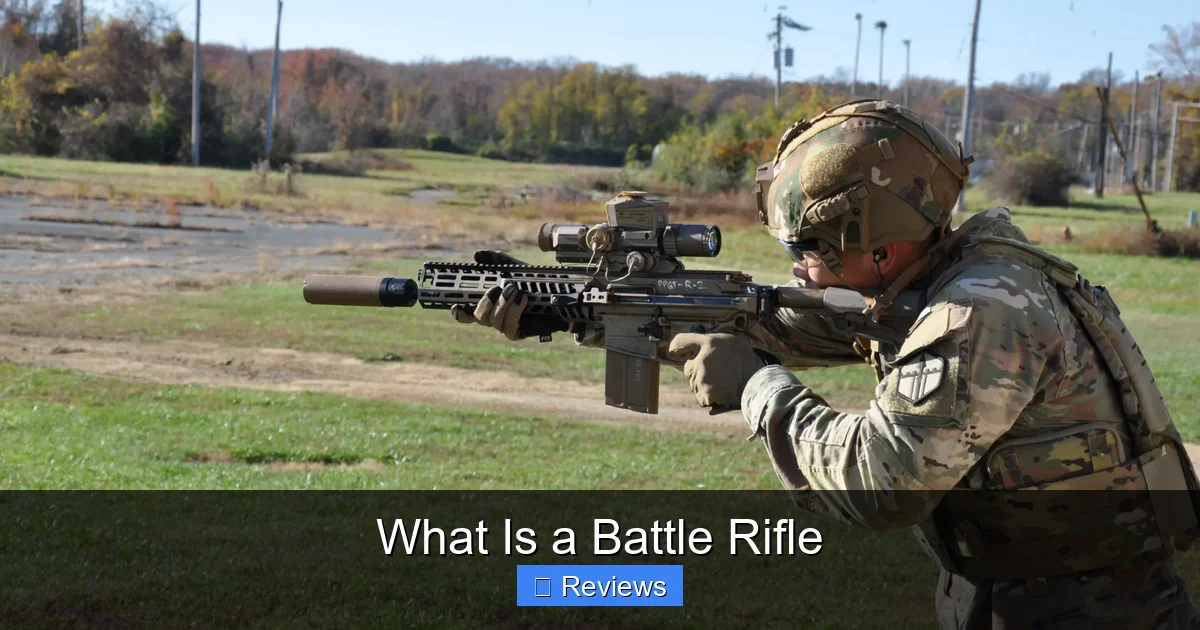
A battle rifle is a semi-automatic, magazine-fed firearm chambered for a full-power rifle cartridge, typically used in military contexts. Known for its robust construction and powerful punch, it bridges the gap between precision long-range rifles and smaller, lighter assault rifles, offering significant stopping power and range.
In the vast world of firearms, terms can sometimes get a little fuzzy. You hear about assault rifles, carbines, hunting rifles, and then there’s the formidable “battle rifle.” What exactly separates a battle rifle from its counterparts? Why does it hold such a distinct place in military history and modern firearm discussions? If you’ve ever found yourself pondering these questions, you’re in the right place.
The concept of a battle rifle is steeped in a fascinating history, born out of the need for a potent, reliable firearm that could deliver significant stopping power over considerable distances. It’s a firearm that embodies raw power and rugged dependability, a true workhorse designed for the serious business of defense and engagement. Understanding what defines a battle rifle helps us appreciate its unique capabilities and its enduring appeal.
This article will pull back the curtain on the battle rifle, exploring its defining features, the powerful cartridges it chambers, and its historical journey. We’ll clear up common misconceptions, especially when comparing it to the more widely known assault rifle, and look at how this venerable firearm continues to hold its own in today’s ever-evolving landscape. So, let’s dive into the fascinating world of the battle rifle!
Key Takeaways
- Full-Power Cartridge: A defining characteristic of a battle rifle is its use of a full-power, intermediate-to-long-range rifle cartridge, such as the .308 Winchester (7.62x51mm NATO).
- Semi-Automatic Operation: While some models have selective-fire capabilities, the primary mode of operation for a battle rifle, especially in civilian hands, is semi-automatic.
- Robust and Durable Construction: Battle rifles are built to withstand the rigors of combat, featuring durable materials and straightforward designs for reliability.
- Distinction from Assault Rifles: Unlike assault rifles which fire intermediate cartridges (e.g., .223/5.56mm), battle rifles use more powerful rounds, offering greater range and energy but often at the cost of increased recoil and weight.
- Historical Significance: Many iconic firearms like the M14, FAL, and G3 are classic examples of battle rifles, playing crucial roles in 20th-century conflicts.
- Modern Relevance: Despite the prevalence of assault rifles, modern battle rifles continue to be utilized for designated marksman roles, special operations, and by civilians for hunting, competition, and self-defense.
- Versatility and Power: A battle rifle offers a unique blend of firepower, range, and relatively high magazine capacity, making it a versatile tool for various applications.
Quick Answers to Common Questions
What is the primary difference between a battle rifle and an assault rifle?
The primary difference lies in the ammunition they fire. A battle rifle uses a full-power rifle cartridge (e.g., .308 Winchester/7.62x51mm NATO), while an assault rifle uses an intermediate cartridge (e.g., .223 Remington/5.56x45mm NATO).
Are all battle rifles fully automatic?
No, not all battle rifles are fully automatic. While some military versions may have selective fire capabilities, most modern and civilian-legal battle rifles are semi-automatic, firing one shot per trigger pull.
What is a common caliber for a battle rifle?
The most common and iconic caliber for a battle rifle is the .308 Winchester, which is the civilian equivalent of the 7.62x51mm NATO military cartridge.
Why are battle rifles typically heavier than assault rifles?
Battle rifles are heavier due to their more robust construction, necessary to withstand the increased recoil and pressure of full-power cartridges, and often feature longer barrels.
Can civilians own battle rifles?
Yes, in many jurisdictions, civilians can legally own semi-automatic battle rifles, subject to local, state, and federal firearm laws which may regulate specific features or magazine capacities.
📑 Table of Contents
- Defining the Beast: What is a Battle Rifle?
- The Punch: Understanding Battle Rifle Caliber
- Anatomy of a Battle Rifle: Key Features and Design
- Battle Rifle vs. Assault Rifle: A Crucial Distinction
- The Enduring Legacy: Modern Battle Rifles and Their Roles
- Bringing a Battle Rifle Home: Practical Considerations and Ownership
Defining the Beast: What is a Battle Rifle?
When we talk about what is a battle rifle, we’re discussing a specific type of military rifle. At its core, a battle rifle is a semi-automatic, magazine-fed rifle chambered for a “full-power” or “full-sized” rifle cartridge. Think of it as a rifle built for serious engagement, designed to project significant power downrange. This isn’t a firearm for plinking tin cans; it’s a tool for engaging targets effectively at extended ranges.
The Full-Power Cartridge Distinction
The most critical defining characteristic of a battle rifle is its ammunition. Unlike an assault rifle, which uses an “intermediate” cartridge (like the 5.56x45mm NATO or 7.62x39mm), a battle rifle fires a full-power cartridge. The classic example here is the .308 Winchester, also known in its military designation as 7.62x51mm NATO. These cartridges are more powerful, heavier, and generally have a flatter trajectory and more energy at longer distances. This means a battle rifle hits harder and travels further with greater accuracy than its intermediate-cartridge counterparts.
A Glimpse into History
The concept of a battle rifle really came into its own during the mid-20th century. After World War II, many nations were looking for a standard infantry rifle that could provide both effective long-range fire and sustained semi-automatic (or even full-automatic) capability. The M1 Garand, while not fully magazine-fed in the modern sense, set the stage for the semi-automatic rifle. Later, iconic designs like the Belgian FN FAL, the German Heckler & Koch G3, and the American M14 emerged as the quintessential battle rifles of their era. These rifles were intended to be the primary service weapons for entire armies, embodying reliability, power, and ruggedness.
The Punch: Understanding Battle Rifle Caliber

Visual guide about What Is a Battle Rifle
Image source: callofduty.com
The heart of any battle rifle’s performance lies in its caliber. It’s the engine that drives its capabilities, dictating everything from range and stopping power to recoil and overall weapon size. When you understand the ammunition, you truly begin to grasp what a battle rifle is all about.
The Power of .308 Winchester / 7.62x51mm NATO
As mentioned, the 7.62x51mm NATO cartridge is the poster child for battle rifle ammunition. It’s an exceptionally versatile and effective round. Originating in the 1950s, it was adopted by NATO as a standard service rifle cartridge. Its civilian equivalent, the .308 Winchester, is one of the most popular hunting and target shooting cartridges in the world.
What makes this caliber so important for a battle rifle?
- Energy and Stopping Power: The 7.62x51mm NATO round carries significantly more kinetic energy than intermediate cartridges. This translates to greater stopping power against unarmored targets and better penetration against light cover.
- Range and Ballistics: It maintains a higher velocity and energy over longer distances, making a battle rifle effective out to 600-800 meters or even further with skilled shooters and precision variants. Its trajectory is relatively flat, simplifying long-range engagements.
- Versatility: The .308 Winchester / 7.62x51mm NATO is available in a wide variety of bullet weights and types, from light, fast rounds to heavy, penetrating designs. This versatility allows a battle rifle to be adapted for many roles, from infantry support to designated marksman applications.
Other Full-Power Cartridges
While 7.62x51mm NATO is the most common, other cartridges have defined battle rifles over history. The 7.62x54mmR (used in the Soviet SVD Dragunov, though often considered a designated marksman rifle rather than a general battle rifle in the strictest sense of semi-auto infantry weapon) and the older .30-06 Springfield (used in the M1 Garand) are examples of other full-power rounds. More recently, cartridges like 6.5 Creedmoor and even .338 Federal are finding their way into modern battle rifle platforms, offering enhanced ballistic performance for specific roles. The key factor is always the “full-power” designation – a cartridge designed for long-range energy, not just high volume of fire.
Anatomy of a Battle Rifle: Key Features and Design
Beyond the cartridge, the physical design and features of a battle rifle are crucial to understanding its role and capabilities. These firearms are built with a purpose, and their construction reflects that.
Semi-Automatic Operation
While many historical battle rifles featured selective fire (the ability to switch between semi-automatic and full-automatic fire), the semi-automatic mode was always the primary method of engagement for infantry. In the civilian market, battle rifles are almost exclusively semi-automatic. This means one pull of the trigger fires one round, and the rifle automatically reloads itself for the next shot. This balances a high rate of practical fire with control.
Magazine-Fed Systems
A modern battle rifle relies on detachable box magazines. These usually hold 20 rounds, though 25-round or even 30-round magazines are available for some platforms. This capacity allows for sustained engagement without frequent reloading, a critical feature in a combat scenario. The ability to quickly swap out an empty magazine for a full one is a significant tactical advantage.
Robust Construction and Materials
Battle rifles are built to be tough. They are designed to operate reliably in harsh environments, from deserts to jungles. This often means using durable materials like steel and high-strength aluminum alloys, with robust operating mechanisms that can handle the recoil and stress of firing powerful cartridges. Reliability is paramount; a rifle that fails in combat is worse than no rifle at all. This robust build contributes to the overall weight of a battle rifle, which is typically heavier than an assault rifle.
Barrel Length and Accuracy
A battle rifle generally features a longer barrel compared to a carbine or many assault rifles. Barrel lengths often range from 18 to 22 inches, sometimes even longer. This extended length allows the powerful cartridges to achieve their full ballistic potential, contributing to higher muzzle velocities and better accuracy at extended ranges. While not a dedicated sniper rifle, a battle rifle is capable of respectable accuracy, especially in the hands of a skilled marksman.
Ergonomics and Accessories
Early battle rifles had more traditional wood or fixed polymer stocks and simple iron sights. Modern battle rifles, however, often feature modular designs, allowing for customization with optics (scopes, red dots), bipods, foregrips, and adjustable stocks. This adaptability enhances their utility across various roles, from precision shooting to more dynamic combat scenarios. The ergonomics, while often robust, might be less refined than some sportier firearms, prioritizing durability and function in tough conditions.
Battle Rifle vs. Assault Rifle: A Crucial Distinction
This is where much of the confusion lies. People often use “assault rifle” and “battle rifle” interchangeably, but they are distinctly different categories of firearms with different purposes and capabilities. Understanding this difference is key to knowing what a battle rifle truly is.
The Caliber Divide
The most fundamental difference, as we’ve already highlighted, is the ammunition.
- Battle Rifle: Fires a full-power rifle cartridge (e.g., .308 Winchester / 7.62x51mm NATO).
- Assault Rifle: Fires an intermediate cartridge (e.g., .223 Remington / 5.56x45mm NATO or 7.62x39mm).
This difference in cartridge size and power leads to a cascade of other distinctions.
Recoil and Control
The more powerful cartridge of a battle rifle naturally generates more recoil. This makes the weapon harder to control, especially during rapid fire. While semi-automatic fire is manageable for a trained shooter, full-automatic fire from a battle rifle is notoriously difficult to control, leading to significant muzzle climb and reduced accuracy. Assault rifles, with their lighter recoil, are much easier to handle in full-auto mode, which is why selective fire is a more practical feature on them.
Weight and Size
Due to the more powerful ammunition and robust construction needed to withstand it, battle rifles are generally heavier and often longer than assault rifles. This can impact maneuverability, especially in close-quarters combat or when carried for long periods. Assault rifles, being lighter and more compact, are generally preferred for infantry where agility and ease of carry are paramount.
Intended Role and Range
Originally, battle rifles were designed for general infantry use, providing strong firepower at longer ranges. Their ability to punch through light cover and reach out to distant targets was highly valued. Assault rifles, on the other hand, emerged from the need for a weapon that was effective in closer engagements, could be easily controlled in full-auto, and allowed soldiers to carry more ammunition due to lighter cartridge weight. While an assault rifle is typically effective out to 300-400 meters, a battle rifle extends that effective range significantly.
Examples to Illustrate
- Classic Battle Rifles: FN FAL, H&K G3, M14, AR-10.
- Classic Assault Rifles: AK-47, M16, AR-15, H&K G36.
Notice how the M14 and AR-10 are often confused with the M16 and AR-15. The M14 is the battle rifle version, firing 7.62x51mm. The M16 is the assault rifle version, firing 5.56x45mm. Similarly, the AR-10 is the original battle rifle design, and the AR-15 is its scaled-down assault rifle cousin. This distinction is vital for understanding what a battle rifle is.
The Enduring Legacy: Modern Battle Rifles and Their Roles
Despite the widespread adoption of assault rifles firing intermediate cartridges, the battle rifle has never truly disappeared. In fact, it continues to evolve and fill crucial roles in modern militaries and the civilian market. The sheer power and range of a battle rifle remain highly desirable for specific applications.
Designated Marksman Rifles (DMRs)
One of the most prominent modern roles for a battle rifle is as a Designated Marksman Rifle (DMR). A DMR bridges the gap between a standard infantry rifle and a dedicated sniper rifle. It allows a skilled shooter within an infantry squad to engage targets at longer ranges than their comrades, providing precision fire support. Many DMRs are enhanced battle rifle platforms, often with heavier barrels, improved optics, and refined triggers to boost accuracy. Examples include the M110 SASS (based on the AR-10 platform), the Mk 17 SCAR-H, and various enhanced M14 variants.
Special Operations and Anti-Material Roles
Special forces units often favor battle rifles for their versatility and power. The ability of a battle rifle to penetrate light vehicles, engage targets behind cover, or handle tougher situations makes it invaluable. For instance, the SCAR-H (Heavy) is a modern modular battle rifle widely used by special operations forces globally due to its adaptability and the punch of its 7.62x51mm cartridge.
The Civilian Market: Hunting, Competition, and Self-Defense
In the civilian world, what is a battle rifle? It’s a highly capable firearm for various purposes.
- Hunting: The .308 Winchester caliber is incredibly popular for hunting medium to large game, and semi-automatic battle rifle platforms offer quick follow-up shots.
- Competition: Long-range shooting competitions and 3-Gun matches often see participants using highly customized battle rifle platforms like the AR-10, valuing their accuracy and reliability.
- Self-Defense and Home Defense: While perhaps overkill for typical home defense scenarios due to its power and potential for over-penetration, a battle rifle offers significant deterrent and engagement capability for rural properties or defensive roles. The powerful cartridge and robust design instill confidence.
Emerging Trends
Modern battle rifles are increasingly modular, allowing for quick barrel changes, caliber conversions, and the attachment of a wide array of accessories. They also incorporate advancements in materials science, leading to lighter yet stronger components. New cartridges like the 6.5 Creedmoor are also being chambered in battle rifle platforms, offering even flatter trajectories and improved ballistic coefficients for long-range precision.
Bringing a Battle Rifle Home: Practical Considerations and Ownership
If you’re considering owning a battle rifle, there are several practical aspects to think about. It’s a significant investment and a powerful tool, so understanding these points will help you make an informed decision.
Recoil Management
The first thing you’ll notice about a battle rifle compared to a smaller caliber rifle is the recoil. It’s more substantial. Proper shooting technique, including a firm stance, good grip, and shoulder placement, is essential for managing it. Muzzle brakes can significantly reduce felt recoil, making the rifle more comfortable to shoot and allowing for faster follow-up shots.
Weight and Ergonomics
As discussed, battle rifles are heavier. This can be a factor if you plan on carrying it for extended periods, such as during hunting trips or competition stages. Try handling different models to see how they feel. Consider adjustable stocks and grips that allow you to customize the rifle to your body size and shooting style.
Cost and Availability
Battle rifles, especially new, high-quality models, can be more expensive than their intermediate-caliber counterparts. Ammunition for full-power cartridges like .308 Winchester also tends to be more costly. Factor in the price of magazines, optics, and other accessories. Availability can vary, but popular platforms like the AR-10 have a robust aftermarket.
Maintenance and Cleaning
Battle rifles are generally designed for ruggedness, but regular cleaning and maintenance are still crucial for reliability and longevity. Familiarize yourself with the breakdown and cleaning procedures for your specific model. Keep the bolt carrier group, barrel, and gas system clean, especially after a range session.
Legal Aspects
Always be aware of local, state, and federal laws regarding firearm ownership. What is a battle rifle in terms of legality can vary widely. Some jurisdictions may have restrictions on magazine capacity, certain features (like threaded barrels or flash hiders), or even outright bans on semi-automatic rifles. Do your homework thoroughly before purchasing.
Training and Skill Development
Owning a battle rifle is one thing; being proficient with it is another. Invest in proper training from a qualified instructor. Learn how to shoot accurately at various distances, manage recoil effectively, perform tactical reloads, and clear malfunctions. The power of a battle rifle demands respect and responsible handling.
In conclusion, the battle rifle is a fascinating and powerful category of firearm. It stands apart through its use of full-power rifle cartridges, offering superior range and stopping power compared to assault rifles. From its historical prominence in major conflicts to its modern roles as a designated marksman rifle and a versatile civilian tool, the battle rifle continues to demonstrate its relevance. While it comes with specific considerations regarding recoil, weight, and cost, for those who seek uncompromising power and reach in a semi-automatic platform, the battle rifle remains an unparalleled choice. It’s a testament to enduring design principles and the timeless need for potent, reliable firepower.
🎥 Related Video: Top 10 Deadliest Assault Rifles
📺 MILITARY CYPHER
In this video, we present the **Top 10 Deadliest Assault Rifles in the World**, used by militaries and special forces globally.
Frequently Asked Questions
What historical firearms are considered classic battle rifles?
Several iconic firearms from the mid-20th century are considered classic battle rifles, including the Belgian FN FAL, the German Heckler & Koch G3, and the American M14. These rifles were known for their robust design and powerful full-sized cartridges.
What advantages does a battle rifle offer over an assault rifle?
A battle rifle offers greater stopping power, increased effective range, and better penetration against light cover due to its use of a full-power cartridge. This makes it more suitable for engaging distant targets or those with light protection.
What are the main disadvantages of a battle rifle?
The main disadvantages include heavier weight, greater recoil (making rapid fire less controllable), and typically higher ammunition costs. These factors can impact maneuverability and sustained fire capability compared to lighter assault rifles.
Are battle rifles still used by modern militaries?
Yes, modern militaries still use battle rifles, primarily in specialized roles such as Designated Marksman Rifles (DMRs) or for special operations forces where the increased range and power of the full-caliber round are highly valued.
Can a battle rifle be used for hunting?
Absolutely. Many battle rifle platforms chambered in calibers like .308 Winchester are highly effective for hunting medium to large game. Their semi-automatic action allows for quick follow-up shots if needed.
What does “full-power cartridge” mean in the context of a battle rifle?
A “full-power cartridge” refers to a rifle round designed to deliver significant energy and range, generally associated with traditional bolt-action hunting rifles (e.g., .308 Win, .30-06 Sprg), as opposed to “intermediate cartridges” which are smaller and less powerful, designed for lighter assault rifles.