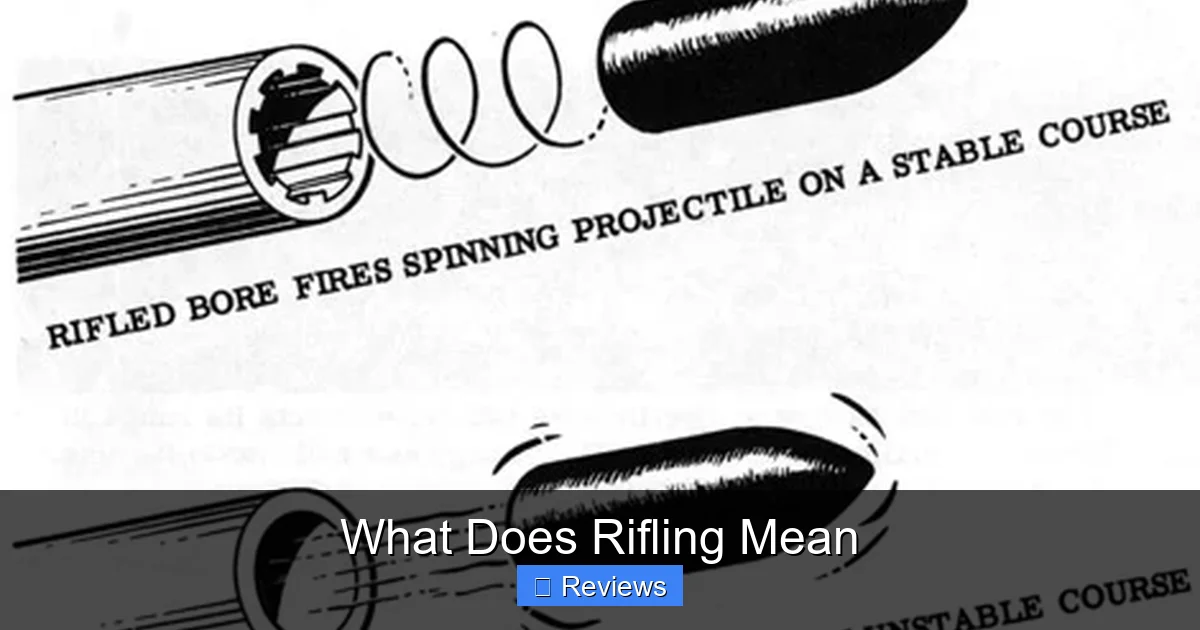
Rifling refers to the helical grooves cut or formed inside a firearm’s barrel that impart a spin to a projectile as it travels through. This crucial spin creates gyroscopic stability, much like a football spiraling through the air, preventing the bullet from tumbling and ensuring it flies straight and true over long distances. Understanding what does rifling mean is key to appreciating firearm accuracy and ballistic performance.
Have you ever watched a skilled shooter hit a distant target with pinpoint precision? Or perhaps marveled at the incredible accuracy of modern firearms? It might seem like magic, but behind every straight-flying bullet is a clever bit of engineering that has been refined over centuries. This engineering marvel is known as rifling, and it’s arguably one of the most significant innovations in firearm technology.
But what does rifling mean, exactly? It’s a term you’ve probably heard if you’ve spent any time around firearms or even just watched a documentary. At its heart, rifling refers to the spiral pattern of grooves found inside the barrel of nearly every modern firearm. These aren’t just decorative marks; they serve a crucial purpose: they make bullets fly straight. Without rifling, bullets would tumble wildly through the air, making accurate shooting virtually impossible beyond very short distances. It’s the unsung hero that turns a simple projectile into a predictable, stable, and highly accurate object.
Let’s embark on a journey to fully understand what does rifling mean, how it works its magic, and why it’s so vital to the world of shooting. We’ll explore its history, the different types that exist today, and the science that makes it all possible. By the end, you’ll have a profound appreciation for these intricate patterns hidden within the steel.
Key Takeaways
- Core Definition: Rifling means the helical (spiral) grooves inside a firearm’s barrel that force a bullet to spin around its long axis as it exits the muzzle.
- Purpose of the Spin: The primary goal of rifling is to impart gyroscopic stability to the projectile, preventing it from tumbling end-over-end and significantly improving accuracy and range.
- Grooves and Lands: Rifling consists of “grooves” (the cut-out channels) and “lands” (the raised portions between the grooves) which engage with the bullet’s softer material, forcing it to rotate.
- Twist Rate: An essential characteristic of rifling is its “twist rate,” which measures how quickly the rifling completes one full revolution (e.g., 1 turn in 10 inches). This rate must be optimized for bullet length and weight.
- Types of Rifling: Various manufacturing methods exist, including cut rifling, button rifling, hammer forging, and polygonal rifling, each with distinct characteristics and production processes.
- Impact on Performance: Rifling is fundamental to modern firearm performance, allowing for precise shot placement, longer effective ranges, and consistency, which are critical for hunting, sport shooting, and defense.
- Beyond Firearms: While synonymous with firearms, the principle of imparting spin for stability is also seen in other projectiles, like artillery shells and even some sporting equipment.
Quick Answers to Common Questions
What is the main purpose of rifling?
The main purpose of rifling is to impart a spin to the bullet as it travels down the barrel. This spin creates gyroscopic stability, preventing the bullet from tumbling and allowing it to fly straight and accurately over longer distances.
How does rifling make a bullet spin?
Rifling consists of helical grooves and lands inside the barrel. When a bullet is fired, the lands bite into its softer material, forcing the bullet to rotate as it’s propelled forward by the expanding gases, much like a screw turning in a threaded hole.
What is “twist rate” in rifling?
Twist rate refers to how quickly the rifling completes one full revolution inside the barrel. It’s typically expressed as a ratio, like “1:10 inches,” meaning the rifling makes one full turn every 10 inches of barrel length.
Can different types of bullets require different twist rates?
Yes, absolutely. Longer and heavier bullets generally require a faster twist rate (a lower number, e.g., 1:7) to achieve sufficient stability, while shorter and lighter bullets perform better with slower twist rates (a higher number, e.g., 1:12).
Are all firearm barrels rifled?
Almost all modern firearms designed for firing single projectiles (like pistols, rifles, and some shotguns with slug barrels) are rifled. Shotguns primarily designed for firing shot (pellets) are generally smoothbore, as spin would actually disperse the shot pattern.
📑 Table of Contents
The Core Concept: What Does Rifling Mean?
At its most basic, when we talk about what does rifling mean, we are describing the helical, or spiral, grooves that are cut or formed into the bore (the interior surface) of a firearm’s barrel. Think of a screw thread, but inside a tube. When a bullet is fired, the expanding gases behind it propel it forward. As the bullet travels down the barrel, its softer material (typically lead or a lead alloy jacket) is forced into these grooves and lands. The “lands” are the raised portions between the grooves, while the “grooves” are the depressions themselves. This engagement forces the bullet to rotate rapidly around its longitudinal axis, just like a football thrown with a perfect spiral.
The Spin Factor
This rotation is the entire point. Just as a perfectly thrown football or a spinning top remains stable, a bullet needs to spin to maintain its trajectory. Without this spin, aerodynamic forces would cause the bullet to tumble end-over-end almost immediately after leaving the barrel. This tumbling would drastically reduce its accuracy, range, and impact energy. The spin provided by rifling creates gyroscopic stability, ensuring the bullet stays nose-first throughout its flight. This stability is fundamental to understanding what does rifling mean for projectile flight.
Groove vs. Land
To visualize this, imagine looking down a barrel. You’d see a series of parallel lines running its length, but they’re not straight; they twist. The parts that “stick out” are the lands – they’re the original bore diameter. The parts that are “cut in” are the grooves. When the bullet passes, the lands cut into the bullet’s surface, creating grooves on the bullet itself. This ensures a tight seal, preventing gas leakage (which would reduce muzzle velocity), and, most importantly, gripping the bullet to impart that critical spin. The depth, width, and number of these grooves can vary significantly between different firearms and calibers.
A Brief History of Rifling
The concept of imparting spin to a projectile isn’t new; archers have used fletching on arrows for millennia to achieve similar stability. However, applying it to firearms took much longer. Understanding what does rifling mean today requires a glance back at its origins.
Early Innovations
The earliest forms of rifling appeared in Europe, specifically Germany, in the late 15th and early 16th centuries. These initial attempts involved straight grooves, which were found to collect powder fouling and make loading easier. It wasn’t long before gunsmiths like Gaspard Kollner from Vienna, around 1500, or August Kotter from Nuremberg, around 1620, began experimenting with helical grooves. The idea was to impart a spin. However, these early muzzleloaders were incredibly difficult to load. The bullet had to be hammered down the barrel, deforming to fit the grooves, a laborious process unsuitable for military use. Smoothbore muskets, though inaccurate, remained dominant for centuries due to their ease of loading and rapid fire rate.
Industrial Revolution Impact
The true revolution in rifling came with advancements in manufacturing and projectile design. In the 18th and 19th centuries, the development of new bullet types, like the Minie ball (designed by Claude-Étienne Minié in the 1840s), changed everything. This bullet was conical with a hollow base that expanded upon firing, engaging the rifling without needing to be forced down the barrel. This innovation combined the accuracy of rifling with the fast loading of smoothbores, leading to the widespread adoption of rifled firearms, particularly during the American Civil War. From this point forward, understanding what does rifling mean became synonymous with understanding firearm accuracy. The industrial age allowed for precise and repeatable rifling manufacturing, moving it from a laborious handcraft to a factory process.
Types of Rifling
Not all rifling is created equal, nor is it all made the same way. The type of rifling and its manufacturing process can significantly impact a barrel’s characteristics, including its accuracy potential, bullet velocity, and ease of cleaning. Let’s look at the primary methods used today to understand the nuances of what does rifling mean for different firearms.
Cut Rifling
This is one of the oldest and most precise methods. A single cutting tool passes down the bore, cutting one groove at a time. The tool takes a small slice, then retracts, the barrel rotates slightly, and the tool takes another slice, progressively deepening the groove with each pass. This process is repeated for each groove.
- Pros: Extremely precise dimensions, low stress on the barrel, excellent accuracy potential, allows for custom twist rates.
- Cons: Very slow and expensive, typically reserved for high-end match barrels.
- Practical Example: Many custom target rifles and high-precision firearms use cut rifling for its consistency.
Button Rifling
A popular and faster method. A hardened steel “button” with the rifling profile machined onto its exterior is forced (pushed or pulled) through a slightly undersized, smooth-bore barrel blank. The button displaces the steel, forming the grooves and lands.
- Pros: Faster than cut rifling, less expensive, good accuracy, smooth finish.
- Cons: Induces stress into the barrel material, requires stress-relieving after the process.
- Practical Example: Many commercially produced sporting rifles, like those from Ruger or Savage, frequently feature button-rifled barrels.
Hammer Forging
This is a highly efficient and widely used method for mass production. A barrel blank with a slightly larger bore is placed over a mandrel (a rod) that has the reverse image of the rifling on its surface. Large hammers then repeatedly strike the outside of the barrel blank, compressing the steel around the mandrel and forming the rifling.
- Pros: Extremely fast, creates very durable barrels with a work-hardened interior, excellent consistency for mass production, often results in long barrel life.
- Cons: High initial setup cost for machinery, less flexibility for custom twist rates compared to cut rifling.
- Practical Example: Glock pistols, many AR-15 barrels, and military firearms often use hammer-forged barrels due to their durability and efficient production.
Polygonal Rifling
Instead of traditional sharp-edged lands and grooves, polygonal rifling features a “smoother” bore with a series of rounded, undulating “flats” that twist down the barrel. The bore cross-section often resembles a polygon with rounded corners.
- Pros: Less bullet deformation, potentially higher velocities (due to a better gas seal and less friction), longer barrel life, easier to clean (less sharp edges for fouling to accumulate).
- Cons: Can be problematic with lead bullets (due to potential for lead buildup), specific bullet designs might be less optimal.
- Practical Example: Famously used by Glock and H&K pistols, it’s gaining popularity in various modern firearms.
Electro-Chemical Machining (ECM) Rifling
A non-contact method using an electrically charged tool and a salt solution to erode the barrel material and form the rifling.
- Pros: No tool wear, highly precise, low stress on the barrel, can create very intricate rifling patterns.
- Cons: Slower than button or hammer forging, requires specialized equipment.
- Practical Example: Used in some high-precision or specialized firearm barrels where consistent and intricate rifling is required.
How Rifling Works: The Science Behind the Spin
Understanding what does rifling mean means diving a little deeper into the physics. The spin imparted by rifling isn’t just a side effect; it’s a meticulously calculated aerodynamic principle.
Bullet-Barrel Interaction
When a cartridge is fired, the primer ignites the propellant, creating a rapid buildup of high-pressure gas. This gas pushes the bullet forward. As the bullet enters the rifled portion of the barrel, the lands (the raised parts of the rifling) bite into the bullet’s softer outer jacket (or lead core). This creates a tight seal, preventing gas from “leaking” past the bullet (known as “blow-by”), which maximizes muzzle velocity. More importantly, as the bullet continues down the barrel, the helical twist of the lands forces it to rotate. By the time the bullet exits the muzzle, it’s spinning at tens of thousands of revolutions per minute.
Twist Rate Explained
A critical aspect of rifling is its “twist rate.” This refers to the distance the bullet travels down the barrel to complete one full revolution. It’s usually expressed as a ratio, such as “1:10” or “1 in 10 inches,” meaning the rifling completes one full 360-degree turn every 10 inches of barrel length.
- Slow Twist: A higher number (e.g., 1:12 or 1:14) indicates a slower twist rate. These are generally suitable for shorter, lighter bullets.
- Fast Twist: A lower number (e.g., 1:7 or 1:9) indicates a faster twist rate. These are necessary for longer, heavier bullets, which require more spin to stabilize.
Practical Tip: Choosing the correct twist rate for your bullet is crucial. Too slow a twist for a long, heavy bullet will result in an unstable flight (keyholing or tumbling). Too fast a twist for a short, light bullet can over-stabilize it, potentially causing excessive bullet deformation, or even causing the bullet to shed its jacket in extreme cases, though this is rare with modern components. Always match your barrel’s twist rate to the recommended bullet weights for optimal accuracy.
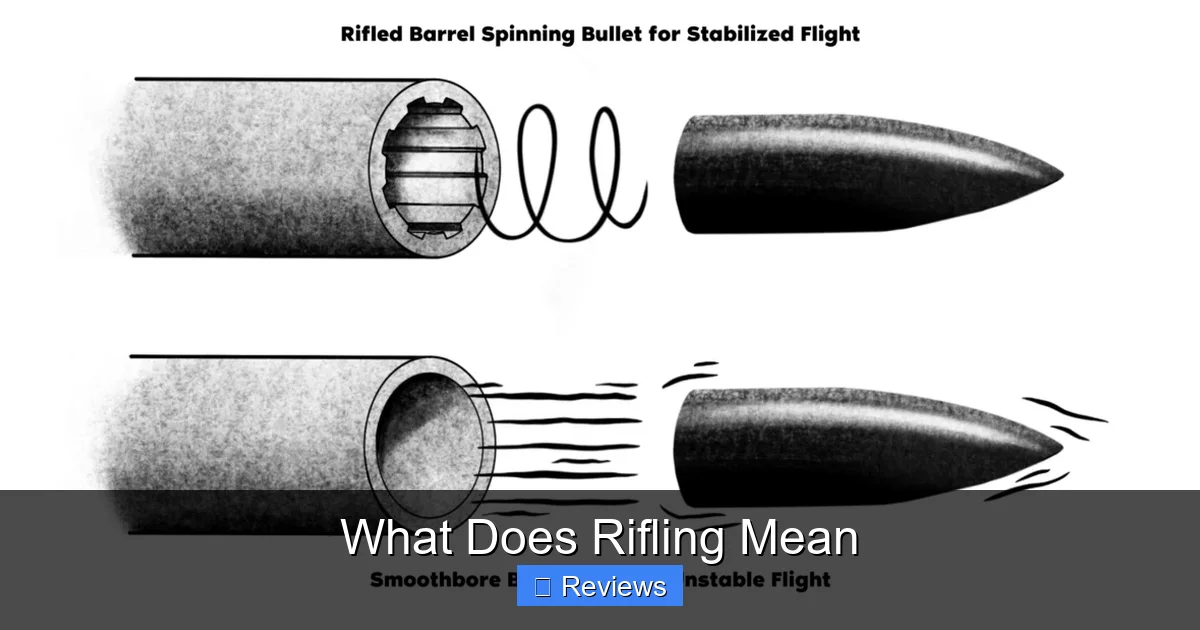
Visual guide about What Does Rifling Mean
Image source: gununiversity.com
External Ballistics and Accuracy
The spin ensures gyroscopic stability. Imagine throwing a frisbee straight; it flies because it spins. If it didn’t spin, it would just wobble and fall. Similarly, the spinning bullet resists aerodynamic forces that would otherwise cause it to pitch or yaw (tumble). This maintains its nose-forward attitude, dramatically reducing drag and enabling it to fly straighter and farther. This stability is the core reason what does rifling mean for target shooters and hunters alike: it means consistency and accuracy.
Impact of Rifling on Firearm Performance
The presence and characteristics of rifling are paramount to a firearm’s performance envelope. Without it, modern shooting sports, hunting, and tactical applications as we know them would simply not exist.
Enhancing Accuracy and Range
This is the most obvious and significant impact. Rifling transforms a short-range, blunt instrument into a precision tool. A smoothbore barrel firing a round ball might be accurate to 25-50 yards; a rifled barrel with a modern bullet can easily achieve accuracy at hundreds of yards, even a mile or more in specialized long-range shooting. The stable flight path ensures that where the barrel points, the bullet tends to go, within the limits of gravity and wind.
Caliber and Bullet Considerations
The specific dimensions and design of the rifling are tailored to the caliber and intended bullet types. A .22LR barrel will have different rifling characteristics (fewer, shallower grooves, different twist rate) than a .50 BMG barrel. Bullet manufacturers design their projectiles to work optimally with common twist rates for a given caliber. For instance, a heavier .223 Remington bullet (like 77 grains) will require a faster twist rate (e.g., 1:7 or 1:8) than a lighter 55-grain bullet (which might be stable in a 1:12 twist).
Maintenance and Barrel Life
The interaction between the bullet and the rifling also affects barrel wear and maintenance. Every time a bullet travels down the barrel, there is friction and erosion. High-pressure, high-velocity rounds wear out rifling faster, particularly near the chamber where heat and pressure are highest (known as “throat erosion”). This wear reduces the effectiveness of the rifling, eventually leading to a loss of accuracy.
Practical Tip: Proper cleaning is essential. Carbon fouling, copper fouling (from bullet jackets), and lead fouling (from unjacketed bullets) can build up in the grooves, altering their profile and reducing accuracy. Using appropriate bore cleaners and brushes can help maintain the rifling’s integrity and extend barrel life. However, over-cleaning with aggressive tools can also damage rifling, so moderation and correct technique are key.
Beyond Firearms: Other Applications of Rifling
While we typically associate what does rifling mean with firearms, the principle of imparting spin to a projectile for stability isn’t exclusively limited to guns. The same physics apply to other applications where a stable trajectory is desired.
Artillery and Cannons
Large-caliber artillery pieces, from howitzers to tank guns, also feature rifled barrels. Imagine the destructive power and range of a modern artillery shell – it would be useless if it tumbled wildly after leaving the cannon. Just like smaller bullets, artillery shells are designed to engage the rifling, spin, and fly true to their target, often many miles away. The scale is different, but the core principle of what does rifling mean for stability remains identical.
Sporting Goods
Even in recreational items, you can find the influence of rifling. Airsoft guns sometimes feature “hop-up” systems that backspin a BB to increase its effective range and accuracy, mimicking the lift generated by a spinning projectile. Similarly, some high-end paintball markers use rifled barrels, although their effectiveness is often debated due to the inconsistent spherical shape of paintballs. The underlying idea, however, is a direct nod to the stabilizing power of spin.
Conclusion
So, what does rifling mean? It’s far more than just a pattern inside a barrel. It’s a critical piece of engineering that transforms an uncontrolled projectile into a precise and stable object, fundamentally dictating the accuracy, range, and overall performance of almost every modern firearm. From its humble beginnings in 16th-century Europe to the advanced manufacturing techniques of today, rifling has been a continuous testament to human ingenuity in the pursuit of greater precision.
Next time you hear the term or look down the bore of a firearm, you’ll know that those helical grooves are not just there by chance. They are the silent, spinning heart of accuracy, allowing bullets to defy gravity and wind, hitting targets with remarkable consistency. It’s a testament to the power of physics applied through clever design, making every shot a testament to this incredible innovation.
🎥 Related Video: How Bullet Spin Works 🤔
📺 Zack D. Films
Frequently Asked Questions
What is the difference between lands and grooves?
Lands are the raised portions inside the barrel that retain the original bore diameter, while grooves are the cut-out channels between the lands. As a bullet passes through, the lands cut into the bullet’s surface, creating a tight seal and imparting spin.
Does rifling wear out?
Yes, rifling does wear out over time due to the friction, heat, and pressure generated with each shot, particularly in high-velocity firearms. This wear, especially throat erosion near the chamber, gradually reduces accuracy and can eventually necessitate barrel replacement.
Is polygonal rifling better than conventional rifling?
Whether polygonal rifling is “better” depends on the application. It can offer higher velocities, longer barrel life, and easier cleaning due to reduced friction and a better gas seal. However, traditional rifling can be more precise in manufacturing and is generally more forgiving with different bullet types, especially unjacketed lead bullets.
Why do some shotguns have smooth bores and others are rifled?
Most shotguns have smooth bores because they are designed to fire multiple small pellets (shot). Rifling would cause the shot pattern to spin and spread out into a donut shape, rendering it ineffective. However, shotguns specifically designed to fire single projectiles (slugs) often have rifled barrels to provide accuracy for these projectiles.
How does rifling affect forensic analysis?
Rifling is incredibly important in forensic analysis. The unique patterns of the lands and grooves leave distinct striations (scratch marks) on a fired bullet. These “ballistic fingerprints” can be matched to a specific firearm, making rifling a crucial tool in crime investigations.
Can you clean a rifled barrel too much?
While cleaning is important, excessive or improper cleaning can potentially damage rifling over time. Using overly aggressive brushes, wrong cleaning rod techniques, or harsh chemicals repeatedly can wear down the delicate rifling lands, leading to a loss of accuracy. It’s important to follow manufacturer recommendations and use appropriate tools.