When asking “what caliber is a sniper rifle,” there’s no single answer; it depends entirely on the mission. Common calibers range from the versatile .308 Winchester for general precision to the powerful .338 Lapua Magnum and .50 BMG for extreme long-range and anti-materiel roles. The ideal caliber balances factors like range, target type, recoil, and ballistic performance to achieve specific objectives.
Imagine the classic image of a sniper: a silent, unseen guardian, delivering pinpoint accuracy from incredible distances. When people ponder such a feat, one of the most common questions that comes to mind is, “what caliber is a sniper rifle?” It’s a perfectly natural question, conjuring images of powerful rounds that defy gravity and wind to hit their mark. However, the answer is far more nuanced than a simple single caliber.
The truth is, there isn’t just one caliber that defines a sniper rifle. Instead, the choice of caliber is a carefully considered decision, dictated by the specific mission, the expected engagement range, the type of target, and even environmental conditions. Military forces and law enforcement agencies around the world utilize a variety of calibers, each selected for its unique ballistic properties and the role it’s intended to fill. It’s a fascinating world where precision, power, and physics collide.
So, if you’ve ever wondered about the heart of these incredibly precise instruments, you’re in the right place. We’re going to dive deep into the diverse world of sniper rifle calibers, exploring the workhorses, the long-range specialists, and the anti-materiel behemoths. By the end, you’ll have a clear understanding of why a sniper might choose one caliber over another, and what makes each one special.
Key Takeaways
- No Single Answer: There isn’t one universal “what caliber is a sniper rifle.” The choice depends on the mission, range, target, and operational environment.
- Versatile .308 Winchester: The .308 (7.62x51mm NATO) is a highly common and versatile sniper rifle caliber, suitable for medium-range precision due to its manageable recoil and widespread availability.
- Long-Range Dominance: For extended ranges, the .300 Winchester Magnum offers increased power and reach, while the .338 Lapua Magnum is a premier choice for extreme long-range precision.
- Anti-Materiel Power: The .50 BMG (12.7x99mm NATO) is primarily an anti-materiel round, capable of engaging light vehicles and equipment at vast distances, though sometimes used against personnel in specific scenarios.
- Emerging Calibers: Newer calibers like the 6.5 Creedmoor are gaining popularity for their excellent ballistic efficiency, lower recoil, and suitability for precision rifle competitions.
- Beyond Caliber: A sniper rifle’s effectiveness isn’t solely about its caliber; it’s a system encompassing rifle quality, optics, ammunition consistency, and the shooter’s skill.
- Mission Dictates Choice: The selection of a sniper rifle caliber is always driven by specific tactical requirements, balancing factors like trajectory, energy, and bullet wind drift.
Quick Answers to Common Questions
What is the most common sniper rifle caliber?
The most common sniper rifle caliber, particularly for medium-range precision, is the .308 Winchester (7.62x51mm NATO) due to its versatility, manageable recoil, and widespread military adoption.
What caliber is used for extreme long-range (ELR) sniping?
For extreme long-range sniping, the .338 Lapua Magnum is widely considered the king, effective out to 1,500 meters and beyond. Specialized calibers like .408 CheyTac also excel in ELR roles.
Is the .50 BMG commonly used against personnel?
While capable of engaging personnel at long ranges, the .50 BMG (12.7x99mm NATO) is primarily an anti-materiel round, designed to neutralize light vehicles, equipment, and other hardened targets due to its immense power.
Why is the 6.5 Creedmoor gaining popularity for precision shooting?
The 6.5 Creedmoor is gaining popularity due to its excellent ballistic efficiency (high ballistic coefficient), relatively mild recoil, inherent accuracy, and effectiveness out to 1,000 yards and beyond.
Does a bigger caliber always mean a better sniper rifle?
No, a bigger caliber doesn’t always mean a better sniper rifle. The “best” caliber depends on the mission’s specific requirements, balancing factors like range, target type, recoil management, and logistics, rather than just raw power.
📑 Table of Contents
Understanding the Role of a Sniper Rifle and its Caliber
Before we dissect specific calibers, it’s crucial to understand what a sniper rifle is designed to do. A sniper rifle is a precision instrument, built for accuracy over range. Its primary function is to place a shot exactly where intended, often under high-stress conditions. The caliber, or the diameter of the bullet, plays a direct role in how well the rifle can perform this task.
Precision vs. Power: The Balancing Act
When we talk about “what caliber is a sniper rifle,” we’re essentially talking about a balance. On one side, you have precision – the ability to hit a small target consistently. On the other, you have power – the ability of the bullet to retain energy and overcome external factors like wind, and to effectively neutralize a target upon impact. A smaller, faster bullet might have a flatter trajectory at shorter ranges, but it might lose energy quickly. A larger, heavier bullet will retain more energy and buck the wind better, but it will often have a more pronounced trajectory arc and produce more recoil.
Factors Influencing Caliber Choice
Several key factors influence the choice of what caliber is a sniper rifle for a given situation:
- Engagement Range: Is the shot expected at 300 yards or 1500 yards? Different calibers excel at different distances.
- Target Type: Is the target a human combatant, light vehicle, or unexploded ordnance? This dictates the required terminal ballistics (how the bullet behaves upon impact).
- Wind Drift: Wind is a sniper’s enemy. Calibers with high ballistic coefficients (BC) and greater mass resist wind drift better.
- Recoil Management: A powerful round often means more recoil, which can make follow-up shots slower and affect shooter fatigue.
- Ammunition Availability and Cost: For training and deployment, readily available and affordable ammunition is a significant advantage.
- Logistics: Military operations need standardized calibers for supply chain simplicity.
Common Sniper Rifle Calibers for Medium to Long Range
Let’s begin our exploration of what caliber is a sniper rifle by looking at the workhorses – those calibers renowned for their versatility and widespread use in scenarios ranging from urban environments to open battlefields.
.308 Winchester (7.62x51mm NATO): The Workhorse
When people ask “what caliber is a sniper rifle,” the .308 Winchester (or its military equivalent, 7.62x51mm NATO) is often the first answer that comes to mind, and for good reason. It is arguably the most common sniper rifle caliber in the world.
Why it’s popular:
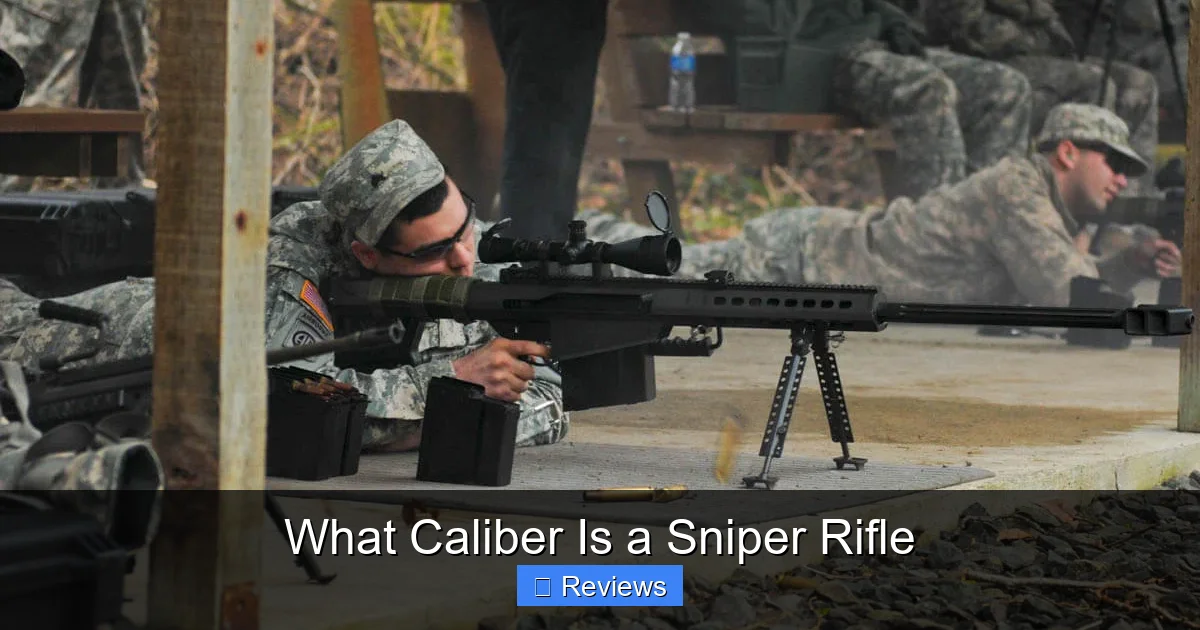
Visual guide about What Caliber Is a Sniper Rifle
Image source: images02.military.com
- Versatility: The .308 is effective from close quarters out to about 800-1000 meters, making it suitable for a wide range of engagements.
- Manageable Recoil: Compared to larger calibers, its recoil is relatively mild, allowing for faster follow-up shots and extended training sessions without excessive fatigue.
- Accuracy: It’s inherently very accurate, with a vast array of match-grade ammunition available.
- Availability: Both the ammunition and rifles chambered in .308 are abundant and generally more affordable than specialized long-range options.
- Military Adoption: Widely adopted by military and law enforcement agencies globally, further cementing its status.
Practical Example: A police sniper on a SWAT team would likely use a .308 Winchester rifle. Its ability to perform precision shots at typical urban engagement distances (100-300 yards) while being easy to handle and readily available makes it ideal for such roles.
.30-06 Springfield: A Classic Still Relevant
The .30-06 Springfield is an older, but still capable, cartridge. Developed in 1906, it served as the primary rifle and machine gun cartridge for the U.S. for over 50 years.
Why it’s used:
- Power: It generally offers slightly more power and a flatter trajectory than the .308 at longer ranges, especially with heavier bullets.
- Historical Significance: Many older military sniper rifles, particularly from the World Wars, were chambered in .30-06.
- Hunting Crossover: It’s an excellent hunting round, so rifles are readily available.
While less common for modern military sniper rifles due to logistical standardization around 7.62x51mm NATO, the .30-06 can still be found in some civilian precision rifles and is historically significant when discussing what caliber is a sniper rifle.
.300 Winchester Magnum: Stepping Up the Power
When the .308 isn’t quite enough, but you don’t need the extreme power of a .338 Lapua, the .300 Winchester Magnum (.300 Win Mag) often steps in. It’s a belted magnum cartridge introduced in 1963.
Why it’s a good choice:
- Increased Range and Energy: The .300 Win Mag significantly extends the effective range beyond the .308, often pushing out to 1,200 meters or more, while delivering substantially more energy on target.
- Flatter Trajectory: It boasts a flatter trajectory, simplifying holdovers at longer distances.
- Military and Civilian Use: Used by some military special operations units and is very popular in long-range hunting and precision shooting competitions.
Tip: If you’re looking to get into precision shooting beyond 1000 yards without jumping straight to the most expensive calibers, the .300 Win Mag is an excellent intermediate step for answering “what caliber is a sniper rifle” for those longer shots.
Dominant Calibers for Extreme Long Range (ELR)
For those truly astonishing shots, where targets are miles away, a different class of caliber is required. These are the giants, designed to defy gravity and wind for maximum effect.
.338 Lapua Magnum: The ELR King
When someone asks “what caliber is a sniper rifle” for extreme long range, the .338 Lapua Magnum (often just “.338 Lapua”) is usually the answer. Developed in the 1980s specifically for long-range military sniping, it has proven itself time and again.
Why it excels:
- Extreme Range: Reliably effective out to 1,500 meters (about a mile) and beyond, with reported successful engagements past 2,000 meters.
- Exceptional Ballistics: Its heavy, high-BC bullets retain energy incredibly well and are highly resistant to wind drift.
- Terminal Performance: Delivers devastating energy on target, making it effective against personnel and even light fortifications.
- Military Standard: Widely adopted by numerous elite military units globally for its unparalleled ELR capabilities.
Practical Example: A military sniper needing to neutralize a high-value target or disable critical equipment from over a mile away, especially in open terrain, would likely rely on a .338 Lapua Magnum system. The precision and energy retention are unmatched by smaller calibers at those distances.
.50 BMG (12.7x99mm NATO): The Anti-Materiel Beast
The .50 BMG is an iconic cartridge, often associated with heavy machine guns like the M2 Browning. When considering “what caliber is a sniper rifle” in the context of anti-materiel roles, the .50 BMG stands alone.
Its primary role:
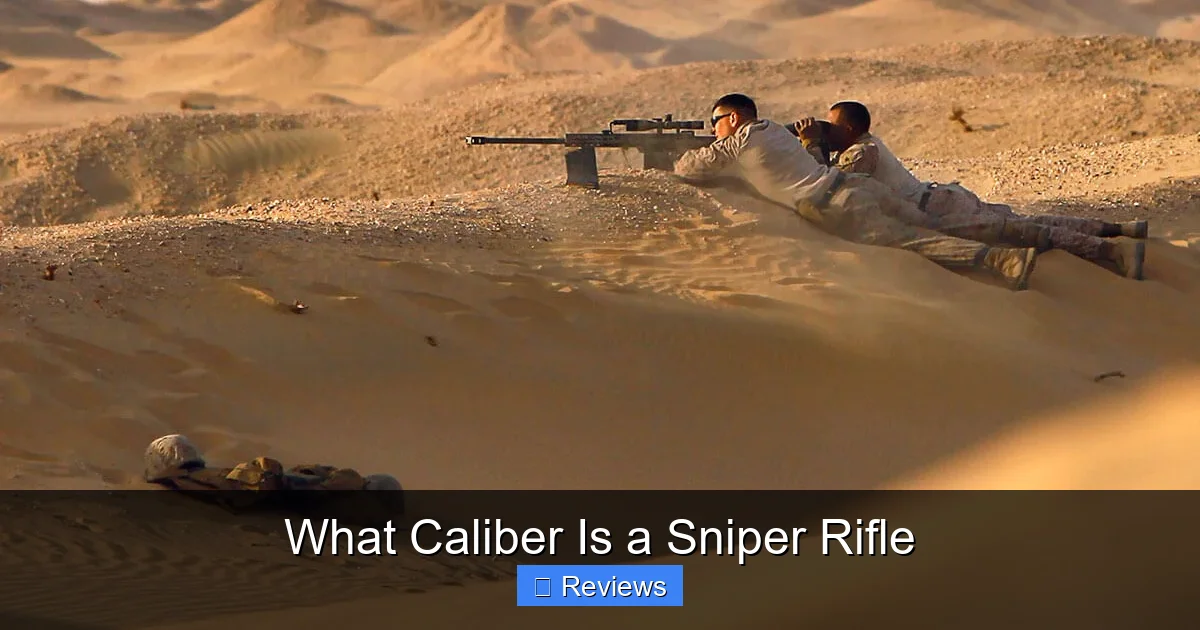
- Anti-Materiel: Designed to engage and defeat light armored vehicles, aircraft, unexploded ordnance, and other hardened targets. It can effectively penetrate engine blocks and disable equipment.
- Extreme Range: While not as precise as the .338 Lapua against human-sized targets at its absolute maximum range, it can engage targets effectively out to 2,000 meters and even further, with incredible energy.
- Sheer Power: The immense kinetic energy delivered by a .50 BMG round is simply unmatched by smaller calibers.
Consideration: While capable of engaging personnel at long ranges, its primary use as a sniper rifle caliber is for anti-materiel applications. Its massive recoil and weight make it less practical for frequent personnel engagement compared to smaller, more precise calibers.
.408 CheyTac and .375 CheyTac: Specialized ELR Options
For those pushing the absolute limits of extreme long-range shooting, specialized calibers like the .408 CheyTac and .375 CheyTac have emerged.
Their niche:
- Hyper-Performance: Engineered to deliver superior ballistic coefficients and reduced drag, allowing for exceptional performance beyond 2,000 meters, sometimes even out to 2,500 meters or more.
- Reduced Recoil (relative to .50 BMG): While still substantial, these calibers offer a more manageable recoil impulse than the .50 BMG, allowing for better shooter control for extreme precision.
- Specialized Role: Primarily found in specialized military applications and elite long-range shooting competitions.
These calibers answer “what caliber is a sniper rifle” for those who absolutely need to touch targets at distances most people can only dream of.
Emerging and Specialized Calibers
The world of firearms is constantly evolving, with new calibers emerging to fill specific niches or improve upon existing designs.
6.5 Creedmoor: Precision and Low Recoil
The 6.5 Creedmoor has taken the precision shooting world by storm in recent years. While not typically a military sniper’s primary caliber, its attributes make it a strong contender for precision rifles and potentially niche sniper roles.
Why it’s gaining popularity:
- Excellent Ballistics: The 6.5mm bullets generally have very high ballistic coefficients for their weight, meaning they fly flat and resist wind effectively.
- Mild Recoil: Compared to .308 or .300 Win Mag, the 6.5 Creedmoor offers significantly less recoil, making it much easier to shoot accurately for extended periods and observe impacts.
- Accuracy: Known for its inherent accuracy, making it a favorite in precision rifle series (PRS) competitions.
- Effective Range: Easily effective out to 1,000 yards and beyond for precision work.
Tip: For new precision shooters or those wanting to hone their skills without the punishing recoil and cost of larger magnum rounds, a rifle chambered in 6.5 Creedmoor is an excellent option to consider. It demonstrates that “what caliber is a sniper rifle” can also lean towards efficiency and ease of use.
7mm Remington Magnum: A Versatile Hunter’s Choice
While less common in dedicated military sniper roles, the 7mm Rem Mag is a powerful and versatile magnum cartridge. It offers a good balance of flat trajectory and energy for long-range hunting and can certainly be adapted for precision shooting. It provides similar long-range capabilities to the .300 Win Mag with slightly less recoil for some shooters.
Other Niche Calibers
Some other calibers might make an appearance in specific sniper contexts:
- .223 Remington (5.56x45mm NATO): While primarily an assault rifle round, .223 precision rifles are used for short-range designated marksman roles or for cost-effective training due to its low recoil and inexpensive ammunition.
- .300 PRC (Precision Rifle Cartridge): A newer cartridge designed specifically for extreme long-range precision, offering improved ballistics over the .300 Win Mag. It’s quickly gaining traction in the ELR community.
More Than Just Caliber: The Rifle System
It’s vital to remember that the answer to “what caliber is a sniper rifle” is only one piece of a much larger puzzle. A sniper rifle’s effectiveness is a holistic combination of many factors.
Ammunition Quality and Consistency
Even the best caliber is useless without high-quality, consistent ammunition. Match-grade ammunition, manufactured to extremely tight tolerances, is critical for achieving sub-minute-of-angle (MOA) accuracy. Bullet weight, powder charge, primer, and case consistency all impact performance.
Optics and Accessories
A high-magnification, reliable scope with clear glass and precise adjustments is non-negotiable. Bipods, adjustable stocks, suppressors, and ballistic computers also play crucial roles in enhancing a sniper’s capability.
The Shooter’s Skill
Ultimately, the most important component of any sniper system is the human element. The shooter’s training, experience, ability to read wind, manage recoil, and execute perfect fundamentals are paramount. Even with the perfect caliber and rifle, an unskilled shooter will miss.
Choosing the Right Caliber for Your Needs
If you’re a civilian interested in precision shooting, or simply trying to better understand military decision-making, considering “what caliber is a sniper rifle” for a specific purpose involves a thoughtful assessment.
Range and Target
Define your primary shooting distance and what you intend to hit.
- Under 600 yards: .308 Winchester or 6.5 Creedmoor are excellent choices.
- 600-1200 yards: .300 Winchester Magnum or 6.5 Creedmoor excel here.
- 1200+ yards (ELR): .338 Lapua Magnum, .408 CheyTac, or .50 BMG are the go-to options.
Budget and Availability
Magnum and ELR calibers, along with their specialized rifles and ammunition, tend to be significantly more expensive than common calibers like the .308 or 6.5 Creedmoor. Also consider ammunition availability, especially in challenging times.
Recoil Tolerance
Be honest about your ability to comfortably manage recoil. Excessive recoil can lead to flinching and poor shooting habits. Start with a milder caliber if you are new to precision shooting.
Conclusion
As we’ve explored, the question “what caliber is a sniper rifle” doesn’t have a single, straightforward answer. It’s a dynamic choice, deeply intertwined with the specific demands of a mission, the environment, and the capabilities of the shooter. From the versatile and widely adopted .308 Winchester that serves as a reliable workhorse for medium-range precision, to the powerful .338 Lapua Magnum dominating extreme long-range engagements, and the formidable .50 BMG reserved for anti-materiel tasks, each caliber has its specialized role.
The ongoing evolution of ballistics and firearm technology continues to introduce new contenders like the 6.5 Creedmoor, offering impressive performance with reduced recoil. Ultimately, a sniper rifle’s effectiveness is a symphony of components – the rifle, the optic, the ammunition, and critically, the skill of the person behind the trigger. So, the next time you hear “what caliber is a sniper rifle,” you’ll know that the true answer lies in understanding the complex interplay of precision, power, and purpose.
🎥 Related Video: One of the best sniper rifles in the world
📺 Polenar Tactical
Sako TRG is one of the best sniper rifles – made in Finland.
Frequently Asked Questions
What is the typical effective range of a .308 Winchester sniper rifle?
A .308 Winchester sniper rifle is typically effective for precision engagements out to about 800-1000 meters (roughly 875-1090 yards). Its capabilities make it suitable for a wide array of medium-range tactical scenarios.
How does the .338 Lapua Magnum compare to the .308 Winchester in terms of range?
The .338 Lapua Magnum significantly outperforms the .308 Winchester in terms of effective range. While the .308 is effective up to about 1000 meters, the .338 Lapua Magnum can reliably engage targets out to 1500 meters and even beyond 2000 meters in capable hands.
Are sniper rifles always bolt-action?
While many traditional and extreme long-range sniper rifles are bolt-action for maximum accuracy and simplicity, there are also semi-automatic sniper rifles or designated marksman rifles (DMRs). These often provide faster follow-up shots but may sacrifice some pinpoint precision found in bolt-action designs.
What is a “ballistic coefficient” and why is it important for sniper rifle calibers?
A ballistic coefficient (BC) is a measure of a bullet’s ability to overcome air resistance during flight. A higher BC indicates that a bullet is more aerodynamic and will retain its velocity and resist wind drift better, which is crucial for accuracy at long distances.
Can a sniper rifle use different types of ammunition for the same caliber?
Yes, a sniper rifle can use different types of ammunition for the same caliber, but the performance will vary. For precision work, match-grade ammunition with specific bullet types (like Sierra MatchKing) is preferred for its consistency and accuracy, while other rounds might be used for training or specific terminal effects.
What role does recoil play in choosing a sniper rifle caliber?
Recoil plays a significant role because excessive recoil can lead to shooter fatigue, slower follow-up shots, and the tendency to flinch, all of which negatively impact accuracy. Milder recoiling calibers like the 6.5 Creedmoor allow for more comfortable training and sustained precision, while heavy-recoiling calibers require more skill and specialized equipment to manage.