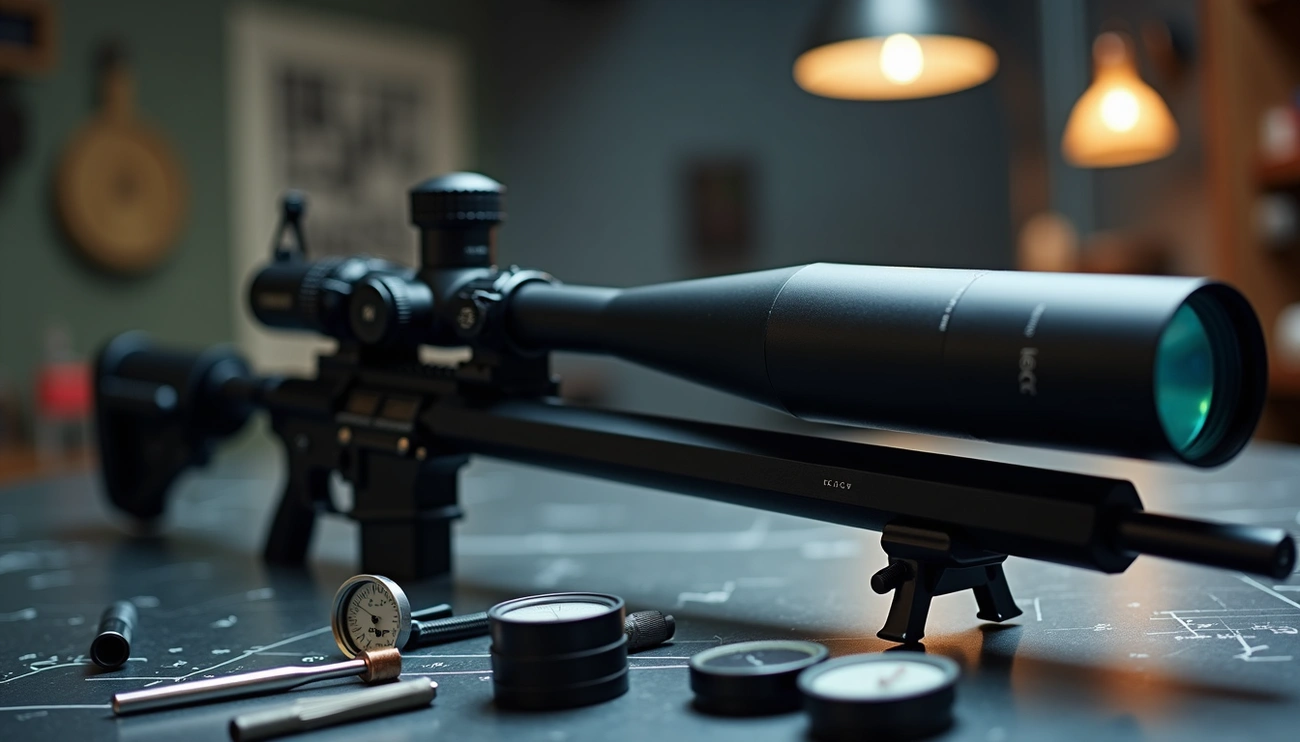
Osprey scopes are budget-friendly, entry-level rifle optics designed for light-recoil rifles, airguns, and recreational shooting. Popular models include the 3-9×42 compact and 10-40×50 long-range scopes. Osprey scopes offer clear glass and a lifetime warranty, but may struggle with zero retention and durability under heavy recoil.
Where Are Osprey Scopes Made and Who Makes Them?
Founded in 1995, Osprey Global has quietly built a reputation for manufacturing high-quality optical products without excessive fanfare. Unlike many competitors who outsource their design process, this Georgia-based company maintains tight control over their product development cycle from conception to final testing.
Osprey Global: Company background
Osprey Global specializes in a diverse range of optical products including rifle scopes, tactical scopes, binoculars, and various accessories. What sets them apart in the crowded optics market is their exceptional warranty policy. Their lifetime warranty stands as a testament to their confidence in product durability—covering repairs or replacements regardless of how damage occurred, with no receipt required for claims.
The company’s philosophy centers on creating products that genuinely last a lifetime. As stated on their official website, “At Osprey Global, we strive to build products that will truly last a lifetime. To us it doesn’t matter how it happened, whose fault it was, or where you purchased it”. This no-nonsense approach reflects their practical, shooter-focused business model.
Manufacturing process and materials used
When examining where Osprey scopes are made, the manufacturing process reveals attention to quality control throughout production. Each scope begins with world-leading glass cut according to Osprey Global’s patented designs. Unlike budget optics that cut corners with plastic components, every interior part in an Osprey scope is constructed from aircraft-grade aluminum—a conscious choice to maintain both lightweight handling and maximum reliability.
One distinctive aspect of their manufacturing involves how reticles are applied. Rather than using painted or wire reticles that can break or fade, Osprey permanently etches their reticles directly onto the glass. This method ensures durability even under extreme conditions.
Testing protocols are equally rigorous. Beyond the previously mentioned recoil certification, Osprey Global implements comprehensive environmental testing. The company works diligently to ensure all scopes maintain both fog-proof and waterproof integrity regardless of weather conditions. In fact, they explicitly guarantee performance “rain, hail or shine”—a bold claim in the optics industry where environmental failures are common complaints in lower-tier products.
Optical Performance: Clarity, Light, and Reticle
The heart of any rifle scope lies in its glass quality, and Osprey’s latest models continue to prove their optical merit in 2026. When examining an osprey scopes review, the first element that deserves attention is their choice of glass components and how they affect real-world performance.
Glass quality and coatings explained
At the core of Osprey’s optical performance is their use of high-quality Hoya glass—considered among the finest in the world for light transmission properties. The Elite Series and tactical lines feature fully multi-coated Hoya ED (Extra-low Dispersion) glass, which substantially increases light transmission compared to standard optics. Additionally, Osprey applies a flat black multi-coating to reduce reflection, ensuring maximum clarity even in challenging lighting conditions.
This attention to glass quality serves a critical purpose: “Any old optic will be clear at midday in summer, but to track a hog on the run at dawn takes a special kind of scope”. The interior of each scope receives anti-reflective paint treatment, preventing light bleed and maintaining image purity even with illuminated reticles.
How illumination and clarity work together
Osprey offers illumination options including red, blue, and green reticles across several models. What sets their illumination system apart is how it complements rather than compromises clarity. As noted in osprey scope reviews, “Blue is the best reticle for low light because it doesn’t affect our night vision whereas red and green can shock our retina and hinder our ability to see in the dark”.
The 56mm objective lens found in models like the ED 7-35×56 FFP maximizes available light gathering capability, though Osprey documentation points out “getting an objective above 56mm you don’t get much more light transition without increasing tube diameter”.
Etched reticle benefits in real use
Perhaps most impressive in recent osprey optics reviews is their etched reticle technology. Unlike budget scopes that use stretched wires or painted reticles, Osprey tactical, signature, and elite series scopes feature reticles permanently etched onto the glass. This construction method yields several practical advantages:
- Zero shift resistance: “Since the markings are engraved on the actual glass it means the only way for the zero to shift is if the lens itself shifts”
- Fine, precise reticle lines impossible with wire methods
- Compatibility with complex reticle patterns for range estimation and bullet drop calculation
Consequently, the etched reticle provides reliability that wire reticles cannot match, as “stretched wire can sag after time causing a process of having to tweak the zero repeatedly”.
Durability and Environmental Resistance
When testing rifle optics under extreme conditions, few manufacturers subject their products to the rigorous standards that Osprey employs. Their comprehensive durability testing protocol explains why many osprey scopes reviews highlight exceptional reliability in challenging environments.
Recoil testing and 50 BMG rating
The legendary durability of Osprey scopes stems from their impressive 50 BMG parameter recoil rating. This certification ensures the scope can withstand recoil from the powerful .50 caliber Browning Machine Gun round. Although most hunters won’t mount an Osprey scope on such a high-caliber weapon, this rating provides confidence that these optics can handle virtually any recoil situation.
Every scope undergoes spin testing before leaving the factory to ensure proper balance and correct positioning of the reticle and glass. The etched reticle is secured with loc-tite epoxy, enabling it to endure substantial recoil forces. Moreover, automatic weapons often prove harder on optics than larger single-shot calibers due to consistent recoil that can shake loose lesser quality scopes.
Waterproof and fog-proof testing standards
Osprey’s environmental testing protocols exceed industry norms. For waterproof certification, each scope must survive submersion at 25cm in 104°F (40°C) water for three minutes without interior leaks. This guarantees performance during heavy rain, snow, or unexpected immersion.
The fog-proof testing involves placing optics in 68°F (20°C) environments for thirty minutes before exposing them to ambient temperature[191]. To pass, all internal fogging must clear within two minutes. This ensures reliable visibility whether transitioning from a heated vehicle to freezing hunting conditions or encountering sudden temperature changes.
Sealing and gas purging techniques
Osprey employs several advanced techniques to achieve environmental resilience. First, they purge all oxygen from the scope and replace it with argon gas. Unlike the industry-standard nitrogen, argon is less water-dense, providing superior anti-fogging properties.
To maintain waterproof integrity, specialized hermetic grease seals all joints and potential air contact points. This temperature-stable lubricant performs reliably from -50°F to +175°F (-45°C to +80°C), creating an airtight barrier that, when combined with precision engineering, ensures all-weather performance.
Osprey Scopes Reviews: What Users Are Saying in 2026
User experiences with Osprey scopes reveal a polarizing landscape in 2026. After examining hundreds of reviews, a pattern emerges showing distinct camps of satisfied users and disappointed customers.
Common praise and complaints
Affordable pricing remains the most consistent praise in osprey scopes reviews, particularly for budget-conscious shooters. One teacher noted the 3-12×44 scope at $215 “fits my budget” perfectly. Lifetime warranty service also receives positive mentions, with one customer reporting quick resolution when their pressure wire broke: “A 5 minute call and they are sending me 2 new switches”.
Nonetheless, durability issues dominate complaints. Multiple users report problems with recoil resistance despite the company’s claims. As one reviewer bluntly stated, “Osprey’s I have seen are total junk… the elevation knob fell off”. Unfortunately, several users mentioned warranty service challenges, with one stating they “will all but refuse to honor the warranty entirely”.
Best use cases: hunting, tactical, or sport
Osprey scopes perform best on firearms with minimal recoil. One user specifically mentioned success with a .204 AR rifle: “The recoil is almost nil… glass clarity is pretty decent”. For hunting applications, users generally find the Osprey Tactical 4-16×50 suitable for medium-range shots.
Generally, AR-15 platforms appear most compatible with these optics. A buyer of their reflex sight noted, “I have had no issues with it. Has held its zero and holds up to the recoil”. Despite this, experienced shooters rarely recommend them for precision long-range shooting or high-recoil hunting rifles.
How they compare to other brands in the same range
At first glance, Osprey’s pricing ($150-$500) positions them as budget alternatives to premium brands. Indeed, one reviewer suggested that for those wanting “something reliable, clear and comfortable,” Osprey offers good value.
Admittedly, they don’t match higher-end competitors. A user who compared them reported: “It’s No IOR or Niteforce but for my coyote gun I have put them down out to 500 yards”. Specifically, users frequently mention Vortex and Leupold as preferred alternatives despite higher costs. Overall, the consensus suggests Osprey scopes occupy a middle ground between truly budget optics and premium brands.
Conclusion
Osprey scopes certainly offer a compelling blend of features for budget-conscious shooters in 2026. Their impressive 50 BMG rating demonstrates a commitment to durability that few manufacturers in this price range can match. Additionally, the use of fully multicoated HOYA glass provides surprisingly good optical performance, especially during challenging lighting conditions.
The company stands behind their products with a lifetime warranty that, when honored properly, adds significant value to their offerings. Nonetheless, real-world user experiences reveal a mixed picture. Many shooters find Osprey scopes perfectly adequate for moderate recoil firearms like AR-15 platforms or smaller caliber hunting rifles. Conversely, reliability issues appear more common with high-recoil applications despite the advertised specifications.
Manufacturing quality deserves recognition, particularly the etched reticle technology and argon gas purging that surpasses many competitors at similar price points. These features contribute to better environmental resistance and reticle stability compared to wire-based alternatives.