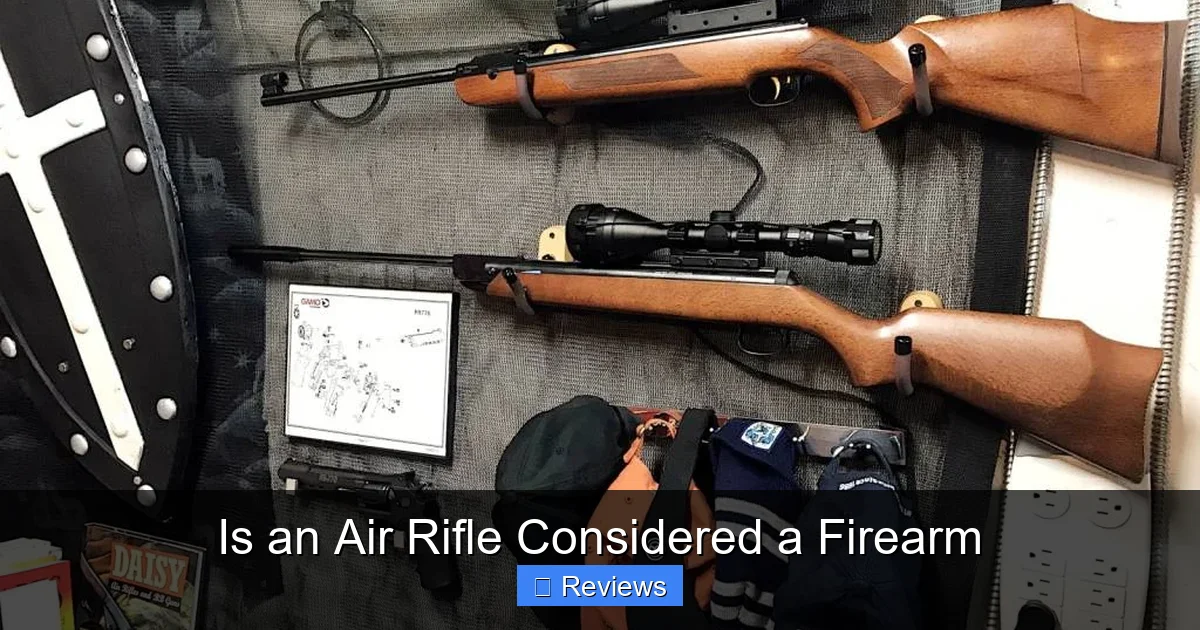
The question of is an air rifle considered a firearm is complex and varies significantly by jurisdiction. Federally, most air rifles are *not* classified as firearms by the ATF, as they don’t use an explosive propellant. However, many state and local laws *do* regulate them similarly to firearms, imposing age restrictions, specific use zones, and even permitting requirements for certain models. Always check your local regulations to ensure compliance and responsible ownership, as the answer to “is an air rifle considered a firearm” can change depending on where you are.
There’s a question that often pops up in discussions about recreational shooting and hunting: “Is an air rifle considered a firearm?” It sounds like a simple question, right? But as with many things in the legal and regulatory world, the answer is far from straightforward. The truth is, it’s a complicated maze of federal, state, and local laws that can leave even seasoned enthusiasts scratching their heads.
The confusion stems from a fundamental difference in how air rifles operate compared to traditional firearms. One relies on compressed air or gas, while the other harnesses the explosive power of gunpowder. This mechanical distinction forms the basis for legal definitions, yet different jurisdictions draw their lines in very different places. What might be perfectly legal and unregulated in one state could land you in serious trouble just across the border.
So, whether you’re considering an air rifle for target practice, pest control, or small game hunting, understanding its legal status is paramount. This article will delve into the nuances of federal, state, and local laws, explain the key differences that matter, and arm you with the knowledge to answer “is an air rifle considered a firearm” in your specific situation. Let’s clear up the confusion together.
Key Takeaways
- Federal vs. State Discrepancy: Federally, the ATF generally does not classify air rifles as firearms because they do not use an explosive propellant. However, many states and local municipalities *do* classify and regulate them as firearms or similar weapons, especially high-powered models.
- Propellant is Key: The primary legal distinction hinges on the method of propulsion. Firearms use a chemical explosion (gunpowder), while air rifles use compressed air, CO2, or a spring mechanism.
- Varied State Regulations: States like New Jersey, Michigan, New York, and California have specific laws that can classify certain air rifles as firearms or restrict their ownership and use, including age limits and power restrictions.
- Local Ordinances Matter Most: Even if a state doesn’t classify air rifles as firearms, local cities and counties often have strict ordinances regarding discharge, possession in public, and even specific types of airguns.
- Age Restrictions Are Common: Regardless of firearm classification, nearly all jurisdictions impose age restrictions (typically 18, sometimes 16 with supervision) for purchasing and using air rifles.
- Treat Them Responsibly: Regardless of legal classification, air rifles are dangerous weapons capable of serious injury or death. Always treat an air rifle with the same respect and safety precautions as a traditional firearm.
- Always Check Local Laws: The most crucial takeaway is that the answer to “is an air rifle considered a firearm” is highly location-dependent. Before purchasing or using an air rifle, you *must* research and understand the specific federal, state, and local laws applicable to your area.
Quick Answers to Common Questions
Is an air rifle considered a firearm by the ATF?
Generally, no. The ATF defines a firearm as a device that expels a projectile by the action of an explosive. Air rifles use compressed air or gas, not an explosion, so they typically fall outside the federal definition.
Are there any states where an air rifle is considered a firearm?
Yes, several states, such as New Jersey and Massachusetts (for certain models), classify air rifles as firearms or subject them to similar regulations based on criteria like muzzle velocity or caliber.
Do I need a background check to buy an air rifle?
Federally, no background check is required for air rifle purchases. However, some states or local jurisdictions that classify air rifles as firearms may require background checks or permits.
Can a minor own or use an air rifle?
Purchasing an air rifle usually requires being 18 years old. Minors can often use an air rifle under direct adult supervision, but specific laws vary by state and local municipality.
What is the most important thing to know about air rifle laws?
The most important thing is that laws are highly location-specific. Always check your specific federal, state, and local regulations before purchasing, transporting, or using an air rifle to ensure compliance.
📑 Table of Contents
Defining “Firearm”: A Legal Labyrinth
To understand whether an air rifle is considered a firearm, we first need to look at what exactly defines a “firearm” in the eyes of the law. This is where the core of the confusion lies, as definitions can vary dramatically.
The Federal Stance: What the ATF Says
On a federal level, the Bureau of Alcohol, Tobacco, Firearms and Explosives (ATF) is the primary agency responsible for interpreting and enforcing gun laws. The ATF’s definition of a “firearm” generally focuses on devices that expel a projectile by the action of an explosive. This is crucial because it directly addresses the propellant used.
- Explosive Propellant: Traditional firearms use gunpowder, which creates an explosion within the chamber to propel a bullet down the barrel. This chemical reaction is the key.
- Air Rifles Don’t Qualify: Since air rifles use compressed air, CO2, or a spring to launch pellets or BBs, they do not rely on an explosive propellant. Therefore, under federal law, most air rifles are generally *not* considered firearms. This means they typically aren’t subject to the same federal regulations, such as NICS background checks or transfers through a Federal Firearms License (FFL) holder.
However, it’s important to note that this federal definition isn’t the end of the story. It merely sets a baseline. States and local municipalities are free to implement their own, often stricter, definitions and regulations.
State and Local Interpretations: Where Things Get Tricky
While the federal government offers a general guideline, many states and local governments take a different approach. They might broaden the definition of a “weapon” or “firearm” to include devices that propel a projectile, regardless of the propellant type. This is why the question “is an air rifle considered a firearm” becomes so location-specific.
- Broad Definitions: Some states define firearms based on the potential to inflict serious harm, or simply as any device that can discharge a projectile. This broader scope can easily encompass air rifles, especially high-powered models.
- Energy or Velocity Thresholds: A common approach at the state level is to classify an air rifle as a firearm if its muzzle energy (measured in foot-pounds or joules) or velocity (measured in feet per second) exceeds a certain threshold. For example, an air rifle might be considered a firearm if it shoots a projectile over a specific FPS or delivers more than a certain amount of energy.
Understanding these differing legal definitions is the first step toward responsible air rifle ownership. Never assume that federal non-classification means you’re free from state or local rules.
The Mechanics of an Air Rifle: Why It’s Different
The core reason why federal law often distinguishes an air rifle from a firearm lies in its fundamental operating mechanism. Let’s break down how air rifles work and why this matters legally.
Visual guide about Is an Air Rifle Considered a Firearm
Image source: allaboutairrifles.com
How an Air Rifle Operates
Air rifles are pneumatic devices. This means they use compressed gas to propel a projectile. There are several common types:
- Spring-Piston: These are very common. When you cock the rifle, a spring is compressed. Pulling the trigger releases the spring, pushing a piston forward rapidly. This compresses air in a cylinder, which then forces the pellet out of the barrel.
- PCP (Pre-Charged Pneumatic): PCP air rifles have a built-in air reservoir that is pre-filled with high-pressure air using a hand pump, scuba tank, or compressor. When the trigger is pulled, a valve opens, releasing a precisely metered amount of air to propel the pellet. These are often very powerful and accurate.
- CO2: These air rifles use small, disposable cartridges of compressed carbon dioxide (CO2). A piercing mechanism in the gun allows the CO2 to flow into the firing chamber when the trigger is pulled, pushing the projectile.
- Gas Ram: Similar to spring-piston, but instead of a coil spring, they use a sealed gas strut (like a miniature shock absorber) to compress air. This offers a smoother shot cycle and can be left cocked for longer without spring fatigue.
In all these cases, there is no combustion, no primer, and no explosive gunpowder. The energy comes from stored mechanical force or compressed gas, not a chemical explosion.
Contrast with Traditional Firearms
Compare this to a traditional firearm:
- Primer Ignition: When the firing pin strikes the primer, it ignites a small explosive charge.
- Gunpowder Combustion: This ignition then sets off the main charge of gunpowder, which burns rapidly and creates a massive volume of hot, expanding gases.
- Projectile Propulsion: This intense pressure is what forcefully propels the bullet down the barrel at very high speeds.
This fundamental difference in propellant is what allows the federal government to say “is an air rifle considered a firearm? No, not usually.” However, states and cities often focus on the *result* – a projectile being fired with significant force – rather than the *method*.
Federal vs. State Laws: A Patchwork of Regulations
The answer to “is an air rifle considered a firearm” is primarily determined by where you live. What’s legal in Texas might be a felony in New Jersey. Let’s explore this patchwork of regulations.
The Federal Hands-Off Approach (Mostly)
As established, the ATF generally does not regulate air rifles as firearms. This means:
- No federal background checks are required for purchase.
- No federal age limits beyond those for general contractual agreements (though most retailers impose their own 18+ policy).
- They are not restricted under federal laws pertaining to machine guns, short-barreled rifles, or suppressors (though some states might have their own rules regarding airgun silencers).
This federal stance means that for the vast majority of air rifle owners, federal laws are not a significant concern regarding firearm classification. However, this is where the states step in.
States Where Air Rifles Get Firearm Treatment
Several states have enacted laws that specifically classify certain air rifles as firearms or apply similar restrictions. This is a critical aspect when asking “is an air rifle considered a firearm?”
- New Jersey: NJ has some of the strictest laws. Any air gun that can “expel a projectile by the force of an explosion or other form of energy” is considered a firearm. This broadly includes air rifles, and they are subject to the same purchase permits, registration, and transportation laws as traditional firearms.
- Michigan: Air guns exceeding .177 caliber or having a muzzle velocity greater than 700 feet per second (FPS) are classified as “firearms.” This means they can be openly carried but not concealed, and specific rules apply to their possession.
- New York: New York City, for example, classifies airguns as “firearms” and requires a permit to possess them. New York State law also has specific regulations regarding airgun sales and possession.
- California: While not universally classified as firearms, California has specific regulations regarding airguns, including age restrictions (18+ to purchase) and requiring them to be treated as firearms in terms of safe handling and transport in vehicles. There are also restrictions on certain replica firearms, including airsoft guns that resemble real firearms.
- Massachusetts: Airguns with a muzzle velocity exceeding 600 FPS are considered “firearms” and require a Firearm Identification (FID) card for possession.
These examples highlight the diverse ways states handle the classification. It’s not always a blanket “yes, it’s a firearm,” but often contingent on caliber, muzzle velocity, or location within the state.
Local Ordinances: The Final Layer of Complexity
Even if your state has a relaxed view on whether an air rifle is considered a firearm, your city or county might have very strict local ordinances. These local laws often dictate:
- Discharge Restrictions: Many cities prohibit the discharge of any projectile-firing device, including air rifles, within city limits or in residential areas, even on private property.
- Possession in Public: Some localities might prohibit carrying air rifles openly or concealed in public spaces, even if the state allows it.
- Specific Airgun Bans: Rare, but some extremely restrictive municipalities might ban certain types of airguns altogether.
Always assume that local laws will be the most restrictive. Ignorance of these local ordinances is not a valid defense if you find yourself facing charges.
Specific Regulations and Restrictions You Need to Know
Beyond the primary classification of “is an air rifle considered a firearm,” there are various other regulations that owners need to be aware of. These apply regardless of whether the air rifle is legally a firearm in your area.
Age Requirements for Purchase and Use
This is one of the most consistent regulations across the board. While a minor might technically be able to *use* an air rifle with adult supervision in many places, purchasing one is almost universally restricted:
- 18 Years Old: Most states and retailers require you to be at least 18 years old to purchase an air rifle.
- Supervised Use for Minors: Minors (under 18) are often allowed to use air rifles for target shooting or hunting if they are under the direct supervision of an adult who is legally able to possess the air rifle. Always check local laws regarding minor possession.
Permits and Licensing
As mentioned, some states (like New Jersey and Massachusetts for certain power levels) require permits or licenses similar to those for traditional firearms. This is not common federally, but if “is an air rifle considered a firearm” in your state, then permits might be required.
- Firearm Identification (FID) Card: In states like Massachusetts, if your airgun meets the definition of a firearm, you’ll need an FID card.
- Handgun Purchase Permits: In NJ, air pistols require a pistol purchase permit. Air rifles require a firearms purchaser ID card.
Transportation Laws
Even if an air rifle isn’t a firearm, common sense and many state laws dictate how you transport it.
- Cased and Unloaded: It’s always best practice to transport your air rifle in a case, unloaded, and separate from ammunition (pellets/BBs). This prevents accidental discharge and avoids alarming the public or law enforcement.
- Vehicle Storage: Some states have laws regarding how any “weapon” (which could include an air rifle) must be stored in a vehicle, such as in the trunk or a locked compartment, rather than easily accessible in the passenger cabin.
Hunting Regulations for Air Rifles
Hunting with an air rifle is becoming increasingly popular, but it’s heavily regulated. State wildlife agencies set specific rules:
- Permitted Game: Most states limit air rifle hunting to small game (squirrels, rabbits), varmints, and some non-game species. Very few allow it for larger game like deer, and those that do often specify very high-powered PCP air rifles in large calibers.
- Caliber and Energy Requirements: There are often minimum caliber and muzzle energy requirements for hunting specific animals to ensure a humane kill.
- Seasons and Zones: Air rifle hunting is subject to the same hunting seasons, bag limits, and designated hunting zones as other forms of hunting.
Always check your state’s Department of Natural Resources or Fish and Wildlife website for current air rifle hunting regulations.
Muzzle Energy/Velocity Limits
This is a critical point where an air rifle might cross the line into firearm classification. As noted for Michigan and Massachusetts, exceeding a certain FPS or muzzle energy threshold can change the legal status of an air rifle. These limits are often designed to differentiate between low-power “toy” airguns and high-power air rifles capable of significant harm.
Responsible Ownership and Practical Considerations
Regardless of whether an air rifle is considered a firearm in your jurisdiction, responsible ownership is non-negotiable. These are powerful tools, not toys, and must be treated with the utmost respect.
Always Practice Firearm Safety Rules
This is the golden rule. Even if your air rifle isn’t legally a firearm, treat it exactly like one:
- Assume it’s loaded: Even if you know it’s empty, always handle it as if it could fire.
- Never point at anything you don’t intend to shoot: Keep the muzzle in a safe direction.
- Keep your finger off the trigger until ready to shoot: Rest it alongside the frame.
- Be sure of your target and what is beyond it: Pellets can travel surprisingly far and penetrate many materials.
These four rules are the foundation of all shooting sports and are just as vital for air rifles as they are for gunpowder firearms.
Safe Shooting Locations
Understanding where you can legally and safely discharge an air rifle is critical. This ties directly into local ordinances.
- Private Property: If you own private land, you might be allowed to shoot, but you must be absolutely certain about your backstop, projectile travel, and local noise ordinances. Always notify neighbors as a courtesy.
- Designated Ranges: Airgun ranges or multi-purpose shooting ranges are the safest and most legal places to practice.
- Hunting Areas: If you’re hunting, ensure you’re in a designated hunting zone and have all necessary permits.
Never shoot in public parks, residential backyards without checking laws, or any area where you cannot guarantee the safety of others and property.
Secure Storage
Just like firearms, air rifles should be stored securely to prevent unauthorized access, especially by children. A locked gun cabinet or safe is ideal. Remove pellets and CO2 cartridges before storage. This is a crucial safety measure that reinforces the serious nature of the question, “is an air rifle considered a firearm?” even if legally it is not.
Stay Informed
Laws can change. What was legal last year might not be this year. Make it a habit to periodically check the websites of your state’s attorney general, local sheriff’s department, and city ordinances. When in doubt, contact law enforcement directly for clarification. Never rely solely on online forums or anecdotal evidence.
Conclusion
The question “is an air rifle considered a firearm” is anything but simple. Federally, the answer is generally no, due to the absence of an explosive propellant. However, this federal stance is frequently overridden by a complex web of state and local laws that may classify air rifles as firearms or impose similar stringent regulations, often based on factors like muzzle velocity, caliber, or the specific location of ownership.
From age restrictions and permitting requirements in some states to strict discharge ordinances in countless municipalities, the legal landscape for air rifle owners is highly fragmented. The most crucial takeaway is the absolute necessity of due diligence. Before you purchase, transport, or use an air rifle, you must thoroughly research and understand the specific federal, state, and local laws that apply to your situation.
Ultimately, regardless of its legal classification, an air rifle is a capable weapon that demands respect and responsible handling. Treating it with the same rigorous safety protocols as a traditional firearm is not just smart, it’s essential for preventing accidents and ensuring lawful, enjoyable ownership. Stay informed, stay safe, and always know the laws that apply to whether an air rifle is considered a firearm in your specific location.
🎥 Related Video: World's Most Powerful Break Barrel Air Rifle! #gun #airgunning #airgun #shorts
📺 BLOCKETH OUTDOORS
Frequently Asked Questions
Are air rifles regulated the same as traditional firearms?
No, not universally. While federal law generally differentiates them, many state and local governments impose regulations on air rifles that are similar to those for traditional firearms, including age restrictions, permitting, and use restrictions.
What makes an air rifle different from a firearm in a legal sense?
The key legal difference often lies in the propellant. Firearms use an explosive chemical reaction (gunpowder), whereas air rifles use non-explosive compressed air, CO2, or spring mechanisms to propel a projectile.
Can I hunt with an air rifle?
Hunting with an air rifle is permitted in many states, but regulations vary significantly. You must check your state’s specific game laws for allowed species, caliber requirements, muzzle energy minimums, and hunting seasons.
Is it safe to store an air rifle loaded?
No, it is never safe to store any projectile-firing device, including an air rifle, loaded. Always unload your air rifle and store it securely to prevent accidental discharge and unauthorized access, especially by children.
What should I do if I’m unsure about air rifle laws in my area?
If you are unsure about the laws regarding air rifles in your specific area, you should consult your state’s attorney general’s office, local law enforcement (police or sheriff’s department), or a qualified legal professional specializing in firearms law. Do not rely solely on internet forums.
Do local laws always override state or federal laws regarding air rifles?
Local ordinances often add additional restrictions on top of state and federal laws. While they cannot contradict higher laws, they can impose stricter rules, especially concerning discharge within city limits or public possession. Always adhere to the most restrictive applicable law.