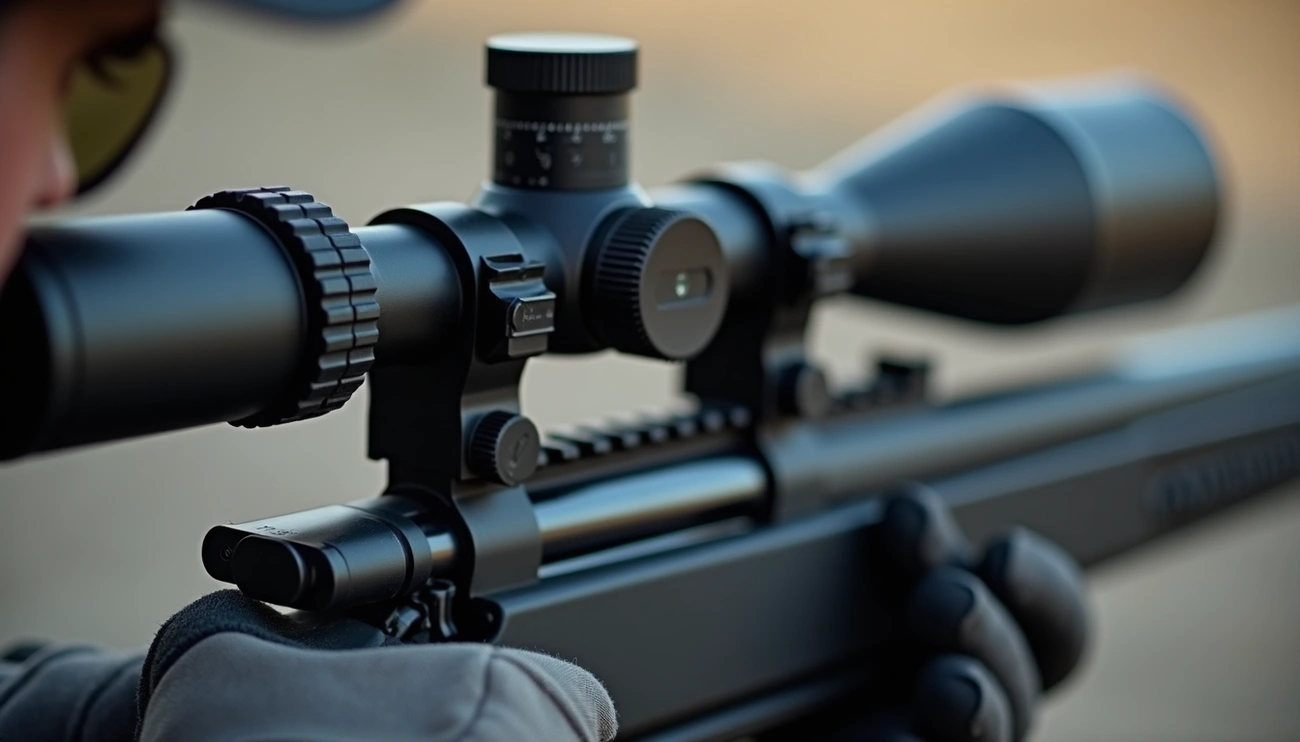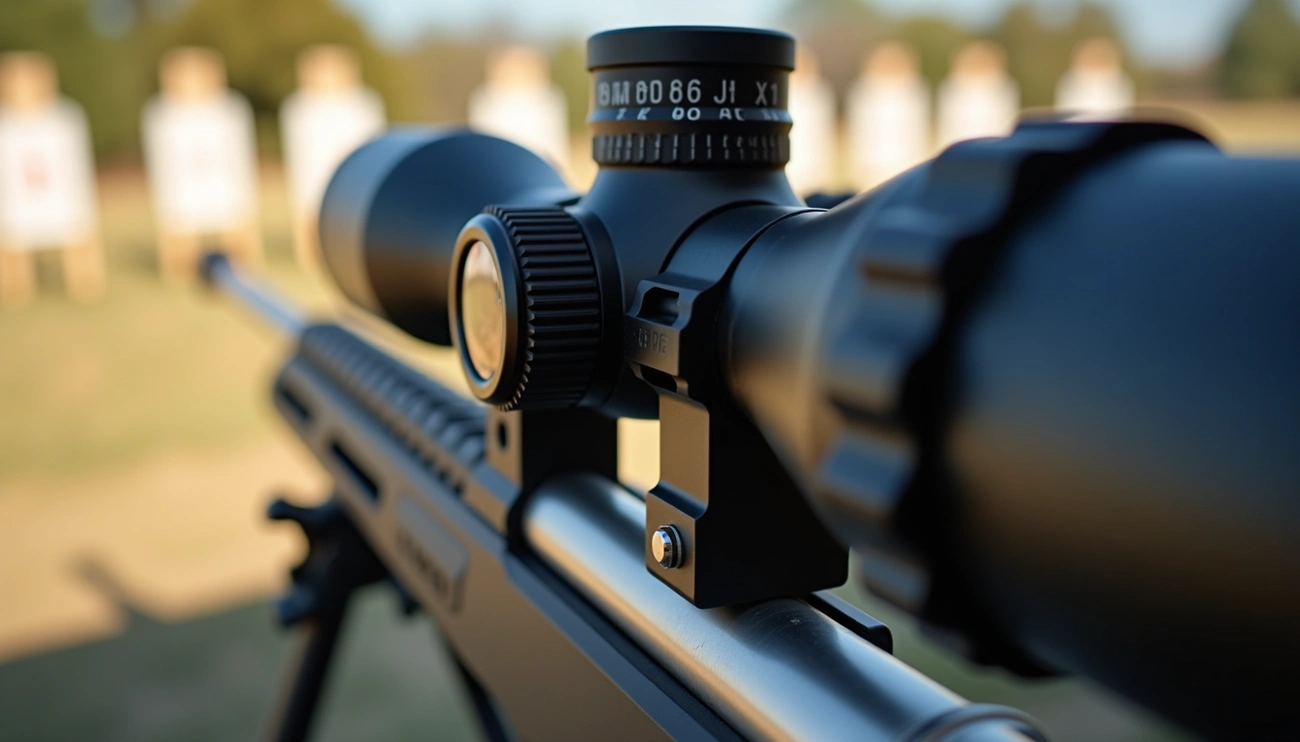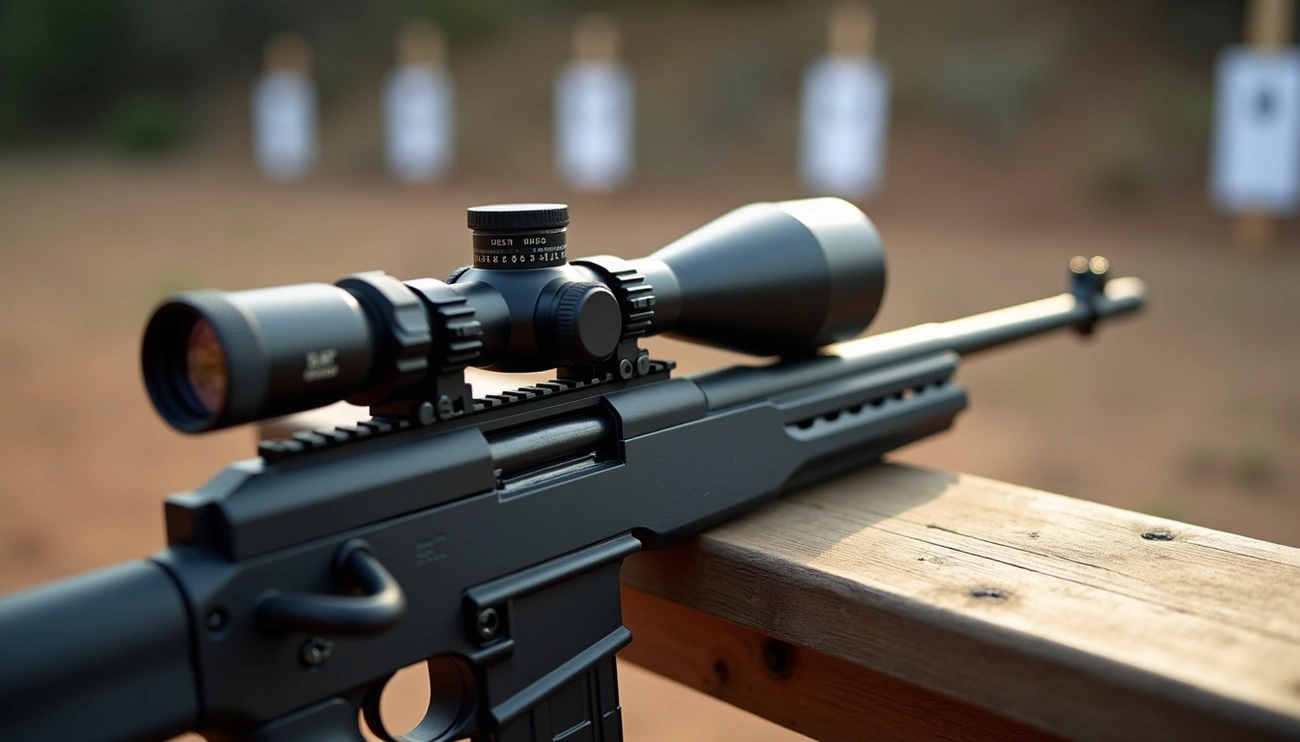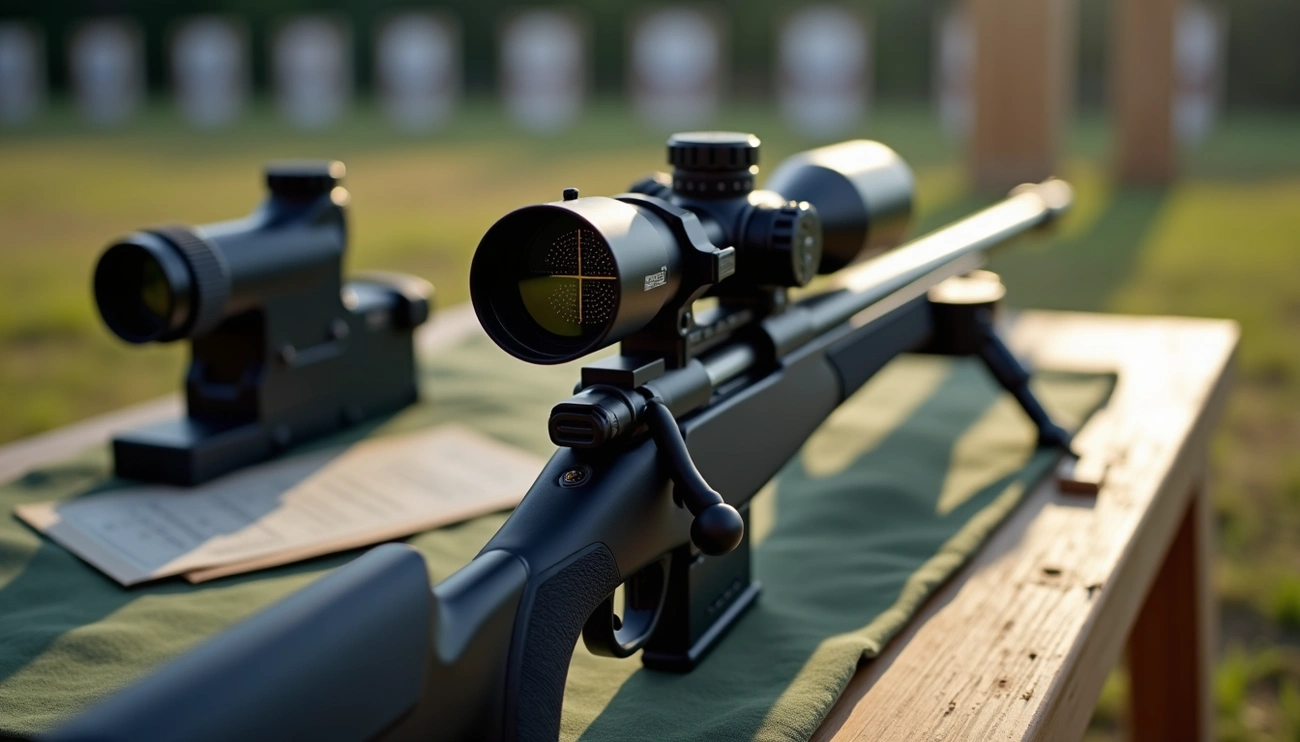
Use mil dots on a rifle scope by measuring the target with the dots to estimate distance, then holding or dialing for bullet drop and wind. Calculate range with the formula: Distance (yards) = (Target height in yards × 1000) ÷ mils measured. One mil equals about 3.6 inches at 100 yards.
Understanding Mil-Dot Reticles
Contrary to popular belief, “mil” in mil-dot reticle doesn’t stand for military. Rather, it’s shorthand for milliradian, an angular measurement that forms the foundation of this precision aiming system.
What is a mil and how is it measured?
A milliradian is precisely 1/1000th of a radian. To understand this concept, imagine a circle with radius lines extending from the center to the circumference. A radian is the angle created when the arc length equals the radius length. Since there are approximately 6.283 radians in a circle, this gives us roughly 6,283 milliradians in a complete circle.
The beauty of the mil system lies in its proportional nature. At 100 yards, 1 mil equals 3.6 inches. As distance increases, this measurement scales proportionally – at 500 yards, 1 mil represents 18 inches, and at 1000 yards, it equals 36 inches (or 1 yard). Similarly, 1 mil at 100 meters equals 10 centimeters.
How mils differ from MOA
Although both mils and Minutes of Angle (MOA) measure angles, they differ significantly in several ways:
First, mils are considerably larger than MOA – 1 mil equals approximately 3.438 MOA. Additionally, mil-based scopes typically adjust in 0.1 mil increments, while MOA scopes usually adjust in quarter-MOA clicks.
Moreover, the mil system works well with both metric and imperial measurements. As one shooter noted, “Mil is base 10, so it’s easier to mentally track for most people”. This makes calculations more straightforward, especially during field adjustments.
How mil-dot reticles are structured
A standard mil-dot reticle features a specific pattern of dots placed along horizontal and vertical crosshairs. The dots themselves don’t equal one mil – rather, the space from the center of one dot to the center of the adjacent dot equals exactly one mil.
Typically, mil-dot reticles contain four dots placed along each axis, with each dot measuring 0.2 mil in diameter. This precise spacing allows shooters to:
- Estimate range to targets of known size
- Calculate holdovers for bullet drop
- Measure wind drift for accurate horizontal adjustments
Notably, first focal plane (FFP) scopes maintain consistent mil measurements regardless of magnification, while second focal plane (SFP) scopes only provide accurate mil measurements at specific magnification settings, usually maximum power.
Using Mil-Dots for Range Estimation
Range estimation is perhaps the most practical application of mil dot reticles. Once I learned how to use these markings effectively, my shooting accuracy improved dramatically across various distances.
Mil dot range formula explained
The core of range estimation with mil dots uses a straightforward mathematical relationship. The formula is: Target size (in inches) × 27.77 ÷ Target size (in mils) = Distance (in yards).
To clarify, if you’re working with metric measurements, the formula becomes: Target size (in centimeters) ÷ Target size (in mils) × 10 = Distance (in meters).
These formulas work because a mil represents a specific angular measurement that widens proportionally with distance – exactly 3.6 inches at 100 yards or 36 inches at 1,000 yards.
How to estimate distance using known target size
Firstly, identify an object with a known size. Subsequently, measure how many mils it spans in your scope. For example, if a 6-foot (2-yard) target spans 8 mils in your scope, the distance would be: 2 × 1000 ÷ 8 = 250 yards.
Accuracy depends on precise estimations. Even small errors can lead to significant miscalculations – a 5-foot target (1.67 yards) spanning 2.8 mils is 596 yards away, not 500 yards.
Examples of bracketing with mils
Bracketing involves placing the target between specific markings on your reticle. For instance, a bird measuring approximately 200mm that brackets between a five-mil spacing would be about 40 meters away (200mm ÷ 5 = 40m).
Likewise, if a rabbit’s body (approximately 150mm tall) spans 3 mils, it’s about 50 meters away.
First focal plane (FFP) scopes maintain consistent bracketing regardless of magnification, whereas second focal plane (SFP) scopes provide accurate measurements only at specific magnification settings.
Using mil-dot rulers and analog tools
The Mildot Master is an analog calculator designed like a slide rule that performs logarithmic calculations. This tool enables:
- Quick calculation of range to target
- Calculation of sight corrections for bullet drop and wind drift
- Compensation for uphill/downhill shooting angles
Consequently, even without electronics, you can make precise calculations in the field.
Compensating for Bullet Drop and Wind
Once you’ve mastered range estimation, the next challenge becomes accounting for bullet trajectory and wind effects. The mil-dot reticle excels at both tasks when used correctly.
How to calculate bullet drop in mils
To calculate bullet drop using mil dots, first obtain your round’s trajectory data. At 100 yards, one mil equals 3.6 inches, expanding to 36 inches at 1000 yards. For instance, a .308 rifle firing 168-grain boat tail match rounds with a 100-yard zero will impact 35.5 inches low at 400 yards.
Divide the drop in inches by the mil size at your target distance. For example:
- 400-yard drop: 35.5 inches ÷ 14.4 inches per mil = 2.5 mils holdover
- 500-yard drop: 59.7 inches ÷ 18 inches per mil = 3.3 mils holdover
Using mils for windage correction
Wind correction follows identical principles. Assess wind speed and direction, then determine lateral drift in inches. Henceforth, convert this measurement to mils by dividing by the mil size at that distance.
With mil-based turrets, each click typically represents 0.1 mil. After estimating a 3-mil wind drift, simply dial 30 clicks or hold 3 mils into the wind. Remember – always correct into the wind direction.
Real-world examples with ballistic charts
Consider a Winchester .308 with RWS KS 10.7g bullets at 300 meters. According to ballistic charts, bullet speed drops from 800 m/s to 556 m/s, creating a 570mm deflection. Your elevation correction would be approximately 1.9 mils.
Why practice matters more than math
Despite precise calculations, wind reading remains among shooting’s most challenging skills. Undoubtedly, the fastest way to improve involves carrying a wind meter, guessing speeds, then verifying. Moving targets present even greater challenges – start with slow speeds, gradually increasing as your skills develop.
Making Scope Adjustments and Choosing the Right Setup
Perfect scope adjustment depends on understanding how reticle measurements translate to physical turret movements. Let me guide you through mastering this critical skill.
How to convert mils to turret clicks
Most modern mil scopes feature 0.1 mil adjustments, meaning 10 clicks equal 1 full mil. Given that 1 mil equals 3.6 inches at 100 yards, each click moves your point of impact 0.36 inches. In effect, for a .270 rifle shooting at 500 yards with 73 inches of bullet drop, you’d calculate: 73÷18=4.06 mils (rounded to 4.1), requiring 41 total clicks on your elevation turret.
FFP vs SFP scopes: what matters for mil-dot use
First Focal Plane (FFP) scopes position the reticle before the magnification lens, allowing it to scale proportionally as magnification changes. This means mil measurements remain accurate at any magnification level. Conversely, Second Focal Plane (SFP) scopes place the reticle behind the magnification system, keeping reticle size constant. As a result, mil measurements are only accurate at specific magnification settings—typically maximum power. Overall, FFP offers consistency but comes with a higher price point and learning curve.
Tips for zeroing your scope with mils
For zeroing with mil turrets:
- Identify your scope’s adjustment interval (typically 0.1 mil per click)
- After firing a group, read the mil value of your offset directly through the reticle
- Adjust your turrets by the exact mil measurement observed (example: “down 1.7 and right 1.5 mils”)
- Remember—zeroing isn’t training but a maintenance procedure to prepare your weapon
In truth, the reticle acts as a built-in ruler that matches your turret adjustments, making corrections intuitive once you understand the system.
Conclusion
Mastering mil dot reticles ultimately transforms ordinary shooters into precision marksmen. Throughout this guide, we’ve explored how these powerful tools leverage angular measurements to calculate distances with remarkable accuracy. Mil dots serve far beyond simple aiming points – they provide a comprehensive system for range estimation, bullet drop compensation, and windage adjustments.
Additionally, understanding the fundamental differences between first and second focal plane scopes proves crucial when selecting the right equipment for your shooting style. FFP scopes maintain consistent mil measurements regardless of magnification, while SFP options require specific settings for accurate readings. This knowledge directly impacts field performance when seconds matter most.
Remember that practice matters more than perfect calculations. Even the most sophisticated mil dot system requires regular field testing to develop intuitive shooting skills. Many experienced shooters agree that time spent practicing wind reading and range estimation pays greater dividends than memorizing formulas alone.