Navigating the world of short barrel rifles (SBRs) requires careful attention to federal regulations. This article demystifies how to register a short barrel rifle, guiding you through the essential steps, from understanding NFA rules to submitting your ATF forms. Learn about the different ownership paths and post-registration responsibilities to ensure full compliance and responsible enjoyment of your SBR.
So, you’ve been thinking about getting a short barrel rifle (SBR). Maybe you like the compact size, the maneuverability, or the unique aesthetic. Whatever your reason, diving into SBR ownership is an exciting prospect. However, it’s also a journey that requires careful navigation through federal regulations. Unlike your standard rifle, SBRs are highly regulated under the National Firearms Act (NFA). This means there’s a specific process you need to follow, and skipping a step can lead to serious legal trouble.
Don’t let the legal jargon intimidate you. While the process of registering an SBR might seem a bit daunting at first, it’s entirely manageable when you break it down. Think of this article as your friendly guide, walking you through each stage, step-by-step. We’ll cover everything from understanding what an SBR actually is in the eyes of the law to submitting your paperwork and fulfilling your post-approval responsibilities. By the end, you’ll have a clear roadmap for how to register a short barrel rifle, ensuring you stay compliant and enjoy your firearm responsibly.
Understanding Short Barrel Rifles (SBRs) and NFA Rules
Before we even talk about forms, let’s get crystal clear on what an SBR is and why it’s treated differently. This foundational knowledge is crucial for anyone wondering how to register a short barrel rifle.
What Qualifies as a Short Barrel Rifle?
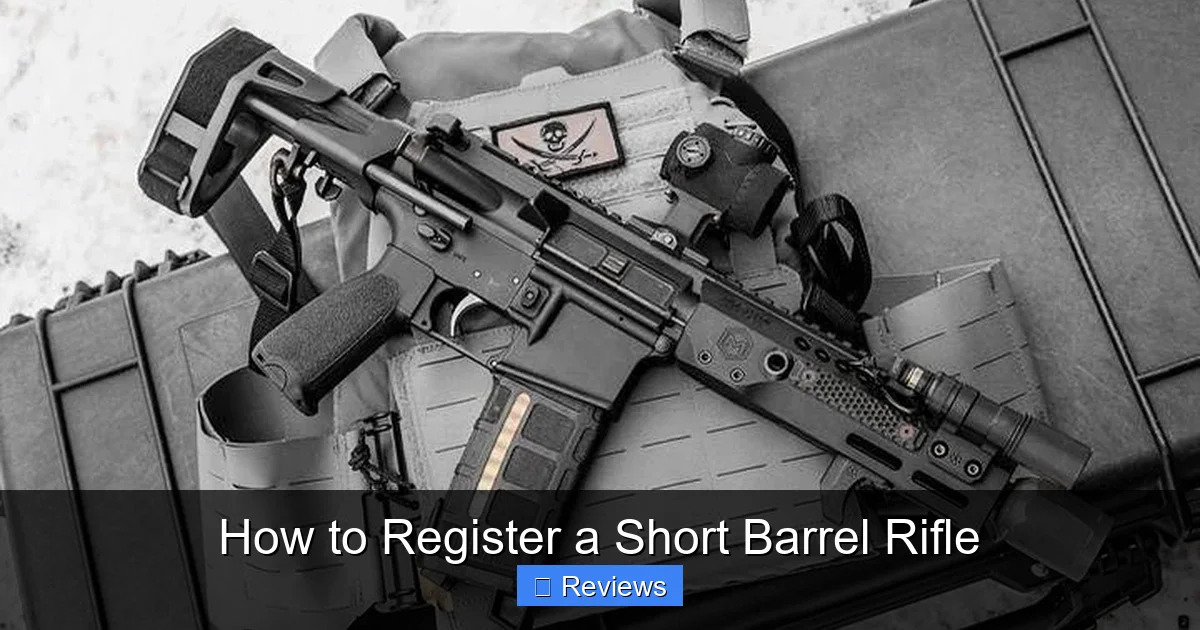
In simple terms, a “short barrel rifle” (SBR) is a rifle with a barrel less than 16 inches in length, or a rifle that has an overall length of less than 26 inches. If you attach a stock to a pistol, and that pistol now has a barrel shorter than 16 inches or an overall length less than 26 inches, it also becomes an SBR in the eyes of the law. This definition is set by the Bureau of Alcohol, Tobacco, Firearms and Explosives (ATF).
It’s important to differentiate SBRs from “pistols” or “firearms” that might have short barrels but use pistol braces. The ATF has specific guidelines that can sometimes blur these lines, but generally, if it has a traditional rifle stock and a short barrel, it’s an SBR. This distinction is critical because SBRs fall under a different regulatory category than pistols.
The National Firearms Act (NFA)
The National Firearms Act of 1934 (NFA) was enacted during the Prohibition era to regulate certain types of firearms, often referred to as “Class 3” or “Title II” firearms. These include machine guns, short barrel shotguns, suppressors (silencers), destructive devices, and, of course, short barrel rifles.
The NFA requires these firearms to be registered with the ATF and mandates the payment of a tax stamp for each item. The purpose of the NFA is to control the manufacture, sale, and possession of these specific types of firearms. Owning an unregistered NFA item, including an SBR, carries severe federal penalties, including hefty fines and lengthy prison sentences. This is why knowing how to register a short barrel rifle correctly is paramount.
The Three Paths to SBR Ownership
When you decide to acquire an SBR, you typically have three main legal avenues for registration: as an individual, through an NFA gun trust, or via a corporation/LLC. Each path has its own set of advantages and considerations, impacting how to register a short barrel rifle for your specific needs.
Individual Ownership (Form 1 or Form 4)
Registering an SBR as an individual means you, and only you, are the legal owner. This is often the simplest path for many first-time NFA owners, especially if they are the only person who will ever possess or use the SBR.
* Pros: Generally the most straightforward application process, less upfront paperwork than setting up a trust.
* Cons: Only the registered individual can possess the SBR. If you want to let a friend or family member use it, you must be present and maintain direct control. If you pass away, the SBR becomes part of your estate and must be transferred, which can be a complex process for your heirs.
* Process: You will either fill out an ATF Form 1 (if you’re manufacturing it) or an ATF Form 4 (if you’re purchasing it from a dealer).
NFA Gun Trust (Form 1 or Form 4)
An NFA gun trust is a legal entity specifically designed to own NFA firearms. It acts as a shield, allowing multiple individuals (called “responsible persons” or “trustees”) to legally possess and use the registered SBR. This is a very popular option for families or groups of friends who want shared access.
* Pros: Multiple people can legally possess and use the SBR without the primary owner being present. It simplifies inheritance, as the trust continues to exist even if one trustee passes away. It offers greater privacy, as trusts don’t usually require a Chief Law Enforcement Officer (CLEO) sign-off (though CLEO *notification* is still required).
* Cons: Requires setting up a legal trust document, which usually involves consulting an attorney specializing in NFA trusts. This adds an initial cost and complexity. All “responsible persons” listed on the trust must submit fingerprints and photos for each application.
* Process: You’ll apply via ATF Form 1 or Form 4, but the applicant will be the trust itself, and all trustees must be identified.
Corporation/LLC (Form 1 or Form 4)
Similar to a trust, a corporation or LLC can also be used to register an SBR. This path is less common for individual enthusiasts but can be useful for businesses, gun ranges, or collectors with specific corporate structures.
* Pros: Can offer similar benefits to a trust in terms of multiple users (employees/members of the corporation). Provides liability protection in some cases.
* Cons: Requires formal business registration and ongoing corporate compliance. Can be more complex and costly to maintain than a trust for a private individual. All “responsible persons” (officers, directors) must submit fingerprints and photos.
* Process: Similar to a trust, the corporation is the applicant on Form 1 or Form 4.
The Registration Process: Form 1 Application (Making Your Own SBR)
Now, let’s get into the nitty-gritty of how to register a short barrel rifle if you plan to convert an existing rifle or build one from a receiver. This involves submitting an ATF Form 1, also known as the “Application to Make and Register a Firearm.” The eForm 1 system is generally faster and preferred by many.
Step 1: Selecting Your Firearm
First, you need a “host” firearm or a receiver that you intend to turn into an SBR. This must be a Title I firearm (a standard rifle) or a stripped receiver that has never been assembled into a pistol or rifle. You cannot convert a pistol into an SBR unless you remove the stock. Crucially, the firearm you choose must be legally owned by you.
* Tip: If starting with a stripped lower receiver, make sure it’s legally transferred to you as “Other” (neither rifle nor pistol) to allow maximum flexibility.
Step 2: Gathering Necessary Information
You’ll need specific details about yourself and the firearm.
* Personal Information: Full name, address, date of birth, place of birth, citizenship, etc.
* Firearm Information: Manufacturer, model, caliber, serial number, original barrel length, overall length, and *proposed* new barrel length and overall length for the SBR. You’ll also need to decide on a “manufacturer” name (usually your name or trust name) and city/state for engraving purposes.
* Payment: A $200 non-refundable tax stamp fee is required. This is paid online during the eForm 1 submission.
Step 3: Fingerprints and Passport Photos
This is a critical step for all responsible persons (for trusts/corporations) or the individual applicant.
* Fingerprints: You will need two sets of FD-258 fingerprint cards. You can often get these done at local law enforcement agencies, private fingerprinting services, or even do them yourself with the right kit, though professional services are recommended for quality.
* Passport Photos: You’ll need one 2×2 inch passport-style photo, taken within the last year. This photo will be uploaded digitally for an eForm 1.
Step 4: CLEO Notification
The ATF requires you to notify your Chief Law Enforcement Officer (CLEO) of your intent to register an SBR. This isn’t a request for permission; it’s simply a notification.
* For Individuals: Find the address of your local police chief, county sheriff, or state police head.
* For Trusts/Corporations: You still need to notify the CLEO.
* Process: Once you submit your eForm 1, the system generates a cover letter that you print. Attach a copy of your submitted eForm 1 application to this letter and mail it to your CLEO. Keep proof of mailing (e.g., certified mail receipt).
Step 5: Submitting Your eForm 1 Application
The ATF’s eForms website (eforms.atf.gov) is your portal for submission.
1. Create an Account: If you don’t have one, register for an account.
2. Start a New Form 1: Select “Form 1 (5320.1) – Application to Make and Register a Firearm.”
3. Fill Out the Form: Carefully input all the information gathered in Step 2. Double-check every detail, especially serial numbers and proposed lengths. Mistakes can cause delays or rejections.
4. Upload Documents: Upload your passport-style photo. For fingerprint cards, you will receive a cover sheet after submission; you print this sheet, attach your physical fingerprint cards, and mail them to the ATF.
5. Pay the Tax Stamp: Use the integrated payment system to pay the $200 tax stamp fee.
6. Certify and Submit: Review everything one last time, certify, and hit submit!
Step 6: The Waiting Game and Approval
After submission, patience is your greatest virtue. The ATF processes thousands of applications, and wait times can vary significantly (typically a few months for eForm 1s, longer for paper submissions).
* Status Updates: You can check the status of your application on the eForms website.
* Approval: When approved, you will receive an email notifying you that your “Form 1 is available.” Log in to eForms, download your approved Form 1 (which includes your tax stamp), and save it securely. You are now officially cleared to “make” your SBR!
The Registration Process: Form 4 Application (Purchasing an SBR)
While this article focuses on how to register a short barrel rifle by *making* one (Form 1), it’s worth briefly mentioning the Form 4 process for *purchasing* a pre-made SBR from a licensed dealer.
Understanding Form 4
ATF Form 4 is the “Application for Tax Paid Transfer and Registration of Firearm.” This form is used when you are acquiring an NFA item, including an SBR, from a licensed NFA dealer (a Class 3 dealer).
Key Differences from Form 1
* Transferor: The dealer you’re buying from acts as the “transferor” and helps you with the paperwork.
* Custody: The SBR remains with the dealer until your Form 4 is approved. You cannot take possession until the ATF gives the green light.
* Wait Times: Form 4 applications typically have longer wait times than eForm 1s, often ranging from 6 to 12 months or even more, depending on ATF backlogs.
* Process: Similar steps regarding fingerprints, photos, CLEO notification, and the $200 tax stamp apply. Your dealer will guide you through completing the Form 4.
Post-Approval Responsibilities
Getting your approved Form 1 or Form 4 is a huge milestone, but your responsibilities don’t end there. Knowing these post-approval requirements is just as crucial as knowing how to register a short barrel rifle.
Engraving Requirements
If you manufactured your SBR via a Form 1, you have a legal obligation to engrave specific information on the firearm. This must be done *after* your Form 1 is approved but *before* you actually configure it as an SBR (i.e., put the short barrel on it).
* What to Engrave:
* Your (or your trust’s/corporation’s) name.
* The city and state where the SBR was manufactured.
* Minimum depth of .003 inches, minimum height of 1/16 inch.
* Where to Engrave: This information must be engraved on the receiver, barrel, or frame of the firearm. Most people engrave the lower receiver in an inconspicuous but visible spot.
* Tip: Find a reputable gunsmith or engraver who specializes in NFA engravings. This ensures compliance with ATF regulations.
Interstate Travel with an SBR
You can travel across state lines with your SBR, but there’s an important step you must take first. You need to fill out and submit an ATF Form 5320.20, “Application for Transport of NFA Firearms,” *before* you travel.
* Approval Required: You must receive approval from the ATF for interstate travel with your SBR. This form specifies where and when you will be traveling.
* Exceptions: Form 5320.20 is generally not required for temporary movement within the same state. Always check local and state laws, as some states prohibit SBRs entirely.
* Tip: Submit your Form 5320.20 well in advance of your travel date, as processing times can vary.
Selling or Transferring Your SBR
If you decide to sell or transfer your registered SBR, it must go through a similar NFA transfer process, utilizing an ATF Form 4.
* To Another Individual/Trust/Corporation: The SBR must be transferred through a Class 3 dealer. The new owner will submit a Form 4, pay another $200 tax stamp, and undergo the full NFA background check and waiting period.
* Inheritance: If the SBR is part of a trust, the trust structure simplifies inheritance. If owned by an individual, it becomes part of their estate and typically requires a tax-exempt transfer via an ATF Form 5 to an eligible heir.
Conclusion
Congratulations! You’ve now got a solid understanding of how to register a short barrel rifle, from the initial planning stages to the crucial post-approval responsibilities. While the process involves a bit of paperwork and patience, it’s a straightforward path when approached systematically. Remember, the goal is always compliance and responsible ownership.
Always double-check your information, especially serial numbers and personal details, to avoid unnecessary delays. Keep copies of all your submitted forms and, most importantly, your approved tax stamp and Form 1 or Form 4. Owning an SBR can be a fantastic and rewarding experience, offering unique benefits to shooters. By diligently following these steps, you’ll ensure your SBR journey is a smooth, legal, and enjoyable one. Happy shooting!
Key Takeaways
- Understanding NFA Rules: Short Barrel Rifles (SBRs) are regulated under the National Firearms Act (NFA) of 1934, requiring federal registration and a tax stamp.
- Two Main Registration Paths: You can register an SBR by either manufacturing one yourself (ATF Form 1) or by purchasing a pre-made SBR from a dealer (ATF Form 4).
- Ownership Structures Matter: SBRs can be registered to an individual, an NFA gun trust, or a corporation/LLC, each having distinct advantages and legal implications.
- The Form 1 eFile Process: Manufacturing an SBR involves selecting a firearm, gathering personal details, fingerprinting, passport photos, notifying your local Chief Law Enforcement Officer (CLEO), and submitting an electronic Form 1 application.
- Required $200 Tax Stamp: A non-refundable $200 federal tax stamp is mandatory for SBR registration, regardless of whether you’re using Form 1 or Form 4.
- Post-Approval Responsibilities: Once approved, you must engrave your SBR with specific information, understand rules for interstate travel, and follow legal procedures for transferring or selling the firearm.
- Patience is Key: The SBR registration process can take several months, so be prepared for a waiting period between application submission and approval.
Quick Answers to Common Questions
What is an SBR?
An SBR (Short Barrel Rifle) is legally defined as a rifle with a barrel less than 16 inches in length, or a rifle that has an overall length of less than 26 inches.
Do I need a tax stamp to own an SBR?
Yes, under the National Firearms Act (NFA), all SBRs require a $200 federal tax stamp and must be registered with the ATF.
What is the difference between Form 1 and Form 4?
ATF Form 1 is used to “make and register” an SBR (i.e., you convert an existing firearm or receiver into an SBR). ATF Form 4 is used to “transfer and register” an SBR, typically when you purchase a pre-made SBR from a licensed dealer.
Can I travel across state lines with my SBR?
Yes, but you must first submit an ATF Form 5320.20, “Application for Transport of NFA Firearms,” and receive approval from the ATF before traveling interstate with your SBR.
Do I need to engrave my SBR?
If you manufactured your SBR using a Form 1, you are legally required to engrave your name (or trust/corporation name) and the city/state of manufacture on the firearm after approval and before making it an SBR.
Frequently Asked Questions
What is the typical waiting period for SBR registration?
The waiting period for SBR registration can vary significantly. For eForm 1 applications (making your own SBR), it typically ranges from a few weeks to several months. For Form 4 applications (buying from a dealer), it can often be 6 to 12 months or even longer.
Can I convert a pistol into an SBR?
Yes, you can convert a pistol into an SBR by attaching a stock, provided you properly register the firearm as an SBR with an approved ATF Form 1 *before* making the conversion. Failing to do so constitutes an unregistered SBR and is illegal.
What happens if my SBR application is denied?
If your SBR application (Form 1 or Form 4) is denied, the ATF will provide a reason for the denial. You may be able to correct the issue and resubmit the application, but the $200 tax stamp fee is generally non-refundable.
Do state laws affect SBR ownership?
Absolutely. While the NFA is federal law, some states have their own restrictions or outright bans on SBRs. Always check your local and state laws in addition to federal regulations before attempting to register or possess an SBR.
What is a “responsible person” for an NFA Trust?
A “responsible person” in an NFA trust is any individual who possesses the power or authority to direct the management and policies of the trust, including those with the power to receive, possess, ship, transport, deliver, transfer, or otherwise dispose of NFA firearms for the trust. All responsible persons must submit fingerprints and photos with each NFA application.
Can I ever remove the short barrel from my SBR?
Yes, you can legally remove the short barrel from your registered SBR. If you replace it with a barrel 16 inches or longer, the firearm technically reverts to a standard rifle and is no longer considered an SBR. However, you should retain your approved Form 1/4 and tax stamp, as you can always reconfigure it back into an SBR if desired.