Identifying Mauser rifles can be a fascinating detective hunt, revealing rich history and unique craftsmanship. This guide simplifies the process, walking you through crucial visual inspections, deciphering receiver markings, understanding model-specific features, and examining proof marks to accurately determine your rifle’s origin and model. By focusing on key details, you’ll gain the knowledge to confidently identify your Mauser rifle.
Stepping into the world of Mauser rifles is like opening a history book. These iconic firearms have seen conflicts across continents, served countless nations, and remain a testament to engineering excellence. Perhaps you’ve inherited an old rifle, found one at an estate sale, or just picked up a new addition to your collection, and now you’re wondering, “What exactly do I have here?” You’re not alone! The sheer variety of Mauser rifles manufactured over more than a century can make identifying them a bit daunting.
But don’t worry, friend! Learning how to identify Mauser rifles doesn’t have to be a mystery. It’s a journey of discovery, blending historical detective work with careful observation. With a little guidance, you’ll be able to decipher those cryptic markings and understand the unique story your rifle tells. This comprehensive guide will walk you through the essential steps and key features to look for, helping you confidently identify Mauser rifles, whether they’re classic German warhorses or international variants.
So, grab your Mauser, find some good light, and let’s embark on this exciting quest to identify your Mauser rifle and unlock its secrets!
Key Takeaways
- Start with a Thorough Visual Inspection: Before diving into specific markings, assess the overall condition, stock configuration, barrel length, and sight types. These initial clues help narrow down potential models when you want to identify Mauser rifles.
- Prioritize Receiver Markings and Crests: The top and sides of the receiver are goldmines of information. Look for manufacturer names, dates of production, national crests (e.g., German eagle, Swedish crown, Turkish star), and serial numbers, which are paramount to accurately identify Mauser rifles.
- Understand Key Mauser Models: Familiarize yourself with the distinguishing features of popular models like the Gewehr 98, K98k, Swedish M96/M38, and various South American or Eastern European variants. Each model has unique characteristics that aid in Mauser rifle identification.
- Caliber is a Crucial Clue: While often stamped on the barrel, examining the chamber and bore can confirm the caliber, which is vital for safe handling and can sometimes help differentiate between models or specific production runs of Mauser rifles.
- Matching Numbers Indicate Originality: Check if major components (receiver, bolt, stock, barrel bands) share matching serial numbers. Non-matching numbers often suggest rebuilds or parts replacements, impacting collector value but not necessarily hindering basic identification.
- Beware of Import Marks and Modifications: Modern import marks, often found on the barrel or receiver, indicate the rifle’s entry into the country. Also, look for signs of sporterization or arsenal refurbishments, which can alter original features and sometimes make it harder to identify Mauser rifles definitively without deeper knowledge.
Quick Answers to Common Questions
What is the most important part of a Mauser rifle to check for identification?
The most important part to check is the receiver, particularly the top ring. This area typically features the manufacturer’s name, the year of production, and often a national crest or emblem, which are crucial for identification.
Do all Mauser rifles have matching serial numbers?
No, not all Mauser rifles have matching serial numbers. While a rifle with all matching numbers is highly prized by collectors, many military Mausers were arsenal-refurbished, had parts replaced during combat, or were assembled from parts kits after conflicts, resulting in non-matching components.
What does “sporterized” mean for a Mauser rifle?
“Sporterized” refers to a military rifle that has been modified for civilian hunting or sport use. This typically involves cutting down the original military stock, often re-contouring the barrel, and sometimes fitting commercial sights or scopes, changing its original military appearance.
Can I identify a Mauser rifle just by its caliber?
While caliber is an important clue and can narrow down possibilities (e.g., 6.5x55mm strongly suggests a Swedish Mauser), it’s not sufficient for full identification on its own. Many different Mauser models were chambered in common calibers like 8x57mm Mauser, so you need to combine caliber information with other markings.
Where are import marks usually found on a Mauser rifle?
Import marks, which indicate the company that brought the rifle into a country (like the USA after 1968), are typically found stamped on the barrel or sometimes on the receiver. They are distinct from original factory or military markings.
📑 Table of Contents
The Mauser Legacy: A Brief Overview
Before we dive into the nitty-gritty of identification, let’s briefly appreciate the legacy of Mauser. The company, founded by Peter Paul Mauser and Wilhelm Mauser, revolutionized rifle design in the late 19th and early 20th centuries. Their bolt-action designs were so robust, reliable, and accurate that they were adopted by dozens of countries worldwide, often produced under license or directly by Mauser itself. This widespread adoption is precisely why there are so many variations when you try to identify Mauser rifles.
Origins and Innovations
The Mauser brothers’ most significant contributions came with the Model 1871, followed by the revolutionary Model 1893 (Spanish Mauser), which introduced features like a staggered-column internal box magazine and a non-rotating claw extractor. These innovations culminated in the legendary Model 1898 (Gewehr 98), considered by many to be the pinnacle of bolt-action rifle design. Its strong action, controlled-feed mechanism, and excellent safety features set the standard for military rifles for decades.
Global Impact and Variation
Because so many nations adopted Mauser designs, each country often introduced its own modifications, crests, and manufacturing practices. This means a Mauser rifle made in Germany for the Wehrmacht will look different from one made in Sweden, Yugoslavia, or Brazil, even if they share the same basic M98 action. Understanding this global impact is the first step in learning how to identify Mauser rifles accurately. It tells us that a simple “Mauser” stamp isn’t enough; we need to dig deeper.
Essential First Steps: Initial Visual Inspection

Visual guide about How to Identify Mauser Rifles
Image source: s3.amazonaws.com
When you first pick up a rifle and want to identify Mauser rifles, start with a general visual inspection. Think of it as gathering initial clues before you get into the detailed forensics.
Overall Condition and Configuration
Take a moment to observe the rifle’s overall configuration. Is it a long rifle, a carbine (shorter barrel), or something in between? What’s the general finish like? Has it been sporterized (modified for hunting, often with a cut-down stock and new sights)? Sporterized rifles can be harder to identify definitively, as original features might be removed, but the core receiver usually remains intact.
Stock Features
The stock provides excellent clues.
- Material: Is it wood (walnut, beech, laminated) or synthetic? Most military Mausers are wood.
- Handguard: Does it have a full-length handguard, a short one, or none at all?
- Finger Grooves: Many earlier Mauser models feature distinctive finger grooves on the forestock.
- Buttplate: Is it flat or cupped? Metal or wood? Does it have a cleaning rod trap?
- Sling Swivels: Where are they located? Are they side-mounted, bottom-mounted, or both?
For example, many German K98k rifles feature a cupped buttplate, while earlier Gewehr 98s often had a flat buttplate. Swedish Mausers are known for their beautiful, often tiger-striped walnut stocks.
Barrel and Sights
Examine the barrel length and profile. Carbines, by definition, have shorter barrels than standard rifles.
- Sights: What type of rear sight does it have? Is it a tangent leaf sight (common on military Mausers), a ladder sight, or a sportier adjustable sight? The range markings (e.g., in meters) can also give a hint.
- Front Sight: Is it a hooded post, a blade, or something else?
- Cleaning Rod: Is there a cleaning rod underneath the barrel? Its presence and length can be specific to certain models.
A German K98k, for instance, typically has a characteristic hooded front sight and a tangent rear sight graduated to 2000 meters. These details are important for you to identify Mauser rifles correctly.
Decoding the Receiver: Markings and Crests
This is where the real detective work begins. The receiver (the metal part housing the bolt and chamber) is the most critical area for Mauser rifle identification. It holds the most definitive information.
Manufacturer and Date Stamps
Look closely at the top of the receiver ring, just in front of the bolt. This area almost always bears the manufacturer’s name and a date of production.
- German Mausers: You might see “MAUSER WERKE AG OBERNDORF A/N” or “byf” (Mauser factory code during WWII), “BCD,” “S/42K,” “S/42G,” “Ar42,” “dot,” or other codes. The year of manufacture will also be present, like “1938” or “43.”
- Swedish Mausers: Look for “Carl Gustafs Stads Gevärsfaktori” or “Husqvarna Vapenfabriks Aktiebolag” along with the year.
- Czech Mausers: You’ll often find “Československá zbrojovka, a.s., Brno” or simply “BRNO” or the lion crest.
- Yugoslavian Mausers: Look for “Preduzeće 44” (Zastava factory) or “TRZ 5” and sometimes the Yugoslavian crest (a crown or later a communist star).
- Other Manufacturers: Many other countries had their own manufacturers, like FN (Fabrique Nationale) in Belgium, Steyr in Austria, or various arsenals in Latin America and Turkey.
This stamped information is perhaps the single most important clue to identify Mauser rifles.
National Crests and Emblems
Often, above the manufacturer’s name and date on the receiver ring, you’ll find a national crest or emblem. These are incredibly helpful for identifying the country that originally ordered or used the rifle.
- German: Imperial German eagles (pre-WWI), Weimar eagles (interwar), or Nazi Party eagles (WWII – often peening out the swastika during de-nazification, but sometimes visible).
- Swedish: A distinct crown with three points.
- Czech: A rampant lion.
- Yugoslavian: A royal crown (pre-WWII) or a communist star with five torches (post-WWII).
- Turkish: A star and crescent moon.
- South American: Various national crests, such as Chilean stars, Argentine suns, Brazilian stars, or Peruvian coats of arms.
The combination of manufacturer, date, and national crest paints a very clear picture for you to identify Mauser rifles.
Serial Numbers and Proof Marks
Every Mauser rifle has a unique serial number, typically stamped on the receiver. You’ll also find it on other components if the rifle has “matching numbers” (more on that later). Proof marks are small stamps, often geometric shapes or stylized eagles, indicating that the rifle passed factory and government safety tests. Their specific design and location can sometimes offer additional identification clues, especially for variations within German production.
Key Models and Their Distinguishing Features
While many Mausers share the M98 action, specific models have features that help distinguish them. Knowing these common types is essential to accurately identify Mauser rifles.
Gewehr 98 (G98)
The original “Great War” Mauser, produced from 1898 to 1918.
- Length: Very long, typically around 49.2 inches (125 cm).
- Sights: Long tangent rear sight, usually graduated to 2000 meters.
- Barrel Bands: Often two, with a bayonet lug on the front band.
- Stock: Straight-wrist stock, often walnut. No finger grooves or a shallow one.
- Bolt Handle: Straight bolt handle.
- Safety: Flag safety.
If you have a very long Mauser with a straight bolt handle and pre-1918 German markings, you likely have a G98.
Karabiner 98 kurz (K98k)
The iconic German rifle of WWII, produced from 1935 to 1945. “Kurz” means short.
- Length: Shorter than the G98, around 43.7 inches (111 cm).
- Sights: Hooded front sight, tangent rear sight graduated to 2000 meters.
- Barrel Bands: Two barrel bands, often a stamped upper band with a screw.
- Stock: Laminate or solid walnut stock with a cupped buttplate (though earlier ones could be flat). Often has a dismounting disk in the buttstock.
- Bolt Handle: Turned-down bolt handle. This is a very distinctive feature.
- Safety: Flag safety.
The K98k is probably the most commonly encountered German Mauser. Its turned-down bolt and shorter length are key identifiers.
Swedish Mausers (M96/M38)
Renowned for their exceptional accuracy and craftsmanship. They use a unique M96 action, slightly different from the M98, typically chambered in 6.5x55mm Swedish.
- M96 (Long Rifle): Very long barrel (29.1 inches), often beautiful walnut or beech stocks, straight bolt handle. Receiver marked “Carl Gustafs Stads Gevärsfaktori” or “Husqvarna.”
- M38 (Short Rifle/Carbine): Shorter barrel (23.6 inches), turned-down bolt handle (some M96s were converted to M38 length and retained straight bolts). Often the same beautiful stocks.
The 6.5x55mm caliber and the specific Swedish crests are dead giveaways for these rifles.
Czech and Yugoslavian Mausers
These often present interesting variations, sometimes incorporating features of both G98 and K98k designs.
- Czech VZ24: A very robust rifle, often considered a short rifle (similar length to K98k). Distinctive lion crest on the receiver. Often has a longer front sight protector than the K98k. Chambered in 8mm Mauser.
- Yugoslavian M24/47, M48: Post-WWII production, often built on refurbished components. The M48 uses an “intermediate length” action, shorter than a standard M98, but not enough to change the cartridge. Look for Yugoslavian crests (crown or star) and manufacturing marks like “Preduzeće 44.” Also typically 8mm Mauser.
These rifles are often high-quality and offer a great value. Distinguishing them helps you to correctly identify Mauser rifles from the region.
South American Mausers
Many South American countries adopted Mauser designs, often purchasing them from Germany, Belgium (FN), or even producing them locally.
- Calibers: Often chambered in 7x57mm Mauser or 7.65x53mm Argentine, though some transitioned to 8mm Mauser.
- Crests: Distinct national crests (e.g., Argentine sun, Chilean star, Peruvian coat of arms).
- Models: Common models include the M1891 (Argentina), M1909 (Argentina), M1895 (Chile), M1912 (Chile), and various Brazilian and Peruvian models.
The combination of specific national crests and unusual calibers (for European Mausers) helps identify Mauser rifles from this region.
Caliber and Cartridge Identification
Knowing the caliber of your Mauser is crucial for safe operation and can also be a helpful identification tool. While often stamped on the barrel, these markings can be worn or absent.
Common Mauser Calibers
- 8x57mm IS (also known as 7.92x57mm Mauser or 8mm Mauser): The most common caliber for German Mausers (G98, K98k) and many Eastern European variants (Czech, Yugoslavian).
- 6.5x55mm Swedish: Exclusively used by Swedish Mausers.
- 7x57mm Mauser: Very common in early Spanish and South American Mausers.
- 7.65x53mm Argentine (or Belgian): Used by Argentina, Belgium, Peru, and others.
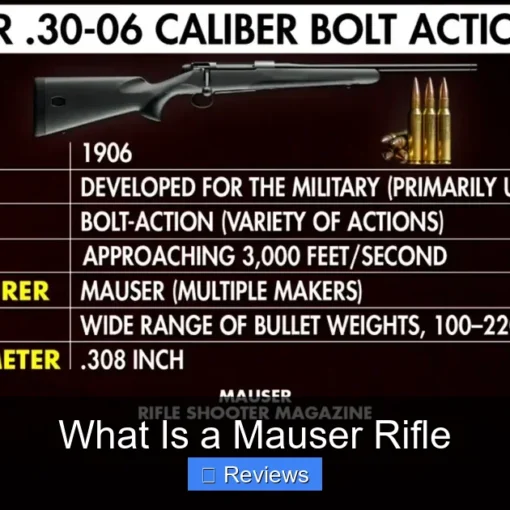
- .30-06 Springfield: Some Mausers, particularly those rebuilt or sold to countries with US aid, were rechambered or manufactured in .30-06. Look for “.30-06” stamped on the barrel.
Examining the Barrel and Chamber
Always check the barrel for caliber markings. They are usually stamped near the receiver. If there’s no clear marking, you can consult a gunsmith or use a specialized chamber casting kit to determine the precise caliber. Never guess the caliber! Incorrect ammunition can be extremely dangerous. The presence of a specific caliber can greatly aid in your quest to identify Mauser rifles.
Beyond the Basics: Advanced Identification Tips
Once you’ve covered the basics, a few more detailed observations can help refine your identification or reveal more about your rifle’s history.
Matching Numbers
One of the most exciting discoveries for collectors is a “matching numbers” rifle. This means the serial number on the receiver matches the serial numbers on the bolt (sometimes on all three bolt components: body, safety, shroud), barrel, stock, trigger guard, floorplate, and even barrel bands.
- Significance: Matching numbers usually indicate an original, un-refurbished rifle, which is highly prized by collectors.
- Non-matching Numbers: Don’t despair if numbers don’t match. Many military Mausers were arsenal-refurbished, had parts replaced during repairs, or were re-assembled from parts kits after wars. A non-matching rifle is still a piece of history, just with a different story.
Checking for matching numbers gives you a deeper insight when you want to identify Mauser rifles.
Bayonet Lugs and Bands
The design and location of the bayonet lug can vary slightly between models and countries. Some rifles might have stacking hooks (for stacking rifles in a pile) on the front barrel band. These small details, while minor, contribute to the overall identification puzzle. For example, some early G98s had a nose cap that extended further forward than later models.
Import Marks
If your Mauser rifle was imported into the US (especially after the 1968 Gun Control Act), it will have an import mark. This is usually a small stamp on the barrel or receiver, indicating the importer’s name and location. These marks aren’t original to the rifle’s military service but are a part of its recent history and can sometimes obscure original markings.
Sporterization and Rebuilds
As mentioned, many military Mausers were sporterized after wars, turning them into hunting rifles. This often involves cutting down the stock, re-contouring the barrel, adding commercial sights, or even re-chambering. While these modifications change the rifle’s appearance, the receiver (with its critical markings) usually remains original, allowing you to still identify Mauser rifles by their core. Also, many countries rebuilt and reissued Mausers after major conflicts, often applying new finishes, replacing parts, and sometimes re-stamping. These arsenal rebuilds have their own historical significance.
Conclusion
Identifying Mauser rifles is a rewarding endeavor that connects you directly with history. From the general configuration to the intricate details of receiver markings, every clue helps tell your rifle’s unique story. Remember to approach the process systematically: start with the overall look, move to the crucial receiver markings and crests, consider the model-specific features, and finally confirm the caliber.
With patience and attention to detail, you’ll be able to confidently identify your Mauser rifle and appreciate the remarkable engineering and historical significance it represents. Enjoy the journey, learn from the wealth of online resources and collector communities, and cherish your piece of firearm history!
🎥 Related Video: 1871/84 Mauser Gewehr
📺 Canadian Classics
1871 sporterized mauser Gewehr #antique #gunvideos #gun #history #historical #surplus #firearms.
Frequently Asked Questions
What makes Mauser rifles so historically significant?
Mauser rifles are historically significant because their innovative bolt-action designs, particularly the M98, set the standard for military rifles worldwide for decades. They were robust, reliable, and accurate, influencing countless other firearm designs and seeing service in numerous conflicts across the globe.
Are all rifles with “Mauser” stamped on them German?
No, not all rifles stamped “Mauser” are German-made. While the original company was German, many countries adopted Mauser designs and produced them under license, sometimes even using the “Mauser” name, but with their own national crests and manufacturing details.
What’s the difference between a Gewehr 98 and a Karabiner 98 kurz (K98k)?
The primary differences between a Gewehr 98 (G98) and a Karabiner 98 kurz (K98k) are length and bolt handle design. The G98 is a longer rifle with a straight bolt handle, primarily used in WWI, while the K98k is a shorter carbine with a distinctive turned-down bolt handle, which became Germany’s standard rifle in WWII.
How can I tell if my Mauser has been re-blued?
You can often tell if a Mauser has been re-blued by looking for tell-tale signs such as softened or faint stampings and markings, a overly glossy or purplish finish that doesn’t match original military finishes, or bluing over areas that should have remained “in the white” (unblued).
What does an “intermediate length” Mauser action mean?
An “intermediate length” Mauser action, famously used in the Yugoslavian M48, means the receiver itself is slightly shorter than a standard M98 action. While it still accommodates standard cartridges like the 8mm Mauser, it’s designed with a more compact bolt travel than the full-length M98 action.
Is it safe to shoot an old Mauser rifle?
Before shooting any old firearm, especially a military surplus rifle, it is crucial to have it inspected by a qualified gunsmith. They can check the bore, chamber, headspacing, and overall mechanical condition to ensure it is safe to fire with appropriate ammunition.