The question of how far can a rifle bullet travel is far more complex than a simple number, depending heavily on factors like bullet design, initial velocity, and environmental conditions. While a bullet might be accurately aimed for hundreds of yards, its absolute maximum range, where it eventually falls to earth, can be several miles. Understanding these dynamics is crucial for both shooting accuracy and, most importantly, safety, ensuring you always know the potential reach of your firearm.
There’s a question that sparks curiosity in almost anyone who’s ever handled a firearm or even just watched an action movie: “How far can a rifle bullet travel?” It’s a fundamental question, full of intrigue and often misconceptions. You might hear stories of bullets traveling for miles, or perhaps you’ve seen targets engaged at extreme distances and wonder how much further that projectile could have gone. The truth is, the answer isn’t simple, and it’s far more fascinating than a single number.
The journey of a rifle bullet from the barrel to its final resting place is a complex dance between physics, engineering, and environmental factors. It’s not just about how powerful the gun is. Every bullet, even one leaving the muzzle at incredible speeds, immediately begins fighting a battle against unseen forces. Understanding these forces and factors isn’t just academic; it’s absolutely crucial for responsible shooting, ensuring both accuracy and, most importantly, safety for everyone involved.
In this article, we’re going to pull back the curtain on bullet flight. We’ll explore the science behind how far a rifle bullet can travel, break down the key elements that dictate its range, look at real-world examples, and discuss why this knowledge is so vital for safe shooting practices. Get ready to dive deep into the fascinating world of exterior ballistics!
Key Takeaways
- No Single Answer: How far a rifle bullet travels depends on a complex interplay of bullet characteristics, initial velocity, and environmental conditions, making a single definitive distance impossible to state.
- Key Factors: Bullet shape (ballistic coefficient), weight, caliber, and the speed it leaves the barrel (muzzle velocity) are primary determinants of its potential range.
- Nature’s Influence: Gravity constantly pulls the bullet down, while air resistance (drag) slows it considerably. Wind, temperature, altitude, and barometric pressure all subtly yet significantly affect a bullet’s trajectory and overall travel distance.
- Maximum vs. Effective Range: The “maximum range” refers to the absolute furthest a bullet can travel before gravity brings it to the ground, which is often miles. “Effective range,” however, is the distance at which a shooter can consistently hit a target with acceptable accuracy and energy.
- Caliber Examples Vary Wildly: A .22LR bullet might travel up to 1.5 miles, while larger cartridges like a .308 Winchester can exceed 3 miles, and a .50 BMG can potentially travel over 5 miles.
- Safety is Paramount: Understanding the potential maximum travel distance of any rifle bullet is crucial for safe shooting. Always ensure you have an adequate backstop and know what lies far beyond your target.
Quick Answers to Common Questions
How far can a .22LR rifle bullet travel?
A .22LR bullet can travel surprisingly far, with an estimated maximum range of up to 1.5 miles (about 2,400 meters or 2,600 yards) when fired at an optimal angle.
What is the difference between effective range and maximum range?
Effective range is the distance at which a shooter can consistently hit a target with good accuracy and energy. Maximum range is the absolute furthest a bullet will travel before gravity brings it to the ground, which can be several miles, far beyond any practical shooting distance.
Does wind significantly affect how far a rifle bullet travels?
Wind primarily affects a rifle bullet’s trajectory by pushing it sideways (wind drift), significantly impacting accuracy. While strong headwinds or tailwinds can slightly alter its forward travel, its main effect is on horizontal displacement rather than overall maximum distance.
Why do bullets travel farther at higher altitudes?
Bullets travel farther at higher altitudes because the air is less dense. With fewer air molecules to push through, the bullet experiences less air resistance (drag), allowing it to maintain its speed and energy for a longer period.
What is a ballistic coefficient and why is it important for bullet travel distance?
A ballistic coefficient (BC) is a measure of a bullet’s aerodynamic efficiency. A higher BC indicates a more streamlined bullet that experiences less air resistance, allowing it to retain its velocity and energy longer, thus traveling further.
📑 Table of Contents
- The Basics: What Gives a Bullet Its Journey?
- Battling Nature: Gravity, Air, and Wind
- The Environment’s Whispers: Temperature, Altitude, and Pressure
- Trajectory Unpacked: From Muzzle to Final Rest
- Real-World Ranges: How Far Do Specific Calibers Go?
- Safety Above All: Knowing Your Bullet’s Reach
- Conclusion
The Basics: What Gives a Bullet Its Journey?
Before we talk about how far a rifle bullet can travel, let’s understand what makes it go in the first place. Several fundamental characteristics of the bullet and the rifle system itself play a huge role in its potential range.
Initial Muzzle Velocity: The Power Behind the Punch
This is perhaps the most obvious factor. Muzzle velocity is the speed at which the bullet leaves the barrel of the rifle. The faster a bullet starts, the further it can potentially go before gravity and air resistance slow it down and bring it to earth. Different cartridges are designed for different velocities. For instance, a small .22LR bullet leaves the barrel at a much lower speed than a high-powered .30-06 Springfield, which significantly impacts their respective maximum travel distances. This initial burst of speed is the primary engine for the bullet’s journey.
Bullet Design and Ballistic Coefficient: The Art of Aerodynamics
Not all bullets are created equal. The shape and construction of a bullet are incredibly important for how efficiently it cuts through the air. This is where the term “ballistic coefficient” (BC) comes in. Think of BC as a bullet’s aerodynamic efficiency score. A higher BC means the bullet is more streamlined, experiences less air resistance, and therefore retains its speed and energy for longer. This allows it to travel further.
- Pointed vs. Round Nose: Pointed bullets (spitzer design) are much more aerodynamic than older, round-nose bullets, leading to greater range.
- Boat-Tail Design: Many modern long-range bullets feature a “boat-tail” at the rear, which tapers in. This design further reduces drag, helping the bullet fly straighter and farther.
- Sectional Density: This refers to the bullet’s weight in relation to its diameter. A heavier bullet of the same diameter will have higher sectional density, which helps it overcome air resistance better than a lighter one, enhancing its range.
Caliber and Weight: Size and Mass Matter
While related to ballistic coefficient, caliber (the diameter of the bullet) and its overall weight are also distinct factors. Larger caliber bullets, especially when combined with a good BC and substantial weight, tend to carry more momentum. This momentum helps them resist air drag more effectively, allowing them to maintain higher velocities for longer periods. For example, a heavy .30-caliber bullet will generally travel much farther than a lightweight .22-caliber bullet, even if they start at similar initial velocities, simply because it has more mass to push through the air.
Battling Nature: Gravity, Air, and Wind
Once a bullet leaves the barrel, it’s immediately at the mercy of the elements. These natural forces are constantly working to slow it down and pull it to the ground, directly influencing how far a rifle bullet can travel.
Visual guide about How Far Can a Rifle Bullet Travel
Image source: cdn.mos.cms.futurecdn.net
Gravity’s Unyielding Pull: The Constant Downward Force
This one is straightforward: gravity. From the very moment a bullet exits the muzzle, gravity starts pulling it towards the earth. This pull is constant and never stops. It’s why bullets don’t travel in a straight line; they always follow a curved path, or trajectory, arc-ing downwards. The longer a bullet is in the air, the more gravity pulls it down. To counteract this for long-range shots, shooters must aim slightly upwards, allowing the bullet to “fall” into the target.
Air Resistance (Drag): The Invisible Wall
Air resistance, or drag, is the primary force working against a bullet’s forward motion. Every time a bullet pushes through air molecules, it experiences friction and turbulence. This force works exponentially: the faster the bullet, the greater the air resistance. As a bullet slows down, the effect of drag lessens, but it’s always there, relentlessly robbing the bullet of its speed and energy.
- Supersonic vs. Subsonic: Many rifle bullets start at supersonic speeds (faster than the speed of sound). When they break the sound barrier, they create a small shockwave, which contributes significantly to drag. Once a bullet drops below the speed of sound (becomes subsonic), the drag characteristics change, often reducing, but it continues to lose speed until it hits the ground.
- Turbulence: As a bullet travels, it creates turbulence behind it, further contributing to drag. Aerodynamic designs aim to minimize this turbulent wake.
Wind: The Sideways Push
While not directly affecting the bullet’s maximum forward travel distance in the same way gravity and drag do, wind is a crucial environmental factor that determines where a bullet lands and its effective range. Wind pushes the bullet sideways, a phenomenon known as “wind drift.” Even a slight breeze can significantly push a bullet off course over long distances. For truly extreme range shots, understanding and compensating for wind is one of the most challenging aspects for a shooter. Strong headwinds or tailwinds can also slightly affect vertical trajectory and speed, but their primary impact is horizontal displacement.
The Environment’s Whispers: Temperature, Altitude, and Pressure
Beyond the obvious forces, the specific atmospheric conditions also subtly yet significantly influence how far a rifle bullet can travel. These factors all tie into air density.
Temperature’s Effect: Hot Air is Thinner
Think about it: hot air rises. Hot air is less dense than cold air. When the air is warmer, there are fewer air molecules for the bullet to push through. This means less air resistance, allowing the bullet to maintain its speed for longer and potentially travel a greater distance. Conversely, in very cold temperatures, the air is denser, increasing drag and slightly reducing maximum range.
Altitude’s Role: Higher Means Thinner Air
Similar to temperature, altitude has a significant impact on air density. The higher you go above sea level, the thinner the air becomes. At higher altitudes, there’s less air resistance for the bullet to overcome. This is why bullets fired in mountainous regions can often travel farther and have flatter trajectories than the same bullets fired at sea level. Shooters at high altitudes need to adjust their aiming points accordingly.
Barometric Pressure and Humidity: Subtle but Present
- Barometric Pressure: This is essentially the weight of the air pressing down. High pressure means denser air, increasing drag. Low pressure means less dense air, reducing drag. While less impactful than temperature or altitude, significant changes in barometric pressure can still affect how far a rifle bullet can travel, especially over very long distances.
- Humidity: Surprisingly, humid air is actually slightly less dense than dry air. Water vapor (humidity) is lighter than nitrogen and oxygen molecules. So, a bullet might travel ever so slightly farther in very humid conditions compared to very dry conditions, assuming all other factors are equal. However, this effect is usually negligible for most practical shooting scenarios.
Trajectory Unpacked: From Muzzle to Final Rest
Understanding the bullet’s journey isn’t just about its maximum range; it’s about the entire path it takes through the air.
The Arc of Flight: Understanding the Bullet’s Path
We already know gravity pulls the bullet down, creating an arc. This arc is the bullet’s trajectory. When you zero a rifle, you’re essentially setting it so the bullet will cross your line of sight at a specific distance. For a bullet to achieve its maximum range, it needs to be fired at an optimal angle, typically around 30-35 degrees above the horizontal. Firing straight up would result in it losing all forward momentum and falling back down, while firing perfectly horizontal means gravity starts pulling it down immediately with no “lift” to extend its range.
Effective Range vs. Maximum Range: Hitting a Target vs. Falling to Earth
This distinction is incredibly important. When someone asks “how far can a rifle bullet travel?”, they often mean its “effective range.”
- Effective Range: This is the distance at which a shooter can reliably hit a target with sufficient accuracy and the bullet retains enough energy to achieve its intended purpose (e.g., ethical hunting, target shooting). This range is determined by the shooter’s skill, the rifle’s accuracy, the bullet’s performance, and the target’s size. For most rifle calibers, effective range for human-sized targets might be a few hundred yards to perhaps 1000 yards for specialized long-range setups.
- Maximum Range: This is the absolute furthest point a bullet will travel before gravity overcomes all forward momentum and brings it to the ground. At this point, the bullet has very little energy and is often tumbling. This maximum range can be many miles, far exceeding any practical or ethical shooting distance. It’s the ultimate answer to “how far can a rifle bullet travel” in terms of raw distance.
Stability and Tumbling: When the Bullet Loses Its Way
For a bullet to fly straight and true, it needs to be stable. The rifling in the barrel imparts a spin on the bullet, much like a spiraling football, which keeps it nose-forward. However, as a bullet travels further and loses speed, especially as it becomes subsonic, its spin can become less effective at stabilizing it. When this happens, the bullet can become unstable, start to wobble, and eventually “tumble” end-over-end. A tumbling bullet is highly inaccurate and loses energy very rapidly, significantly reducing its effective range, though it will still travel until gravity pulls it down.
Real-World Ranges: How Far Do Specific Calibers Go?
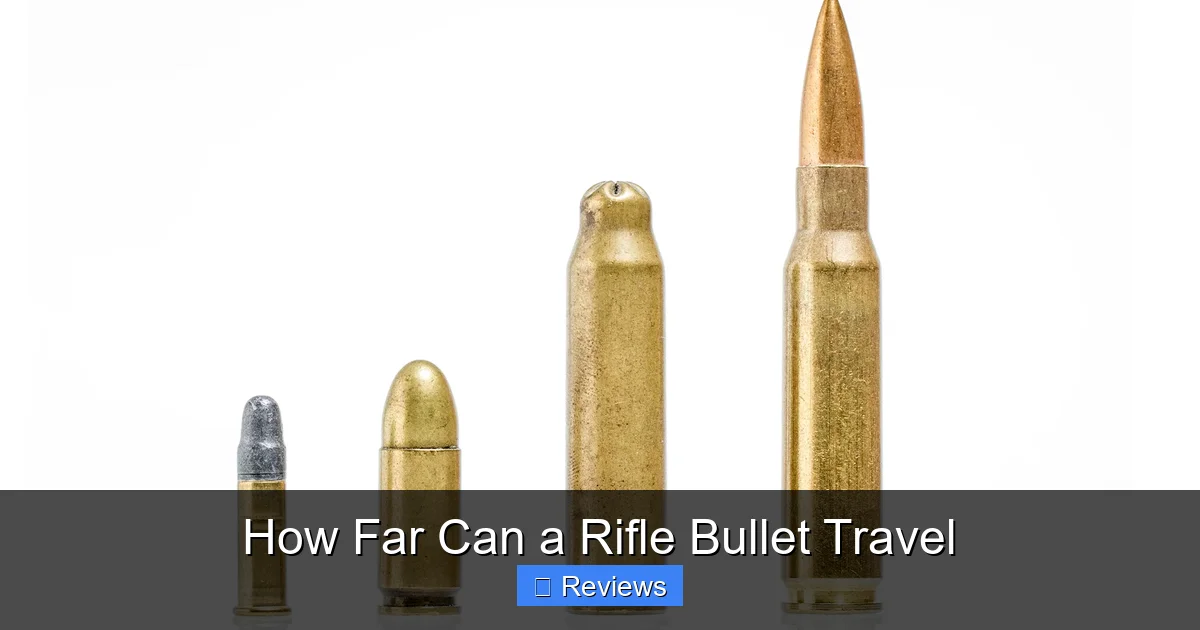
To give you a better idea of how far a rifle bullet can travel, let’s look at some common calibers and their estimated maximum ranges. Remember, these are *maximum theoretical ranges* fired at optimal angles, not practical shooting distances.
.22 Long Rifle (.22LR)
Often considered a “small” round, the .22LR is widely popular for plinking, target shooting, and small game hunting. Despite its size, a .22LR bullet can travel surprisingly far. Its relatively slow velocity and light weight mean it’s more susceptible to gravity and wind, but it can still reach significant distances.
- Estimated Maximum Range: Up to 1.5 miles (approximately 2,400 meters or 2,600 yards).
- Effective Range (for accuracy): Typically 50-100 yards, sometimes up to 200 yards for skilled shooters with precise rifles.
.223 Remington / 5.56x45mm NATO
This is one of the most common rifle cartridges in the world, used in AR-15 style rifles and many military applications. It’s a fast, relatively lightweight bullet with good ballistic properties.
- Estimated Maximum Range: Up to 2.5 miles (approximately 4,000 meters or 4,400 yards).
- Effective Range (for accuracy): 400-600 yards for most shooters, extending to 800+ yards for highly skilled marksmen with specialized setups.
.308 Winchester (7.62x51mm NATO)
The .308 is a highly popular hunting, target, and tactical cartridge known for its balance of power and accuracy. Its heavier bullet and good ballistic coefficient allow it to maintain energy well.
- Estimated Maximum Range: Up to 3 miles (approximately 4,800 meters or 5,200 yards).
- Effective Range (for accuracy): 600-800 yards is common, with skilled shooters pushing beyond 1,000 yards.
.30-06 Springfield
A classic American hunting cartridge, the .30-06 Springfield offers considerable power and velocity. It’s capable of taking down large game and has a long reach.
- Estimated Maximum Range: Up to 3.5 miles (approximately 5,600 meters or 6,100 yards).
- Effective Range (for accuracy): Similar to the .308, often 600-800 yards, with potential for longer shots in expert hands.
.50 BMG (Browing Machine Gun)
This is a truly massive cartridge, often used in heavy machine guns and specialized anti-materiel rifles. It’s designed for extreme range and power.
- Estimated Maximum Range: Over 5 miles (approximately 8,000 meters or 8,700 yards). Some sources even cite ranges exceeding 6-7 miles under ideal conditions.
- Effective Range (for accuracy): Effective anti-personnel range is typically 1,500-2,000 yards, but anti-materiel roles can extend to 2,500+ yards.
These figures demonstrate that how far a rifle bullet can travel varies immensely depending on the caliber. It’s a powerful reminder of the incredible energy stored within these projectiles.
Safety Above All: Knowing Your Bullet’s Reach
Understanding the maximum travel distance of a rifle bullet isn’t just a matter of scientific curiosity; it’s a critical component of responsible firearm ownership and safety. When you pull the trigger, you are responsible for every single bullet that leaves your barrel, from its launch to its final resting place.
The “Backstop” Concept: What’s Behind Your Target?
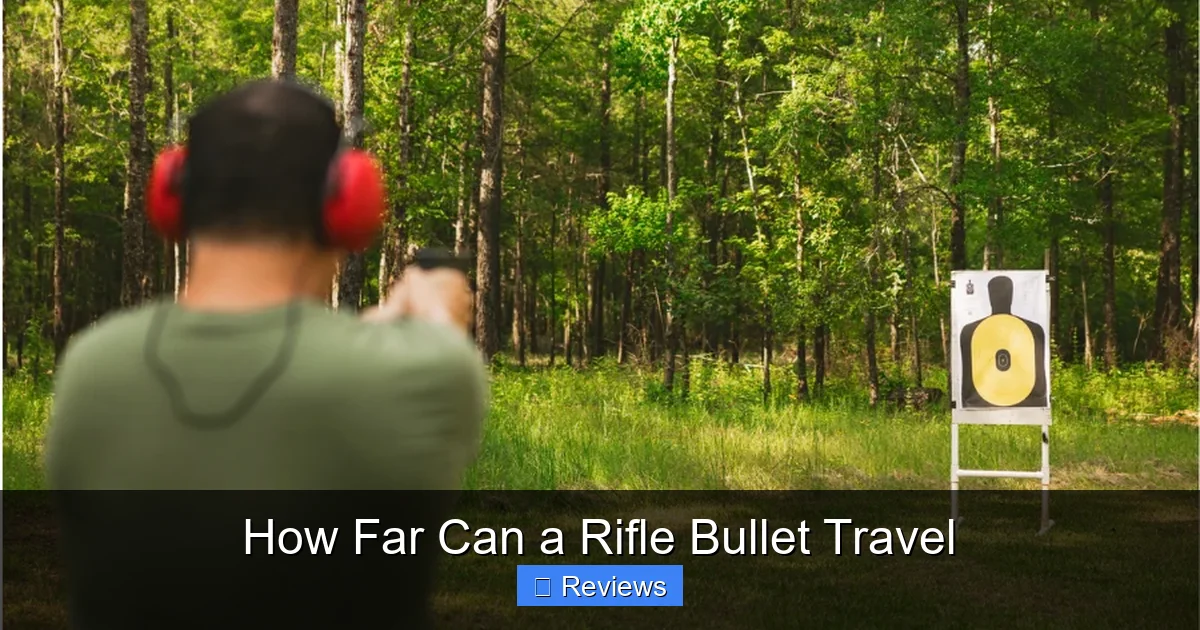
Every time you shoot, you must have an adequate backstop. A backstop is anything solid and substantial enough to safely stop your bullet. This could be a specialized bullet trap, a thick dirt berm, a natural hill, or even dense trees (though be wary of ricochets off trees). Never shoot at a target unless you are absolutely certain of what is behind it and that your bullet will not pose a danger to people, animals, or property far beyond your intended target. Knowing how far a rifle bullet can travel helps you choose a safe shooting location.
Understanding Over-Penetration: Bullets Don’t Just Stop
Bullets are designed to penetrate. Even if they hit your intended target, they may not stop there. The bullet can pass through the target and continue its journey. This is known as over-penetration. For example, shooting a small paper target backed by a thin sheet of plywood is not a safe backstop for a high-powered rifle round, as the bullet will likely punch right through both and continue on for miles.
Ricochet Risks: When Bullets Bounce
Bullets can ricochet, or bounce, off hard surfaces. Rocks, metal objects, frozen ground, and even water at shallow angles can cause a bullet to change direction unpredictably and continue traveling at high speeds. These ricochets can travel in unexpected directions and pose a severe danger. Always be aware of your surroundings and avoid shooting at surfaces that could cause a ricochet. The risk is ever-present, and understanding how far a rifle bullet can travel after a ricochet emphasizes the danger.
Responsible Shooting: It’s Everyone’s Duty
As a firearm owner or shooter, it is your responsibility to know the capabilities of your firearm and ammunition. Always follow the cardinal rules of firearm safety: treat every gun as if it’s loaded, never point a gun at anything you’re not willing to destroy, keep your finger off the trigger until your sights are on the target, and be sure of your target and what’s beyond it. By understanding how far a rifle bullet can travel, you gain a deeper appreciation for the power you hold and the responsibility that comes with it.
So, the next time you’re out shooting, remember that the seemingly small projectile you send downrange has the potential to travel a surprising distance. Always prioritize safety, understand your equipment, and respect the incredible forces at play.
Conclusion
The question “how far can a rifle bullet travel?” unveils a fascinating world of physics, engineering, and environmental science. We’ve seen that there’s no single, simple answer, but rather a complex interplay of factors: the bullet’s initial velocity, its aerodynamic design, its weight and caliber, and the relentless forces of gravity, air resistance, and wind. We’ve also explored how subtle environmental conditions like temperature, altitude, and barometric pressure can impact a bullet’s journey.
From the relatively modest range of a .22LR to the incredible multi-mile reach of a .50 BMG, the maximum travel distance of rifle bullets varies immensely. This theoretical maximum, however, stands in stark contrast to the practical “effective range” at which a shooter can accurately and reliably hit a target. The key takeaway, regardless of the caliber, is the profound responsibility that comes with understanding a bullet’s potential. Knowing how far a rifle bullet can travel is not just about curiosity; it’s about ensuring a safe shooting environment, protecting yourself and others, and respecting the immense power of these projectiles. Always be mindful of your backstop, consider the potential for over-penetration and ricochet, and practice responsible firearm ownership every single time you head to the range or the field.
🎥 Related Video: What happens when a bullet is fired into the sky?
📺 Irad Explains
This video explains what happens when a bullet is shot in the air, where does it goes, how far does it travels, how much altitude it …
Frequently Asked Questions
How does gravity affect a bullet’s flight path?
Gravity constantly pulls a bullet downwards from the moment it leaves the barrel, causing it to follow a curved trajectory. This downward pull means a bullet never travels in a perfectly straight line and will eventually fall to earth, regardless of how fast it starts.
Do all rifle bullets travel the same distance?
No, not at all. How far a rifle bullet can travel varies immensely depending on its specific caliber, weight, shape, and the initial speed it leaves the barrel. For example, a .22LR has a far shorter maximum range than a .50 BMG cartridge.
What role does air resistance play in limiting a bullet’s range?
Air resistance, or drag, is the primary force working to slow a bullet down. It continuously robs the bullet of its speed and energy, causing it to decelerate rapidly. The more air resistance a bullet encounters, the shorter its overall travel distance will be.
Can temperature and humidity impact how far a bullet travels?
Yes, temperature and humidity can subtly impact a bullet’s travel distance by affecting air density. Warmer, more humid air is less dense than cold, dry air, meaning less drag and potentially a slightly longer range, though these effects are usually minor compared to other factors.
Why is it crucial to know the maximum travel distance of a rifle bullet for safety?
Knowing the maximum travel distance is crucial for safety because it informs you of the potential danger zone far beyond your target. This understanding ensures you always have an adequate backstop and are aware of what lies miles downrange, preventing accidental harm to people or property.
What is an optimal angle for a rifle bullet to achieve its maximum travel distance?
To achieve its absolute maximum travel distance, a rifle bullet generally needs to be fired at an upward angle of approximately 30 to 35 degrees above the horizontal. This angle allows the bullet to gain height and spend the longest possible time in the air before gravity brings it back down.