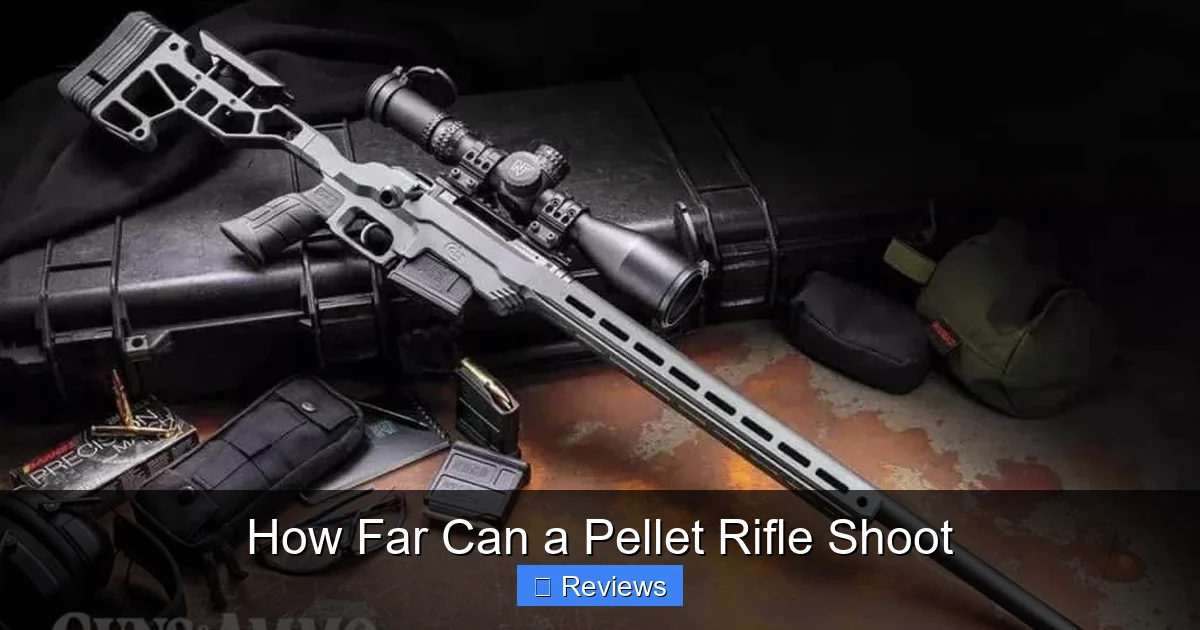
How far can a pellet rifle shoot? The actual distance a pellet rifle can shoot varies significantly, from 25 yards for effective pest control to over 100 yards for target shooting, with maximum ranges potentially exceeding 400 yards. This range is heavily influenced by the rifle’s power, pellet type, and the shooter’s skill, emphasizing that understanding effective range is more crucial than maximum distance for safety and success.
Ah, the classic question that every aspiring airgun enthusiast asks: “How far can a pellet rifle shoot?” It’s a natural curiosity, fueled by visions of hitting distant targets or perhaps taking down a tricky pest in the garden. But unlike a simple “how far can a baseball be thrown” answer, the distance a pellet rifle can shoot isn’t a straightforward number. It’s a nuanced topic, brimming with variables that can drastically change the outcome.
Imagine you’re standing in your backyard, air rifle in hand, wondering if you can ding that soda can across the lawn. Then, consider a professional competing in a field target match, aiming at a silhouette plate 100 yards away. Both are shooting pellet rifles, but the “how far” in each scenario is wildly different. We’re not just talking about the theoretical maximum distance a pellet can travel before hitting the ground, but rather the effective range – the distance at which you can consistently hit your target with adequate accuracy and energy. Let’s dive deep into this fascinating world and uncover the real answers to how far a pellet rifle can shoot.
Key Takeaways
- Maximum vs. Effective Range: While a pellet rifle can technically shoot hundreds of yards, its effective range (where it maintains accuracy and energy) is much shorter, typically 25-75 yards for most practical applications.
- Power Source Matters: PCP (Pre-Charged Pneumatic) rifles generally offer the highest power and thus the longest effective range, followed by gas-ram, spring-piston, and CO2 models.
- Pellet Choice is Crucial: Heavier pellets retain energy better over distance and are less affected by wind, while pellet design (domed, hollow point, pointed, wadcutter) also plays a significant role in ballistics and range.
- Caliber Impact: Larger calibers (.22, .25, .30, .357) typically carry more energy and can be effective at longer ranges than smaller calibers (.177), especially for hunting or pest control.
- Accuracy Trumps Distance: Even the most powerful pellet rifle is useless without accuracy. Proper technique, a quality scope, and consistent practice are vital for hitting targets at any distance.
- Safety First: Always know your target and what’s beyond it. A pellet can travel much further than its effective range, posing a significant safety risk if proper backstops are not used.
Quick Answers to Common Questions
Can a .177 pellet rifle kill a person?
Yes, while not designed for it, a .177 caliber pellet rifle can cause serious injury or even be lethal if the pellet strikes a vulnerable area such as an eye, temple, or throat, especially at close range.
What is the maximum range of a powerful PCP air rifle?
A powerful PCP air rifle can have a maximum theoretical range of over 400-600 yards, meaning the pellet will eventually fall to the ground at that distance. However, its effective range for accuracy and energy is typically much shorter, usually 50-100 yards.
Are lighter or heavier pellets better for long distance shooting?
Generally, heavier pellets within a given caliber are better for long-distance shooting. While they may start slower, their increased mass and typically better ballistic coefficient allow them to retain energy more effectively and resist wind drift better over longer distances.
Why do CO2 rifles have a shorter effective range?
CO2 rifles typically have a shorter effective range because CO2 cartridges provide less power and consistency compared to spring-piston, gas-ram, or PCP systems. Additionally, CO2 power is highly sensitive to temperature, leading to significant power loss in cold conditions.
How much does wind affect a pellet’s trajectory?
Wind has a significant impact on a pellet’s trajectory, even light breezes. Due to their light weight, pellets are easily pushed off course, especially at ranges beyond 25 yards. Learning to compensate for wind is a crucial skill for accurate long-range airgun shooting.
📑 Table of Contents
- Understanding the “How Far” – What Does Range Actually Mean?
- The Core Factors Influencing Pellet Rifle Range
- Practical Shooting Ranges for Different Purposes
- Maximizing Your Pellet Rifle’s Range and Accuracy
- Safety First: Understanding Your Pellet Rifle’s Potential
- Conclusion: The Art and Science of Pellet Rifle Range
Understanding the “How Far” – What Does Range Actually Mean?
When we ask “how far can a pellet rifle shoot?”, we’re often thinking about two distinct concepts: maximum range and effective range. It’s vital to differentiate between these, as one tells you what’s physically possible, and the other tells you what’s practically useful and safe.
Maximum vs. Effective Range
Maximum Range: This refers to the furthest a pellet can travel from the muzzle before gravity pulls it to the ground. Think of it as throwing a baseball as hard as you can – it will eventually hit the ground, potentially hundreds of feet away, even if you couldn’t accurately hit a target at that distance. For powerful air rifles, a pellet can travel an astounding distance, often exceeding 400 yards, and in some high-powered cases, even more than 600 yards! However, at these extreme distances, the pellet has lost almost all its kinetic energy, is heavily affected by wind, and its trajectory becomes a massive arc, making accuracy virtually impossible.
Effective Range: This is the golden number. Effective range is the maximum distance at which you can consistently hit your intended target with sufficient accuracy and energy for the task at hand. If you’re hunting, “sufficient energy” means enough power to humanely dispatch the animal. If you’re target shooting, it means grouping your shots within a specific size. For most common pellet rifles, the effective range for precise target shooting or small game hunting typically falls between 25 to 75 yards. Some high-end PCP rifles, in skilled hands, can extend this effective range to 100 yards or even slightly beyond for specialized tasks like field target competition.
Lethal Range vs. Target Practice Range
The effective range can also be broken down further based on purpose. When hunting or for pest control, you’re concerned with the lethal range – the distance at which the pellet retains enough energy to humanely dispatch the target. This is usually significantly shorter than the range at which you can merely hit a paper target. For instance, a .177 caliber pellet might be effective for squirrels out to 25-35 yards, while a .22 caliber might extend that to 40-50 yards. However, for casual plinking or target practice against inanimate objects, the “target practice range” might be longer, as you’re less concerned with kinetic energy and more focused on simply hitting the target, even if the pellet barely nicks it.
The Core Factors Influencing Pellet Rifle Range
To truly understand how far a pellet rifle can shoot, we need to look under the hood. Several key factors work together to determine a pellet’s velocity, stability, and energy retention, all of which directly impact its range.
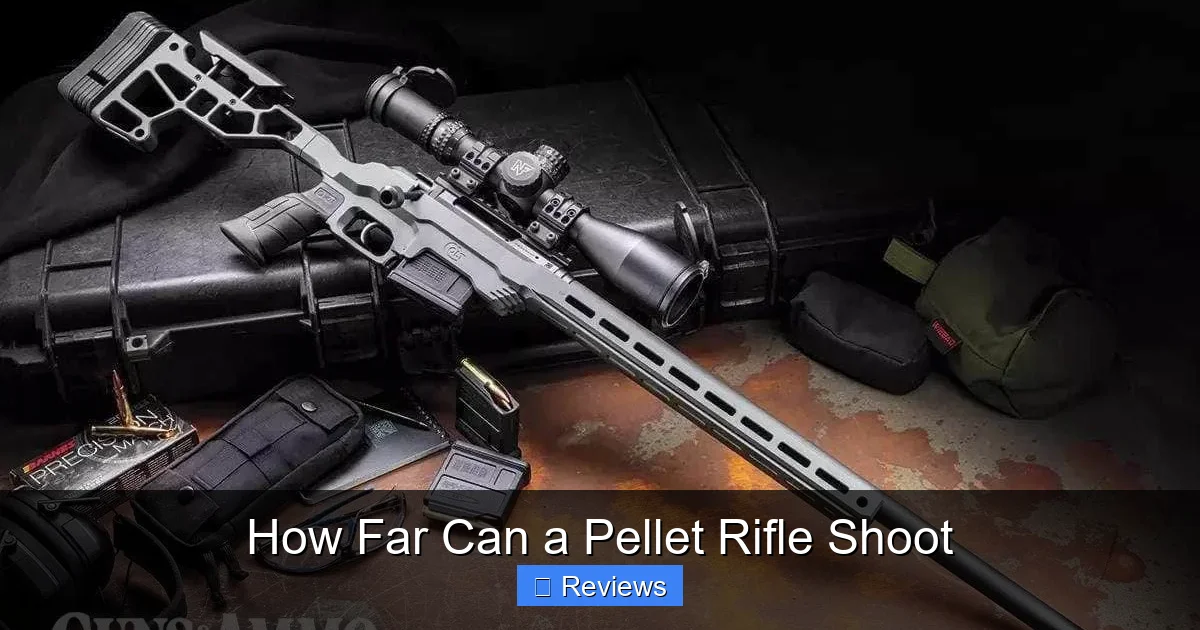
Visual guide about How Far Can a Pellet Rifle Shoot
Image source: bestwildlifecameras.com
Pellet Rifle Power Plant
The mechanism that propels the pellet is perhaps the most significant factor. Different power plants offer varying levels of power and consistency:
- Spring-Piston Rifles: These are very common and often affordable. A spring is compressed when cocked, then released to drive a piston forward, compressing air behind the pellet. They offer good power, but can have significant recoil (“spring twang”), making them harder to shoot accurately at longer distances. Typical effective range for hunting might be 25-40 yards.
- Gas-Ram (or Nitro Piston) Rifles: Similar to springers, but use a sealed cylinder of inert gas instead of a coiled spring. They offer smoother shooting, less recoil, and are less sensitive to temperature changes. This often translates to better accuracy and slightly extended effective range compared to traditional springers, perhaps 30-50 yards for hunting.
- CO2 Rifles: Powered by disposable CO2 cartridges, these are often semi-automatic or repeater models. While convenient, CO2 is sensitive to temperature (losing power in cold weather) and generally offers lower velocities than spring-piston or PCP rifles. Their effective range is usually limited to 10-25 yards, making them ideal for plinking or very close-range pest control.
- PCP (Pre-Charged Pneumatic) Rifles: These are the undisputed kings of power and accuracy in the airgun world. They use an onboard air reservoir filled with highly compressed air from an external source (hand pump, scuba tank, or compressor). PCPs offer minimal recoil, consistent shot strings, and very high velocities, allowing for excellent accuracy and power at much greater distances. A good PCP can have an effective hunting range of 50-75 yards, and even 100+ yards for competitive target shooting. This is often what people mean when they talk about “how far can a pellet rifle shoot” for serious applications.
Caliber and Pellet Weight
The diameter of the pellet (caliber) and its weight significantly influence trajectory and energy retention:
- .177 Caliber (4.5mm): The smallest and fastest. Ideal for target shooting, plinking, and small pests like sparrows or mice at close range (10-30 yards). Its lighter weight means it loses energy faster and is more susceptible to wind.
- .22 Caliber (5.5mm): A very popular all-around choice. It sacrifices some velocity for greater energy and better stability, making it excellent for pests like squirrels, rabbits, and larger birds out to 40-60 yards. It’s less affected by wind than .177.
- .25 Caliber (6.35mm): Offers even more knockdown power, suitable for larger pests like groundhogs, raccoons, or small coyotes at 50-75 yards. It’s slower but carries substantial energy.
- Big Bore Calibers (.30, .357, .45, .50): These are specialized air rifles, often PCPs, designed for hunting medium to large game. They launch heavy projectiles with significant energy, extending lethal ranges significantly, sometimes comparable to rimfire firearms.
Within each caliber, pellet weight plays a huge role. Heavier pellets for a given caliber will be slower initially but often retain energy better over distance and are less susceptible to wind drift, making them a good choice for longer shots. Lighter pellets fly faster but shed energy more quickly.
Pellet Design and Ballistic Coefficient
Pellets aren’t all created equal. Their shape and construction impact how efficiently they cut through the air, described by their Ballistic Coefficient (BC):
- Domed/Round Nose: These are excellent all-around pellets. Their aerodynamic shape gives them a good BC, meaning they retain velocity and energy well over distance, making them ideal for extending how far a pellet rifle can shoot effectively.
- Pointed: Designed for penetration, but often have a slightly lower BC than domed pellets, making them less ideal for extreme range accuracy.
- Hollow Point: Designed for expansion upon impact, delivering more terminal energy. Typically have a lower BC and are best used at shorter ranges where expansion is guaranteed and energy retention isn’t the primary concern.
- Wadcutter: Flat-nosed pellets designed to cut clean holes in paper targets at very close range (10-20 yards). They have a terrible BC and are utterly unsuitable for anything beyond short-range plinking due to rapid velocity and energy loss.
A higher BC pellet will travel further with greater accuracy and energy retention, helping you maximize how far your pellet rifle can shoot.
Barrel Quality and Length
A quality barrel with consistent rifling is crucial for accuracy. A longer barrel generally allows more time for the pellet to accelerate and stabilize, potentially resulting in higher velocities and better accuracy. However, there’s a point of diminishing returns; excessively long barrels can actually introduce more friction, slowing the pellet down, or cause other issues like barrel harmonics. Most air rifles are designed with an optimal barrel length for their power plant and caliber.
Practical Shooting Ranges for Different Purposes
Let’s get down to the brass tacks: what kind of distances can you realistically expect for various activities? This is where the “how far can a pellet rifle shoot” question gets truly practical.
Backyard Plinking and Target Practice
For casual fun, knocking over soda cans, or shooting paper targets in your backyard, typical ranges are very modest.
- 10-25 Yards: Most air rifles, regardless of power plant, can be quite accurate at this range. It’s perfect for beginners to learn the fundamentals of shooting. CO2 rifles excel here, as do lower-powered springers and gas-rams.
Small Pest Control (Mice, Rats, Sparrows)
When dealing with small, close-range pests, precision is paramount to ensure a humane dispatch.
- 15-25 Yards: A good quality .177 or .22 caliber air rifle (springer, gas-ram, or PCP) can be highly effective. Accuracy is key, so practice at these distances to ensure you can consistently hit a small target zone.
Medium Pest Control (Squirrels, Rabbits)
For slightly larger, tougher pests, more energy and range are beneficial.
- 25-50 Yards: This is the sweet spot for many .22 caliber air rifles, especially good quality gas-rams or entry-level PCPs. Experienced shooters with powerful PCPs might extend this slightly further, but accuracy becomes much more challenging beyond 50 yards. A .25 caliber air rifle would also be excellent here, providing more energy.
Field Target and Competitive Shooting
Field Target (FT) is a discipline designed to test both shooter and rifle at varied ranges and conditions.
- Up to 60 Yards (HFT) / Up to 80-100+ Yards (FT): This is where high-end PCP rifles truly shine. They offer the power and consistency needed to hit small targets at these extended distances. Shooters often use sophisticated optics with multiple aiming points and extensively practice range estimation and wind compensation. This is the pinnacle of understanding how far a pellet rifle can shoot accurately under competitive pressure.
Maximizing Your Pellet Rifle’s Range and Accuracy
You have a decent rifle, but you want to squeeze every last bit of performance out of it. Here’s how you can extend how far your pellet rifle can shoot effectively.
Choosing the Right Pellet
This is arguably the easiest and most impactful upgrade you can make. Every air rifle has a “preferred” pellet. Buy several different brands, weights, and head designs (especially domed) within your rifle’s caliber. Shoot groups with each at your desired range. The pellet that gives you the tightest groups is the one to stick with. Often, heavier, quality domed pellets will provide the best long-range accuracy and energy retention.
Optics: Scopes and Sights
While iron sights are fine for close-range plinking, a good quality scope is essential for accuracy beyond 25 yards. Look for:
- Appropriate Magnification: Too much magnification can make the target image shaky, while too little won’t help with precision at distance. Adjustable magnification (e.g., 3-9x or 4-16x) is often ideal.
- Clear Glass: Good optics mean a bright, clear image, crucial for seeing small targets at longer ranges.
- Parallax Adjustment: Important for removing aiming errors at different distances, especially on scopes used for field target shooting.
- Mil-dot or MOA Reticle: These allow for precise holdovers to compensate for pellet drop at varying ranges.
Proper Shooting Technique
The best rifle and pellet in the world are useless without a skilled shooter. Focus on:
- Consistent Hold: For spring-piston and gas-ram rifles, learning the “artillery hold” (a light, consistent grip that allows the rifle to recoil naturally) is critical. PCPs are less hold-sensitive.
- Breathing Control: Shoot between natural respiratory pauses.
- Trigger Control: A smooth, consistent pull that doesn’t jerk the rifle.
- Follow-Through: Maintain your sight picture until the pellet has left the barrel.
Maintenance and Cleaning
A well-maintained rifle performs better. Regularly clean your barrel to remove lead fouling, which can degrade accuracy. Keep moving parts lubricated (according to manufacturer instructions) and check for loose screws, especially on scope mounts. A clean, well-cared-for rifle will consistently shoot how far you expect it to.
Environmental Factors (Wind, Temperature)
Pellets are lightweight and highly susceptible to environmental conditions:
- Wind: Even a light breeze can push a pellet significantly off target at 25+ yards. Learning to “read the wind” and apply appropriate windage corrections is an advanced skill vital for long-range shooting.
- Temperature: Affects CO2 rifle power directly (colder means less power). It can also slightly affect pellet performance and air density, though less dramatically for other power plants.
- Humidity/Altitude: Minor effects on pellet flight, primarily relevant for extreme long-range competitive shooting.
Safety First: Understanding Your Pellet Rifle’s Potential
Understanding how far a pellet rifle can shoot is not just about performance; it’s crucially about safety. Just because a pellet loses effective energy doesn’t mean it ceases to be a danger.
Backstops and Overpenetration
Always have a safe, robust backstop when shooting. Remember that a pellet can travel hundreds of yards beyond your target. Never shoot at hard, flat surfaces that could cause ricochets. Ideal backstops absorb the pellet’s energy without bounce-back. Examples include thick plywood, layers of carpet, sandbags, or specialized pellet traps.
Know Your Target and Beyond
This is the cardinal rule of firearm and airgun safety. Before you take a shot, always be absolutely certain of your target and what lies beyond it. Is there a house, a road, a pet, or a person in the potential path of a missed shot or an over-penetrating pellet? If there’s any doubt, DO NOT take the shot. Even an air rifle pellet can cause serious injury or even death, especially if it hits a vulnerable area like an eye.
Legal Considerations
Laws regarding air rifle use vary by location, often influenced by their power and whether they’re considered firearms. Always check local, state, and national regulations concerning ownership, shooting locations (e.g., within city limits, hunting seasons), and transportation of air rifles. Just because it’s an “airgun” doesn’t mean it’s exempt from serious legal scrutiny.
Conclusion: The Art and Science of Pellet Rifle Range
So, how far can a pellet rifle shoot? The answer, as we’ve explored, is “it depends!” From the 10-yard plinking fun of a CO2 pistol to the 100-yard precision of a high-power PCP, the range is incredibly varied. What’s clear is that the effective range – where accuracy and energy meet your purpose – is far more important than the maximum theoretical distance a pellet can travel.
Achieving impressive range and accuracy with a pellet rifle is a blend of selecting the right equipment, choosing the optimal pellet, understanding external factors, and most importantly, honing your shooting skills through practice. But above all, never compromise on safety. Respect the potential of your air rifle, know your limits, and always shoot responsibly. Happy shooting!
🎥 Related Video: How many pellets can be shot at one time? #airgunning #airgun #gun #hunting #shooting #shorts
📺 BLOCKETH OUTDOORS
Frequently Asked Questions
What is the most accurate pellet rifle for long range?
For long-range accuracy, a Pre-Charged Pneumatic (PCP) air rifle is generally considered the most accurate. Their lack of recoil, consistent power delivery, and typically higher velocities allow for much greater precision at extended distances compared to other power plants.
Can you hunt deer with a pellet rifle?
In most jurisdictions, hunting deer with a pellet rifle is illegal, as they typically do not meet the minimum caliber and energy requirements for humanely taking down such large game. There are specialized “big bore” air rifles that can ethically hunt deer, but always check local regulations first.
How often should I clean my pellet rifle barrel?
The frequency of barrel cleaning depends on usage and pellet type, but a good rule of thumb is every few hundred shots, or if you notice a drop in accuracy. Some barrels “lead up” faster than others, and excessive cleaning can sometimes be detrimental, so monitor your rifle’s performance.
What is “holdover” in airgun shooting?
Holdover refers to aiming above your target to compensate for the pellet’s drop due to gravity over distance. Since pellets follow a parabolic trajectory, understanding how much to aim high for various ranges is crucial for hitting targets beyond your zero distance.
Is a .22 or .177 pellet rifle better for pest control?
For pest control, a .22 caliber pellet rifle is generally preferred over a .177. While the .177 is faster, the .22 delivers more kinetic energy upon impact, increasing the likelihood of a humane and effective dispatch for most common pests like squirrels and rabbits.
Do pellet rifles require a license?
In many places, standard pellet rifles do not require a specific license or permit to own, unlike firearms. However, laws vary significantly by country, state, and even local municipality. It is crucial to research and understand the specific airgun laws in your area before purchasing or using a pellet rifle.