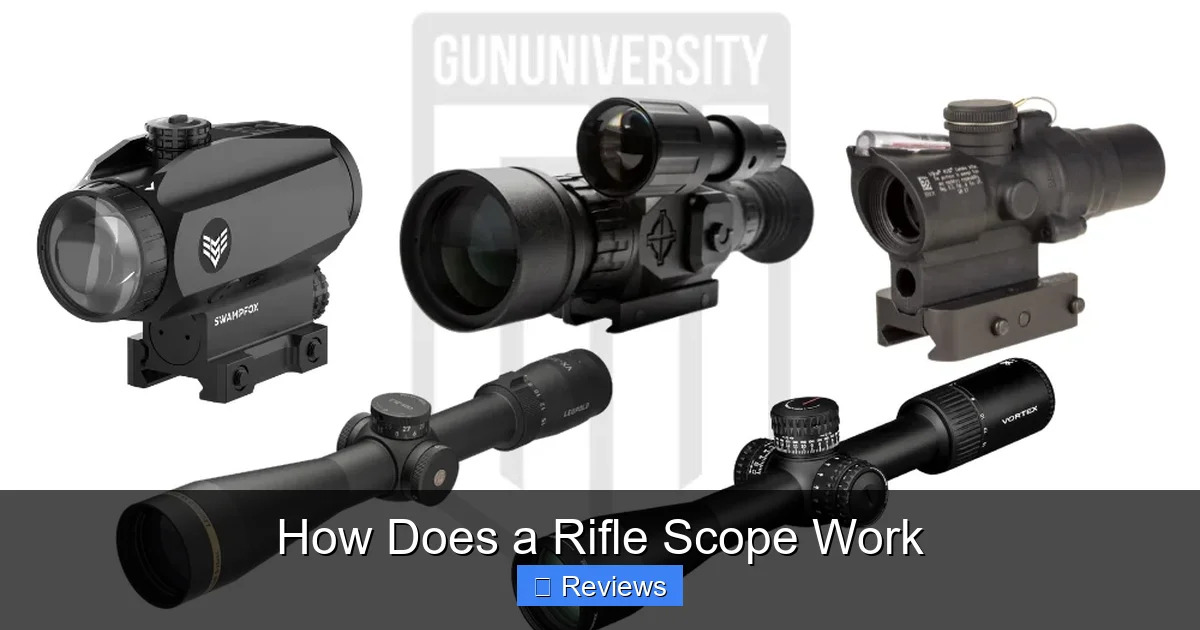
A rifle scope works by ingeniously manipulating light through a series of lenses to magnify a distant target and superimpose a precise aiming reticle onto the magnified image. It uses an objective lens to gather light, an erector system to create magnification and correct the inverted image, and an eyepiece to present the final, focused view to your eye. Adjustments like windage, elevation, and parallax further refine accuracy, making it an indispensable tool for precision.
Have you ever looked through a high-quality rifle scope and been amazed by how it brings a distant target into sharp, clear focus? It feels a bit like magic, doesn’t it? Suddenly, that small target miles away is right there, almost within reach, with a precise aiming point superimposed over it. For many, a rifle scope is an essential tool, transforming a challenging shot into a confident one, but the intricate science behind “how does a rifle scope work” often remains a mystery.
It’s far more than just a fancy tube with glass. A rifle scope is a marvel of optical engineering, a sophisticated instrument designed to enhance precision, extend effective range, and provide a clearer view of your target. Understanding its inner workings not only demystifies this incredible device but also empowers you to use it more effectively, troubleshoot issues, and appreciate the craftsmanship involved. Let’s pull back the curtain and explore exactly how a rifle scope works, from the moment light enters the lens to the perfectly aimed shot.
Key Takeaways
- Optical System: A rifle scope uses an objective lens to gather light, an erector lens system for magnification and image correction, and an eyepiece lens to deliver a magnified, focused image to the shooter’s eye.
- Magnification: Achieved by the erector system, magnification makes distant targets appear closer. Variable power scopes allow adjustment, while fixed power scopes offer a single magnification level.
- Reticle Function: The reticle (crosshairs) is an etched or wire pattern placed at a specific focal plane within the scope, providing an aiming point that can be adjusted for bullet drop and wind.
- Focal Planes (FFP vs. SFP): First Focal Plane (FFP) reticles scale with magnification, keeping subtensions accurate at all powers. Second Focal Plane (SFP) reticles remain constant in size, with subtensions accurate only at a specific magnification.
- Mechanical Adjustments: Windage and elevation turrets precisely move the reticle, compensating for bullet trajectory and environmental factors, typically measured in MOA or MIL.
- Parallax Correction: Parallax adjustment eliminates the apparent shift of the reticle relative to the target when the shooter’s eye moves, ensuring the reticle and target are on the same optical plane for ultimate accuracy.
- Image Correction: Inside, a set of erector lenses ensures the image you see is right-side up and correctly oriented, as raw optical magnification inherently inverts and reverses the view.
Quick Answers to Common Questions
What are the three main lens systems in a rifle scope?
The three main lens systems are the objective lens (front), the erector system (middle), and the eyepiece lens (rear).
What is the purpose of the objective lens?
The objective lens gathers light from the target and forms an initial, inverted image inside the scope.
What is the difference between an FFP and SFP reticle?
An FFP (First Focal Plane) reticle changes size with magnification, keeping subtensions accurate at all powers, while an SFP (Second Focal Plane) reticle remains constant in size, with subtensions accurate only at a specific magnification.
What do the elevation and windage turrets do?
Elevation turrets adjust the reticle vertically to compensate for bullet drop, and windage turrets adjust it horizontally to compensate for wind drift.
Why is parallax adjustment important?
Parallax adjustment eliminates the apparent shift between the reticle and the target when your eye moves, ensuring the target image and reticle are on the same optical plane for precise aiming.
📑 Table of Contents
The Core Components: What’s Inside a Rifle Scope?
To truly grasp how a rifle scope works, we first need to dissect it, metaphorically speaking, and look at its primary components. Think of it as a finely tuned optical instrument, meticulously assembled to guide light in a very specific way.
The Optical System: Lenses and Light
At the heart of every rifle scope is a series of precisely ground and polished glass lenses. These aren’t just any old pieces of glass; they are designed with specific curvatures and characteristics to manipulate light.
- Objective Lens: This is the large lens at the very front of the scope, facing the target. Its primary job is to gather as much light as possible from the scene you’re looking at. The larger the objective lens, the more light it can collect, which generally translates to a brighter, clearer image, especially in low-light conditions. When light passes through the objective lens, it forms an inverted and reversed image of the target inside the scope tube.
- Erector System: This is a crucial set of lenses positioned further back in the scope. Its job is twofold: first, to magnify the inverted image created by the objective lens, and second, to *erect* or reinvert the image so that you see it right-side up and correctly oriented. Without the erector system, your target would appear upside down and backward! This system also allows for variable magnification in adjustable scopes.
- Eyepiece Lens: Also known as the ocular lens, this is the lens closest to your eye. Its function is to magnify the image presented by the erector system and project it clearly onto your retina, allowing you to see the target and the reticle sharply focused.
This interplay of lenses is fundamental to understanding how a rifle scope works, guiding light through a complex path to deliver a clear, magnified view.
The Reticle: Your Aiming Point
The reticle, often referred to as crosshairs, is arguably the most recognizable part of a scope to the casual observer. It’s the pattern you see superimposed over your target, providing a precise aiming point.
- What it is: Traditionally, reticles were fine wires stretched across a frame. Today, most modern scopes feature reticles etched directly onto a glass wafer or a thin piece of metal. This etching makes them much more durable and allows for complex designs.
- Types of Reticles: There’s a vast array of reticle designs, each serving different purposes.
- Duplex: A classic, simple crosshair with thick outer posts tapering to fine inner lines. Great for quick target acquisition.
- Mil-Dot/MOA: Features dots or hash marks along the crosshairs, used for range estimation and holdovers (compensating for bullet drop or wind without adjusting turrets).
- BDC (Bullet Drop Compensator): Designed for specific calibers or loads, with markings to compensate for bullet drop at various distances.
The reticle is not just a static aiming point; it’s a dynamic tool that, when understood, significantly enhances a shooter’s ability to make accurate shots over varying distances and conditions. Its precise placement within the scope is also key, leading us to our next major topic.
The Tube: Housing and Protection
The external tube of the rifle scope works as a protective casing for all the delicate optical and mechanical components.
- Material: Most scope tubes are made from aircraft-grade aluminum, chosen for its strength, lightweight properties, and resistance to corrosion. Some high-end scopes might use steel or other alloys.
- Sealing: To prevent moisture, dust, and internal fogging, scope tubes are typically purged of air and filled with an inert gas like nitrogen or argon. This process makes the scope fogproof and waterproof, critical for reliability in diverse environments.
- Construction: Scopes are generally available in 1-inch (25.4mm), 30mm, 34mm, or even 35mm tube diameters. A larger tube diameter often allows for more internal adjustment range (how much the reticle can move up/down or left/right) and sometimes accommodates larger lens elements.
The Magic of Magnification: Seeing Further, Clearer
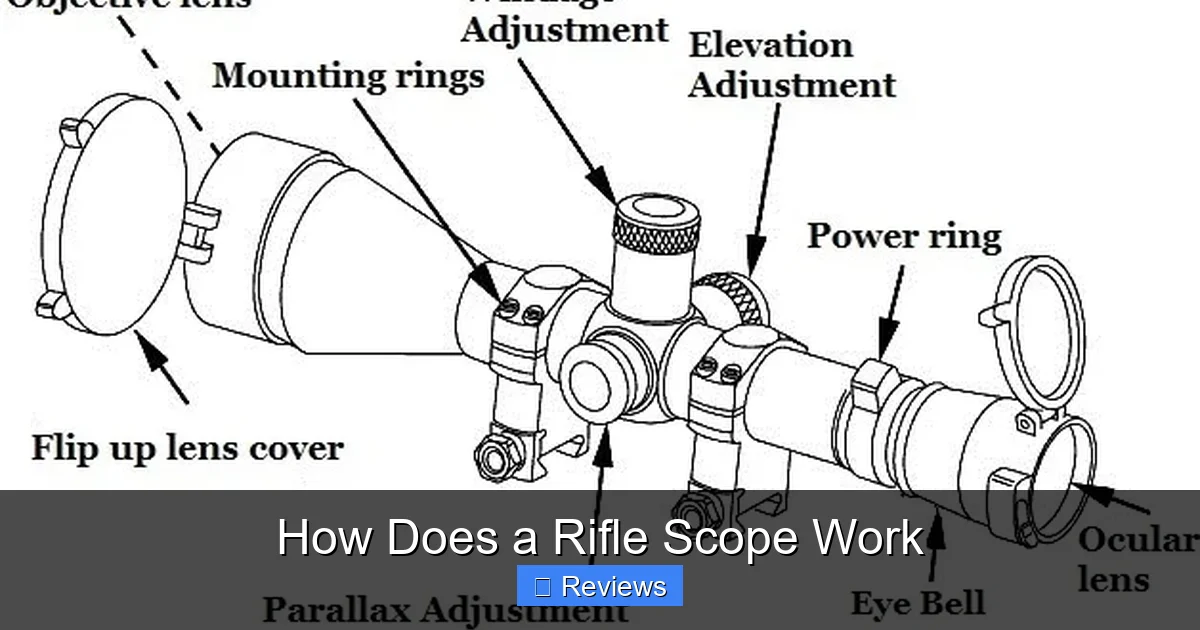
Visual guide about How Does a Rifle Scope Work
Image source: huntingmark.com
One of the primary reasons we use a rifle scope is for its ability to magnify the target. But how does this magnification actually work, and what do those numbers on your scope mean?
How Magnification Works
As mentioned, the erector system is responsible for magnification. It essentially takes the intermediate image from the objective lens and enlarges it before it reaches the eyepiece.
- Fixed Power: Some scopes have a fixed magnification (e.g., 4x). This means they always magnify the image by a factor of four. These scopes are often simpler, more robust, and can offer brighter images due to fewer internal lenses.
- Variable Power: Most modern rifle scopes offer variable magnification (e.g., 3-9x). By rotating a power ring on the scope, you physically move the lenses within the erector system. This movement changes the focal length of the erector lenses, thereby altering the degree of magnification. This flexibility allows shooters to adapt to different scenarios, from wide field-of-view tracking at low power to precise aiming at high power.
Understanding Magnification Numbers (e.g., 3-9×40)
When you see numbers like “3-9×40” on a scope, they tell you a lot about its capabilities:
- 3-9x: This indicates the magnification range. The scope can magnify from 3 times (3x) up to 9 times (9x). If it were a fixed power scope, it would just say “4x” or “6x”.
- 40: This number represents the diameter of the objective lens in millimeters. In this example, it’s 40mm. A larger objective lens generally means more light-gathering capability, which is great for low-light conditions, but it also means a larger, heavier scope.
Exit Pupil and Eye Relief
Two other critical aspects related to magnification that determine how comfortable and effective a rifle scope works are exit pupil and eye relief.
- Exit Pupil: This is the small circle of light that you see when you hold the scope at arm’s length and look through the eyepiece. It’s calculated by dividing the objective lens diameter by the magnification power (e.g., a 9×40 scope at 9x has an exit pupil of 40mm / 9 = 4.4mm). A larger exit pupil makes it easier to quickly acquire a full, bright image, especially in dynamic shooting situations or low light when your own pupil dilates.
- Eye Relief: This is the optimal distance your eye needs to be from the eyepiece to see the full, clear image. It’s crucial for safety, as it prevents the scope from hitting your brow during recoil. A generous eye relief (typically 3-4 inches) provides comfort and safety, especially with powerful calibers.
Reticle Placement and Its Impact: First vs. Second Focal Plane
The placement of the reticle within the optical system is a fundamental design choice that significantly impacts how a rifle scope works, especially when it comes to range estimation and holdovers. There are two primary types: First Focal Plane (FFP) and Second Focal Plane (SFP).
Second Focal Plane (SFP) Reticles
In an SFP scope, the reticle is positioned behind the erector system (closer to the eyepiece).
- Constant Size: As you change the magnification on an SFP scope, the reticle itself *appears* to remain constant in size. It doesn’t grow or shrink relative to your field of view.
- Subtension Accuracy: Because the reticle doesn’t change size, its subtensions (the measured distance between markings on the reticle, like Mil-Dots or MOA hash marks) are only accurate at one specific magnification setting, usually the highest power (e.g., 9x on a 3-9x scope). If you use a lower magnification, the target appears smaller, but the reticle remains the same size, so the space covered by a “Mil-Dot” on the reticle now covers more actual target area.
- Pros: Simpler to manufacture, generally less expensive, reticle remains fine and visible at high magnifications (doesn’t become too thick).
- Cons: Requires specific magnification for accurate holdovers/rangefinding, reticle can become very fine and difficult to see at low magnifications.
First Focal Plane (FFP) Reticles
In an FFP scope, the reticle is placed in front of the erector system (closer to the objective lens).
- Scaling Size: As you increase or decrease magnification on an FFP scope, the reticle appears to grow or shrink in proportion to the target image. It always covers the same *proportion* of the target, regardless of magnification.
- Subtension Accuracy: This means that the subtensions of the reticle (Mil-Dots, MOA hashes) are accurate at *all* magnification settings. A Mil-Dot will always cover one Mil of actual target space, whether you’re at 3x or 9x.
- Pros: Extremely valuable for long-range shooting, hunting, or tactical applications where consistent holdovers and rangefinding are needed at any magnification. You don’t have to remember a specific power setting.
- Cons: More complex and expensive to manufacture, reticle can appear very thick and obscure at high magnifications, or very fine and hard to see at low magnifications.
Choosing the Right Focal Plane
The choice between FFP and SFP depends largely on your shooting style and application. For general hunting at closer ranges where you might adjust magnification frequently, an SFP scope works well. For precision long-range shooting, tactical applications, or competitive shooting where consistent holdovers are paramount, an FFP scope is usually preferred, despite its higher cost. Understanding how a rifle scope works with its reticle placement is key to maximizing its utility.
Making Adjustments: Turrets and Precision
Beyond magnification and the reticle, a scope offers crucial adjustment mechanisms to fine-tune your aim. These are primarily the turrets, which allow you to compensate for gravity (bullet drop), wind, and even parallax.
Windage and Elevation Turrets
These are the most common adjustment turrets found on top and the side of the scope tube.
- Elevation Turret: Located on top, this turret moves the reticle up or down to compensate for bullet drop over distance. When you turn the elevation turret, you’re actually physically shifting the erector system assembly inside the scope, which in turn moves the perceived position of the reticle relative to the target image.
- Windage Turret: Located on the side (usually the right), this turret moves the reticle left or right to compensate for the effect of wind on the bullet’s trajectory. Like elevation, it shifts the erector system horizontally.
- Clicks, MOA, and Mil: Each “click” on a turret corresponds to a precise amount of adjustment at 100 yards (or meters). These adjustments are typically measured in either MOA (Minute of Angle) or MRAD (Milliradian, often simply called “Mil”).
- MOA: One MOA subtends approximately 1.047 inches at 100 yards (often rounded to 1 inch for simplicity). A common click value is 1/4 MOA, meaning each click moves the point of impact by 1/4 inch at 100 yards.
- Mil: One Mil subtends 3.6 inches at 100 yards, or 10cm at 100 meters. A common click value is 0.1 Mil, moving the point of impact by 0.36 inches at 100 yards (or 1cm at 100 meters).
Choosing between MOA and Mil is often a matter of personal preference or what your shooting group uses, but consistency between your reticle and turrets (e.g., a Mil-dot reticle with Mil turrets) simplifies adjustments. This is how a rifle scope works in a very precise, measurable way.
Parallax Adjustment
Parallax is an optical phenomenon where the reticle appears to shift relative to the target when you move your eye slightly. It’s caused when the target image formed by the objective lens is not perfectly focused on the same optical plane as the reticle.
- What is Parallax?: Imagine holding your finger up and looking at a distant object. If you close one eye then the other, your finger seems to jump. That’s parallax. In a scope, if the reticle and target image aren’t on the same plane, moving your eye slightly can cause you to unintentionally aim off-target.
- How it Works: Many modern scopes (especially those with higher magnification) feature a parallax adjustment turret, usually located on the side (coaxially with the windage turret) or sometimes on the objective bell. Turning this knob physically moves an internal lens element to precisely focus the target image onto the same plane as the reticle, eliminating parallax errors. You typically adjust it until the target is perfectly clear and there’s no reticle shift when you move your head slightly.
- Importance: Eliminating parallax is critical for precision shooting, as even a tiny error can lead to a significant miss at longer distances.
Diopter Adjustment
Often overlooked, the diopter adjustment ring is located on the eyepiece and is designed to focus the reticle itself for your individual eyesight. It does not focus the target; it focuses the reticle.
- How it Works: You adjust the diopter by pointing the scope at a clear, bright background (like the sky), ensuring the target is out of focus, and then turning the diopter ring until the reticle appears perfectly crisp and sharp to your eye. This is a “set it and forget it” adjustment, but it’s crucial for ensuring the reticle is sharp for your vision, preventing eye strain and ensuring optimal use of how a rifle scope works.
Advanced Features and Considerations
While the core components and adjustments explain the fundamental “how does a rifle scope work,” several advanced features contribute to overall performance, clarity, and durability.
Illumination: Low Light Performance
Many modern scopes offer an illuminated reticle, which means a portion or the entirety of the reticle can light up.
- Why it’s useful: In low-light conditions (dawn, dusk) or against dark backgrounds, an unilluminated black reticle can become very difficult to see. Illumination provides a clear aiming point without obscuring the target, making it easier to make precise shots when light is scarce. The brightness is typically adjustable.
Lens Coatings: Clarity and Durability
Lens coatings are microscopic layers applied to the surface of the lenses, dramatically improving optical performance.
- Purpose: Coatings reduce glare, minimize light reflection (which would otherwise cause a loss of light), and enhance light transmission, contrast, and color fidelity. Different coatings target specific wavelengths of light.
- Types: “Coated” means at least one surface has one layer. “Fully Coated” means all air-to-glass surfaces have one layer. “Multi-Coated” means at least one surface has multiple layers. “Fully Multi-Coated” (FMC) means all air-to-glass surfaces have multiple layers, offering the best performance. Coatings also protect lenses from scratches and moisture.
Field of View: What You See
Field of view (FOV) refers to the width of the area you can see through the scope at a specific distance, usually 100 yards.
- Impact of Magnification: As you increase magnification, your field of view decreases. This is a trade-off: higher magnification brings the target closer, but you see less of the surrounding area.
- Importance: A wider field of view at lower magnifications is beneficial for scanning, tracking moving targets, and situational awareness.
Understanding Light Transmission: Brightness
Light transmission is the percentage of light that successfully passes through all the lenses and coatings to reach your eye. It’s a critical factor in how bright and clear the image appears, especially in challenging lighting conditions.
- High Quality is Key: High-quality lenses with excellent multi-coatings can achieve light transmission rates of 90% or more. Cheaper scopes often have lower transmission, resulting in dimmer, less vibrant images.
Conclusion
The rifle scope is a testament to ingenious engineering, a complex yet elegant tool that transforms the act of shooting. From the moment light enters the objective lens, it embarks on a precisely choreographed journey through an array of lenses, where it’s gathered, inverted, re-inverted, magnified, and finely focused. The reticle, meticulously placed, provides the aiming anchor, while sophisticated turrets allow for minute adjustments, defying gravity and wind.
Understanding “how does a rifle scope work” isn’t just about appreciating its technical prowess; it’s about unlocking its full potential. Knowing the role of each lens, the difference between focal planes, and the function of every turret empowers you to make informed decisions, optimize your settings, and ultimately, become a more accurate and confident shooter. So, the next time you look through a scope, remember the optical ballet happening within that tube – a symphony of physics and precision working together to put your shot exactly where you intend it to go.
Frequently Asked Questions
How do variable magnification scopes change power?
Variable magnification scopes change power by physically moving lenses within the erector system. As these lenses shift, they alter the focal length and thus the degree to which the target image is magnified before it reaches your eye.
What does “MOA” or “Mil” mean in relation to scope adjustments?
MOA (Minute of Angle) and Mil (Milliradian) are angular units of measurement used for scope adjustments. They quantify how much the point of impact shifts at a given distance, helping shooters make precise corrections for bullet drop and windage.
Is a larger objective lens always better?
A larger objective lens generally gathers more light, leading to a brighter image, especially in low light. However, it also results in a heavier, bulkier scope and may not always be necessary, depending on your shooting conditions and needs.
What is eye relief and why is it important?
Eye relief is the optimal distance your eye should be from the eyepiece to see the full, clear image. It’s crucial for preventing the scope from contacting your brow during recoil, ensuring both comfort and safety for the shooter.
How do lens coatings improve scope performance?
Lens coatings are thin layers applied to glass surfaces to reduce glare, minimize light reflection, and enhance light transmission. This results in brighter, clearer, and higher-contrast images with better color fidelity.
What causes parallax and how is it corrected?
Parallax occurs when the target image and the reticle are not focused on the same optical plane, causing the reticle to appear to shift with eye movement. It is corrected by a parallax adjustment turret that moves an internal lens to bring both into precise focus.