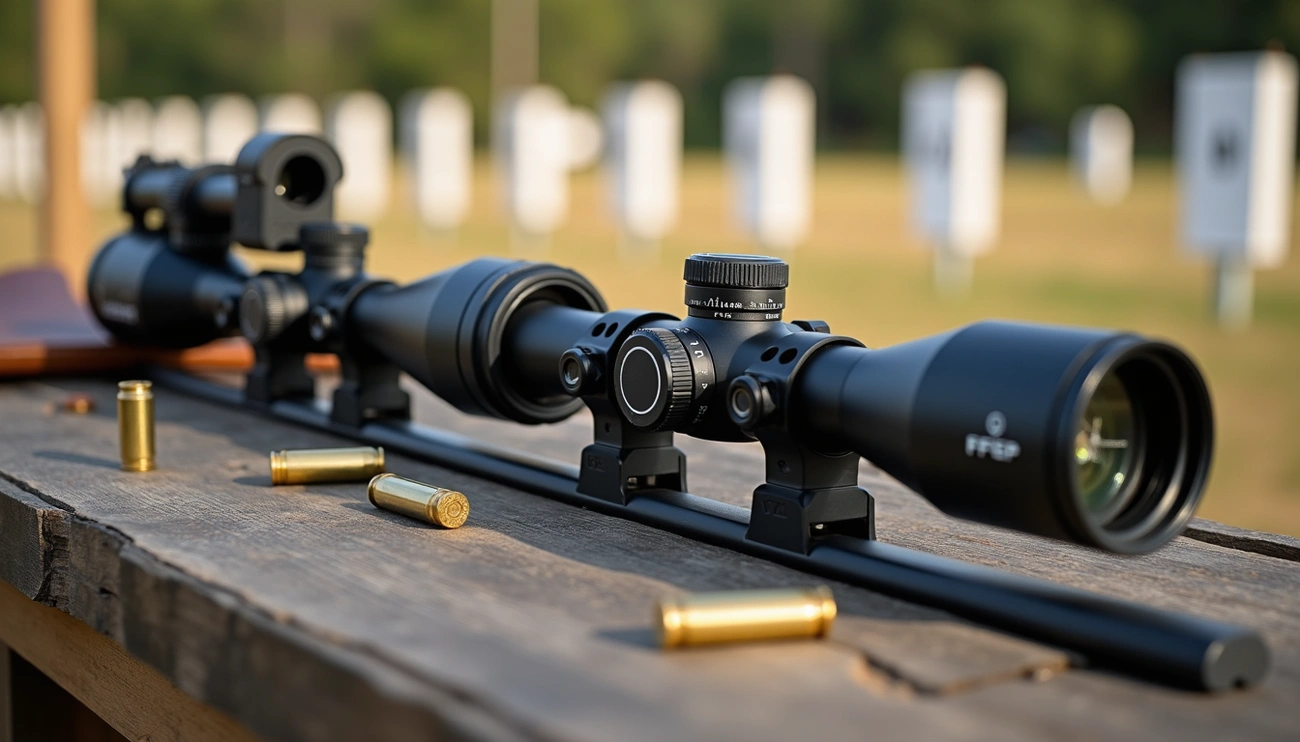
Choosing between first- and second-focal-plane scopes can significantly impact your shooting experience and accuracy. When shopping for a rifle scope, you’ve likely encountered these terms and wondered which option best suits your needs. First focal plane (FFP) scopes are commonly preferred by long-range target shooters, while most hunters have traditionally favoured second focal plane (SFP) scopes for their greater flexibility.
So, what does first focal plane mean? In an FFP scope, the reticle is positioned in front of the magnification lenses, causing it to change size as you adjust magnification. This differs from SFP scopes, where the reticle remains the same size regardless of magnification settings. The difference between first and second focal plane designs isn’t merely technical—it directly affects how you’ll use your rifle in various shooting scenarios. FFP optics excel when long-range precision matters, such as big game hunting and competitive shooting. However, SFP scopes are often lighter and simpler to use, making them ideal for close-range hunting and tactical applications.
Whether you’re a seasoned marksman or new to rifle scopes, understanding these differences is crucial for making an informed purchase. In this guide, we’ll break down everything you need to know about both focal plane types, helping you determine which scope will best complement your shooting style, budget, and specific needs.
Understanding Focal Planes in Rifle Scopes
The location of a scope’s reticle within the optical system fundamentally affects its performance in the field. To understand the technical distinction between first- and second-focal-plane designs, we need to examine how manufacturers position the reticle relative to the magnification lenses.
What does first focal plane mean?
In a first focal plane (FFP) scope, the reticle is positioned in front of the magnification lenses. This placement scales the reticle proportionally with your target image as you adjust magnification. Essentially, both the target and reticle grow or shrink together when you zoom in or out. Think of it like this: as you increase magnification, everything you see through the scope—including the reticle—becomes larger simultaneously.
The difference between the first and second focal planes
The primary distinction lies in reticle placement relative to the magnification system. Unlike FFP scopes, second focal plane (SFP) scopes place the reticle behind the magnification lenses, closer to your eye. Consequently, in SFP scopes, only your target changes size during magnification adjustments, while the reticle remains constant. This difference creates distinct advantages for each design.
FFP scopes maintain consistent subtension values throughout all magnification levels, making them ideal for precision shooting at variable ranges. Conversely, SFP scopes offer a more familiar sight picture with a reticle that never appears too thin or thick, regardless of magnification setting. Additionally, FFP optics are generally more complex and expensive to produce than their SFP counterparts.
How reticle scaling works in FFP vs SFP
The scaling mechanism fundamentally changes how you use these scopes. With an FFP scope, if a hash mark represents 1 MOA or 1 MIL at 4x magnification, it will still represent exactly 1 MOA or 1 MIL at 16x. This consistent relationship between reticle and target simplifies long-range ballistic calculations.
In contrast, SFP reticles maintain their size during magnification changes, but their measurement values shift. For instance, a 1 MOA hash mark on an SFP scope is only truly 1 MOA at a specific magnification (typically maximum). At half that magnification, the same hash mark effectively represents 2 MOA because the target appears half as large while the reticle stays unchanged.
Use Case Scenarios: When to Choose FFP or SFP
Practical applications ultimately determine whether an FFP or SFP scope better serves your shooting needs. Understanding specific scenarios helps clarify which focal-plane design best aligns with your requirements.
Long-range shooting: Why FFP is preferred
Long-range marksmen predominantly favour first focal plane scopes for a fundamental reason—they enable accurate ranging and holdovers at any magnification. When shooting beyond 800 yards, FFP scopes become exponentially more valuable as the reticle subtensions remain true regardless of zoom level. Moreover, in situations with significant mirage, shooters often need to reduce magnification; FFP scopes allow this adjustment without sacrificing ballistic calculation accuracy. For precision rifle shooters, this consistency eliminates the need to remember which magnification setting corresponds to which holdover value—a critical advantage during high-pressure shots.
Short to mid-range hunting: SFP advantages
SFP scopes remain the dominant choice for hunting rifles, particularly at distances under 300 yards. Indeed, most successful shots at game animals occur at considerably shorter ranges. In timber or low-light environments, SFP scopes offer superior visibility because the reticle remains consistently sized, rather than becoming too thin at low magnifications. Furthermore, hunters typically shoot at maximum magnification anyway, negating the primary disadvantage of SFP designs. As a result, the center of an SFP reticle is often easier to acquire when shooting at lower magnification settings, making them particularly valuable for quick shots on moving game.
Tactical and competition shooting considerations
Competitive shooters face unique challenges that often favour FFP optics. Notably, some Precision Rifle Series (PRS) match directors specifically design stages where competitors cannot dial their scope’s turrets, forcing them to use holdovers instead. Military and police snipers likewise benefit from FFP scopes when making rapid follow-up shots based on observed misses or spotter calls. At the same time, for close-quarters tactical shooting, SFP scopes might suffice since most gunfights occur within 100 yards—distances requiring minimal ballistic compensation.
Pros and Cons of First vs Second Focal Plane
Understanding the strengths and limitations of both focal plane designs helps shooters make informed decisions based on their specific needs and shooting style.
FFP: Constant subtension, but variable visibility
First focal plane scopes offer a significant advantage—reticle subtensions remain accurate across all magnification levels. This means your holdover points for bullet drop and windage adjustments work consistently whether you’re zoomed in or out. Nonetheless, this benefit comes with notable trade-offs. At low magnification, FFP reticles appear extremely small, often becoming difficult to see in low light or against dark backgrounds. Alternatively, at high magnification, the reticle grows proportionally larger, potentially obscuring small targets. Despite these visibility challenges, tactical and precision shooters typically prefer FFP for its mathematical consistency—no mental calculations required when changing magnification.
SFP: Consistent reticle size, but limited accuracy at low magnification
Second focal plane scopes maintain a clear, readable reticle at all magnification settings. This provides excellent target acquisition, especially in dim conditions where thin reticles might disappear. The primary drawback, though, is that holdover marks are only accurate at one specific magnification—typically the scope’s highest power. When shooting at lower magnifications, users must perform quick mental math to determine correct holdovers. For example, in a scope where subtensions equal 1 MOA at 24x, they become 2 MOA at 12x magnification.
Cost and complexity differences
Manufacturing complexity directly impacts pricing between these designs. FFP scopes are typically more expensive due to their intricate construction. The process of precisely placing and aligning the glass-etched reticle in front of the erector unit is considerably more involved than installing an SFP reticle. Furthermore, FFP scopes often contain more moving parts, which can increase reliability concerns in extreme field conditions. Despite the narrowing cost gap in recent years, budget-conscious shooters may find SFP options more accessible without sacrificing optical quality.
Making the Right Choice for Your Rifle
Selecting the ideal scope involves matching optics to your specific shooting requirements. Let’s examine how to make this critical decision for your rifle setup.
How to match scope type with your shooting style
Your hunting environment should be the primary factor when choosing between first- and second-focal-plane scopes. For open-country and long-distance shooting where quick follow-up shots with holdovers are common, FFP scopes offer significant advantages. Alternatively, if you hunt in timber or low-light conditions, SFP scopes typically perform better, as FFP reticles can become too small and thin to see clearly against dark backgrounds at low magnification. Ultimately, traditional hunters using dial-up adjustments or holdover estimation at shorter ranges will benefit from standard SFP scopes.
Budget and feature trade-offs
FFP scopes are generally more expensive due to their complex design and assembly requirements. Nevertheless, what matters most is value for money—where do your shooting priorities lie? SFP users often find they can get what they want without substantial expenditure. If reliability is your top concern, many shooters don’t consider the additional features of FFP worth the extra cost.
Tips for testing before buying
Before finalizing your purchase:
- Test tracking by performing a “box test” to verify that adjustments move accurately
- Check parallax settings at various distances.
- Verify that reticle subtensions are correctly calibrated, especially on SFP scopes.
- Test FFP reticle visibility at both low and high magnifications
Comparison Table
| Feature | First Focal Plane (FFP) | Second Focal Plane (SFP) |
|---|---|---|
| Reticle Position | In front of magnification lenses | Behind magnification lenses |
| Reticle Behavior | Changes size with magnification | Remains constant size regardless of magnification |
| Subtension Values | Consistent across all magnification levels | Only accurate at specific magnification (typically maximum) |
| Primary Users | Long-range target shooters, competitive shooters | Hunters, tactical shooters at closer ranges |
| Optimal Range | Beyond 800 yards | Under 300 yards |
| Key Advantages | – Accurate ranging at any magnification – Consistent holdover points – No mental calculations needed | – Clearer reticle visibility – Better in low light conditions – Simpler to use – Lighter design |
| Key Disadvantages | – Reticle too small at low magnification – Can obscure targets at high magnification – More complex design | – Holdovers only accurate at specific magnification – Requires mental calculations for different magnifications |
| Cost | Generally more expensive | More affordable |
| Best For | – Precision long-range shooting – Competition shooting – Military/police applications | – Traditional hunting – Close-range tactical applications – Timber/low-light hunting |
FAQs
Q1. What is the main difference between first focal plane (FFP) and second focal plane (SFP) scopes?
The primary difference lies in reticle placement. In FFP scopes, the reticle is in front of the magnification lenses, so it changes size with magnification. In SFP scopes, the reticle is behind the magnification lenses and remains constant in size regardless of magnification.
Q2. Which type of scope is better for long-range shooting?
First focal plane (FFP) scopes are generally preferred for long-range shooting. They allow for accurate ranging and holdovers at any magnification, which is particularly valuable when shooting beyond 800 yards.
Q3. Are there advantages to using a second focal plane (SFP) scope?
Yes, SFP scopes have advantages, especially for short to mid-range hunting. They offer better reticle visibility in low-light conditions and at low magnifications. SFP scopes are also typically lighter, simpler to use, and more affordable than FFP scopes.
Q4. How do I choose between FFP and SFP for my rifle?
Consider your primary shooting style and environment. If you’re into long-range precision shooting or competitive shooting, an FFP scope might be best. For traditional hunting, especially in timber or low-light conditions, an SFP scope could be more suitable. Also, factor in your budget, as FFP scopes tend to be more expensive.
Q5. Do military snipers prefer FFP or SFP scopes?
Military and police snipers often prefer FFP scopes. These scopes are particularly useful when rapid and precise follow-up shots are needed, such as when spotting their own misses or working with a spotter calling corrections.