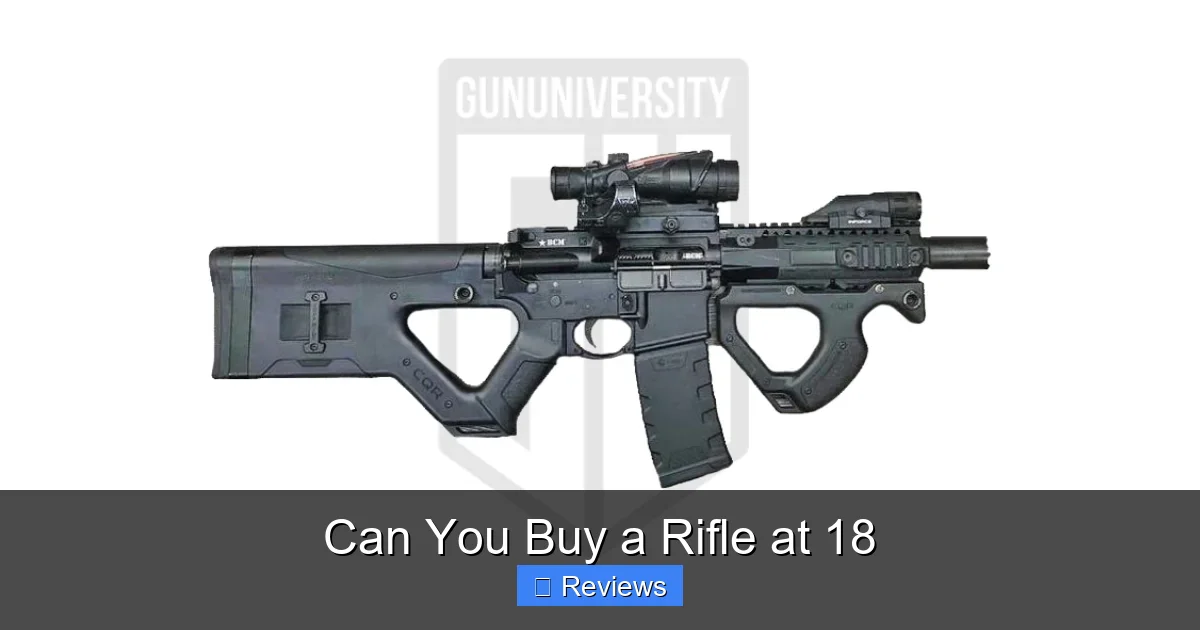
Federally, you can legally buy a rifle at 18 from a licensed dealer (FFL). However, the answer to “can you buy a rifle at 18” becomes more complex when considering specific state laws, which often impose stricter age limits or additional requirements. Always check your local regulations before attempting to purchase.
The question “can you buy a rifle at 18?” is more common than you might think, especially for young adults interested in hunting, sport shooting, or self-defense. It seems straightforward, but the truth is, the answer isn’t a simple yes or no. Instead, it’s a layered response influenced by a mix of federal regulations and a patchwork of state and even local laws. Navigating this legal landscape can feel a bit like trying to find your way through a maze, with different rules applying depending on where you live and who you’re buying from.
Many young adults turn 18 and gain many new legal rights and responsibilities. The ability to vote, sign contracts, and serve in the military often leads to assumptions about firearm ownership. However, when it comes to firearms, the age limits can be confusing. This comprehensive guide aims to clear up that confusion, providing you with all the essential information you need to understand if you can buy a rifle at 18 and what steps you’ll need to take. We’ll break down the federal laws, explore how state laws change the picture, discuss private sales, and highlight your responsibilities as a potential young firearm owner.
So, if you’re 18 and asking yourself, “Can I buy a rifle at 18?” — you’re in the right place. Let’s dive in and unravel the complexities together, making sure you have all the facts before you consider making a purchase.
Key Takeaways
- Federal Law Baseline: Federally, you can buy a rifle at 18 from a Federal Firearms Licensee (FFL) like a gun store. This applies to rifles and shotguns, known as “long guns.”
- Handguns vs. Long Guns: The 18-year-old federal age limit specifically applies to long guns. Handgun purchases from FFLs are restricted to individuals 21 years or older, federally.
- State Laws Override: While federal law sets a baseline, individual states can, and many do, impose stricter age requirements or additional regulations for rifle purchases. Some states require you to be 21 to buy any firearm, including rifles, from an FFL.
- Private Sales Vary: The rules for private sales (between two individuals without an FFL) are different. Federally, an 18-year-old can generally buy a rifle from a private seller if not a prohibited person, but many states have their own laws on private sales, sometimes requiring background checks.
- Know Your Local Laws: The single most important step before attempting to purchase a rifle at 18 is to thoroughly research and understand both your state and local municipality’s specific firearm laws. Ignorance of the law is not a defense.
- Prohibited Persons: Regardless of age, certain individuals are federally prohibited from possessing firearms (e.g., convicted felons, those with domestic violence convictions, certain mental health adjudications).
- Responsibility is Key: Owning a firearm comes with significant responsibility. Prioritize safety training, proper storage, and understanding all legal obligations.
Quick Answers to Common Questions
Can an 18-year-old buy a rifle from a gun store federally?
Yes, federally, an 18-year-old can purchase a rifle from a licensed firearms dealer (FFL), provided they pass a background check and are not a prohibited person.
Do all states allow an 18-year-old to buy a rifle from an FFL?
No, many states have laws that raise the minimum age for all firearm purchases, including rifles, to 21, overriding the federal minimum age.
Is a background check required for an 18-year-old buying a rifle?
Yes, any purchase of a rifle from a licensed firearms dealer (FFL) requires a federal NICS background check, regardless of the buyer’s age.
Can an 18-year-old buy a handgun from an FFL?
No, federally, you must be 21 years old to purchase a handgun from a licensed firearms dealer (FFL).
What is a “long gun”?
A “long gun” refers to rifles and shotguns, which are distinct from handguns in federal firearms law regarding age restrictions for purchase from FFLs.
📑 Table of Contents
- Federal Law: The Baseline for Long Guns
- The State Law Wildcard: Where Things Get Complicated
- Private Sales vs. FFL Purchases: A Different Set of Rules
- Understanding Your Rights and Responsibilities as a Young Firearm Owner
- Potential Roadblocks and Misconceptions When You Buy a Rifle at 18
- Conclusion: Knowledge is Your Best Weapon
Federal Law: The Baseline for Long Guns
When we talk about whether you can buy a rifle at 18, the first stop is always federal law. The federal government sets a baseline for firearm sales, but it’s crucial to understand that this is just the floor; states are free to impose stricter regulations.
The Federal Distinction: Long Guns vs. Handguns
Under federal law, specifically the Gun Control Act of 1968, there’s a clear distinction made between “long guns” (rifles and shotguns) and “handguns.” This distinction is incredibly important for anyone asking, “can you buy a rifle at 18?”
* Rifles and Shotguns (Long Guns): Federally, you must be at least 18 years old to purchase a rifle or a shotgun from a licensed firearms dealer (an FFL). This means if you walk into a gun store in a state that doesn’t have stricter laws, and you’re 18, you generally have the federal right to buy a rifle.
* Handguns: For handguns, the federal age requirement is higher. You must be at least 21 years old to purchase a handgun from an FFL. This is why there’s often confusion; people hear “you have to be 21 to buy a gun” and mistakenly apply it to all firearms, including rifles. But for long guns, the federal age is indeed 18.
The Role of FFLs and Background Checks
Any time you purchase a firearm from a licensed dealer (an FFL), a federal background check is required. This check is conducted through the National Instant Criminal Background Check System (NICS), administered by the FBI. The FFL contacts NICS, and they check your eligibility based on federal and relevant state laws.
* NICS Check: The NICS system looks for disqualifying factors such as felony convictions, certain misdemeanor convictions (like domestic violence), active warrants, specific mental health adjudications, and being an unlawful user of controlled substances. If you pass the NICS check and are federally 18 (and meet state age requirements), you can proceed with purchasing your rifle.
* Denial Reasons: If your NICS check comes back denied, the FFL cannot legally sell you the rifle. It’s important to understand why you might be denied, as some issues can be resolved (e.g., mistaken identity) while others indicate a permanent legal prohibition from firearm ownership.
So, to reiterate, regarding federal law, yes, an 18-year-old can buy a rifle from an FFL, assuming they pass the NICS background check and are not otherwise a prohibited person. But this is only half the story.
The State Law Wildcard: Where Things Get Complicated
Visual guide about Can You Buy a Rifle at 18
Image source: ammoland.com
While federal law sets the age for rifle purchases from FFLs at 18, individual states have the power to enact their own, stricter firearm laws. This is where the answer to “can you buy a rifle at 18” truly becomes a geographical lottery. Many states have chosen to raise the minimum age for all firearm purchases, including rifles, to 21.
States with Stricter Age Limits for All Firearms
Several states have taken federal law a step further, requiring individuals to be 21 years old to purchase any firearm, including rifles and shotguns, from an FFL. If you live in one of these states, even if you are federally old enough, you will be unable to buy a rifle from a gun store at 18.
Examples of states that generally restrict all FFL firearm purchases (including rifles) to age 21 include:
- California: Generally restricts firearm purchases to 21, with some narrow exceptions for certain long guns for active duty military.
- Florida: After the Parkland shooting, Florida raised the age to purchase any firearm to 21.
- Hawaii: Requires purchasers of all firearms to be 21.
- Illinois: Generally 21 for all firearms from an FFL, with a Firearm Owner’s Identification (FOID) card required.
- New Jersey: Requires purchasers of all firearms to be 21.
- New York: Restricts the purchase of semi-automatic rifles to individuals 21 and older.
- Vermont: Raised the age to purchase all firearms to 21.
- Washington: Requires individuals to be 21 to purchase semi-automatic assault rifles.
- Rhode Island: Requires individuals to be 21 to purchase any firearm.
- Delaware: Recently raised the age to purchase most firearms to 21.
This list is not exhaustive and laws can change rapidly. The key takeaway here is: *never assume federal law is the only law that applies.* If you’re 18 and asking “can you buy a rifle at 18,” your state’s specific laws are paramount.
Other State-Specific Regulations
Beyond outright age restrictions, states can also impose other conditions that impact an 18-year-old’s ability to buy a rifle:
- Waiting Periods: Some states have mandatory waiting periods between the time of purchase and when you can actually take possession of your rifle. This isn’t age-specific, but it’s another hoop to jump through.
- Permits or Licenses: Certain states require you to obtain a specific permit or license before you can even purchase a firearm (e.g., a FOID card in Illinois, or a purchase permit in Maryland). These permits often have their own age requirements or application processes.
- Specific Firearm Types: As seen with New York and Washington, some states may have an 18-year-old age limit for *some* rifles (like traditional bolt-action hunting rifles) but a 21-year-old limit for others (like semi-automatic rifles often categorized as “assault weapons”).
The bottom line for any 18-year-old considering a rifle purchase is to conduct thorough research into their state and local firearm laws. A quick online search for “[Your State] firearm age requirements” or “can you buy a rifle at 18 in [Your State]” is an absolute necessity before you even think about visiting a gun store.
Private Sales vs. FFL Purchases: A Different Set of Rules
Another critical aspect of answering “can you buy a rifle at 18?” involves understanding the distinction between purchasing from a licensed dealer (FFL) and purchasing from a private individual. The rules can be significantly different, and this is where many misunderstandings arise.
Purchasing from an FFL (Licensed Dealer)
As discussed, when you buy a rifle from a gun store or any FFL, federal law mandates you must be 18, and a NICS background check is always required. State laws can raise this age to 21, or add other requirements. This is the most regulated form of firearm purchase. The FFL acts as a gatekeeper, ensuring legal compliance.
Purchasing from a Private Seller
This is where the landscape gets even more varied. Federally, if you are 18 and not a prohibited person, you can generally acquire a rifle from a private citizen who also resides in your state. *A federal background check is typically not required for private sales between residents of the same state under federal law.*
However, this federal allowance for private sales is heavily influenced by state law:
- States Requiring Background Checks for Private Sales: Many states have closed the “private sale loophole” and require all private firearm sales, including rifles, to go through an FFL for a background check. This means even if you’re buying from your neighbor, you’d both have to go to a gun store to facilitate the transfer. Examples of such states include California, Colorado, Delaware, New York, Oregon, Washington, and many others. If you live in one of these states, you still generally cannot buy a rifle at 18 privately if the FFL age limit is 21.
- States with No Background Check Requirement for Private Sales: In other states, private sales of rifles between eligible individuals (who are not prohibited persons) do not require a background check or FFL involvement. In these states, an 18-year-old who is not a prohibited person *could* potentially buy a rifle privately, even if they couldn’t buy one from an FFL due to a state-specific age limit. However, the seller is still legally responsible for not knowingly selling to a prohibited person, including someone underage for federal law.
The Importance of Due Diligence in Private Sales
Even in states where private sales don’t require an FFL, both the buyer and seller have responsibilities.
- Buyer’s Responsibility: As an 18-year-old, you must ensure you are not legally prohibited from owning a firearm under any federal or state law. You also need to confirm that you meet any state-specific age requirements for possession (even if the purchase age is different).
- Seller’s Responsibility: A private seller cannot legally sell a firearm to someone they know or reasonably suspect is a prohibited person or is underage under federal law. Selling a rifle to a federally underage person (under 18) or a known felon, even privately, is a serious federal crime.
This difference between FFL and private sales is often overlooked when discussing “can you buy a rifle at 18.” It highlights how deeply you need to understand your local legal landscape before proceeding.
Understanding Your Rights and Responsibilities as a Young Firearm Owner
Acquiring a rifle at 18, where legal, comes with significant rights and equally important responsibilities. It’s not just about the purchase; it’s about safe, legal, and ethical ownership.
Safety First: Training and Education
Responsible firearm ownership begins with comprehensive safety training. Even if you’ve grown up around firearms, formal training is invaluable.
- Certified Courses: Look for certified firearm safety courses, often offered by local gun ranges, instructors, or organizations like the NRA. These courses cover safe handling, storage, shooting fundamentals, and basic maintenance.
- Understanding Your Firearm: Before you ever load a round, understand every aspect of your specific rifle: how it operates, how to load and unload it safely, its safety mechanisms, and potential malfunctions.
- Range Etiquette: Learn and practice proper range rules and etiquette to ensure safety for yourself and others.
Secure Storage and Preventing Unauthorized Access
Safe storage is a cornerstone of responsible firearm ownership, especially for young adults who might share a home with younger siblings or roommates.
- Secure Storage Devices: Always store your rifle unloaded in a locked safe, gun cabinet, or with a trigger lock. Ammunition should be stored separately and securely.
- Preventing Tragedies: Secure storage prevents accidental shootings, theft, and unauthorized access by individuals who should not have a firearm. This is a moral and often legal imperative.
Legal Compliance Beyond Purchase
Your legal obligations don’t end once you’ve successfully purchased a rifle.
- Transportation Laws: Understand your state and local laws regarding transporting firearms. Rules vary widely regarding whether a rifle needs to be unloaded, in a case, or secured during transit in a vehicle.
- Permits for Carrying/Open Carry: While primarily for handguns, some states have specific rules for open or concealed carry of rifles. Be aware of these if you plan to carry your rifle outside your property (e.g., while hunting).
- Local Ordinances: Don’t forget that cities, counties, and municipalities can have their own firearm laws that are even stricter than state laws. These might regulate where you can discharge a firearm, noise ordinances, or even local storage requirements.
Prohibited Persons: A Reminder
Regardless of age, you cannot purchase or possess a firearm if you fall into certain “prohibited person” categories under federal law. These include:
- Convicted felons
- Individuals convicted of certain misdemeanor crimes of domestic violence
- Persons subject to certain restraining orders
- Unlawful users of or addicted to any controlled substance
- Individuals adjudicated as a mental defective or committed to a mental institution
- Illegal aliens
- Persons discharged from the Armed Forces under dishonorable conditions
- Persons who have renounced their U.S. citizenship
If any of these apply to you, the answer to “can you buy a rifle at 18” (or at any age) is a definitive no.
Potential Roadblocks and Misconceptions When You Buy a Rifle at 18
Navigating firearm laws can be tricky, and several common pitfalls or misunderstandings can trip up an 18-year-old trying to buy a rifle. Being aware of these can save you a lot of trouble.
Misconception 1: “All states are the same as federal law.”
This is perhaps the biggest misconception. As we’ve extensively discussed, federal law sets the minimum, but state laws can, and often do, increase the age requirement for rifle purchases to 21. Always check your specific state’s laws. For instance, while you can buy a rifle at 18 in Texas from an FFL, you cannot in Florida.
Misconception 2: “Private sales are always unregulated.”
Another dangerous assumption. While federal law doesn’t mandate background checks for intrastate private sales, many states *do*. Attempting a private sale without going through an FFL in a state that requires it is a felony for both the buyer and the seller. Always verify state private sale laws.
Misconception 3: “If I’m 18, I can buy any gun.”
This ignores the crucial federal distinction between long guns (rifles/shotguns) and handguns. You generally cannot buy a handgun from an FFL until you are 21, even if you can buy a rifle at 18. This federal rule applies across all states for FFL sales.
Roadblock 1: Straw Purchases
A “straw purchase” occurs when someone buys a firearm for another person who is prohibited from owning one or who cannot legally purchase it themselves (e.g., an 18-year-old asking a 21-year-old to buy a handgun for them, or someone legally buying a rifle for an 18-year-old in a state where 18-year-olds cannot buy rifles). This is a serious federal felony for the person making the purchase. Never engage in a straw purchase. The person completing the paperwork at the FFL must be the “actual buyer” of the firearm.
Roadblock 2: Lack of Training/Experience
While not a legal roadblock to purchase, a lack of proper training and experience can be a significant personal roadblock to safe and responsible ownership. Firearm ownership is a serious responsibility, and neglecting training can lead to dangerous situations. Investing in a good training course should be a priority once you’ve determined you can legally buy a rifle at 18.
Roadblock 3: Unfamiliarity with Local Laws
Even if your state allows an 18-year-old to buy a rifle, your specific city or county might have additional ordinances. These could pertain to storage, discharge, or transportation within city limits. A quick call to your local law enforcement agency’s non-emergency line or checking their website can often clarify these nuances.
Conclusion: Knowledge is Your Best Weapon
So, can you buy a rifle at 18? The answer is a resounding “it depends.” Federally, yes, if you’re buying a long gun from an FFL and are not a prohibited person. But state laws are the ultimate decider. Many states have raised the age to 21 for all firearm purchases, including rifles, and others impose strict rules on private sales.
The journey to purchasing a rifle at 18 is paved with research, understanding, and responsibility. Don’t rely on hearsay or assumptions. Take the time to diligently investigate the laws in your specific state and even your local municipality. Consult official government websites, local law enforcement, or a reputable firearms attorney if you have any doubts.
Once you’ve confirmed your eligibility, remember that owning a firearm is a serious commitment. Prioritize safety training, secure storage, and adherence to all transportation and usage laws. By arming yourself with knowledge and embracing responsible ownership, you can confidently and legally answer the question, “can you buy a rifle at 18?” for your unique situation and enjoy your rights safely.
🎥 Related Video: Your First Gun at 19: Jake's Recommendation
📺 GUNBROS
Is it your very first time getting a firearm? Heck! Is it your first time in a gun shop! Here’s what Jake would recommend for you!
Frequently Asked Questions
What federal law governs the age for buying firearms?
The Gun Control Act of 1968 sets the federal minimum age for purchasing rifles and shotguns (long guns) from an FFL at 18 years old. For handguns, the federal minimum age from an FFL is 21.
If my state allows it, can I buy a semi-automatic rifle at 18?
In states where the age for rifle purchases is 18, and there are no specific restrictions on semi-automatic rifles for that age group, an 18-year-old can generally buy one. However, some states (like New York or Washington) specifically raise the age for semi-automatic rifles to 21.
What is a straw purchase and why is it illegal?
A straw purchase is when someone buys a firearm for another person who is legally prohibited from owning one or cannot purchase it themselves. This is a federal felony for the person making the purchase because it circumvents background checks and firearms laws designed to keep guns out of the hands of dangerous individuals.
Do I need a special permit to buy a rifle at 18?
Federally, no special permit is required beyond passing the NICS background check for an FFL purchase. However, some states (like Illinois with its FOID card) do require state-specific permits or licenses to purchase or possess any firearm, regardless of age, so you must check your local laws.
What if I legally bought a rifle at 18 in one state but moved to another with stricter laws?
Generally, if you legally owned a firearm in one state, you can legally possess it when moving to another state, assuming you comply with the new state’s laws regarding possession, registration (if any), and storage. However, you might not be able to purchase new firearms in the stricter state until you meet their age requirements, and some firearms legal in one state might be prohibited in another.
Are there any exceptions for military personnel to buy a rifle at 18 in states with stricter laws?
Some states that restrict rifle purchases to age 21 do include specific, narrow exceptions for active-duty military personnel aged 18-20. For example, California has such an exception for certain long guns. It’s crucial to check your state’s exact statutes for any military exceptions.