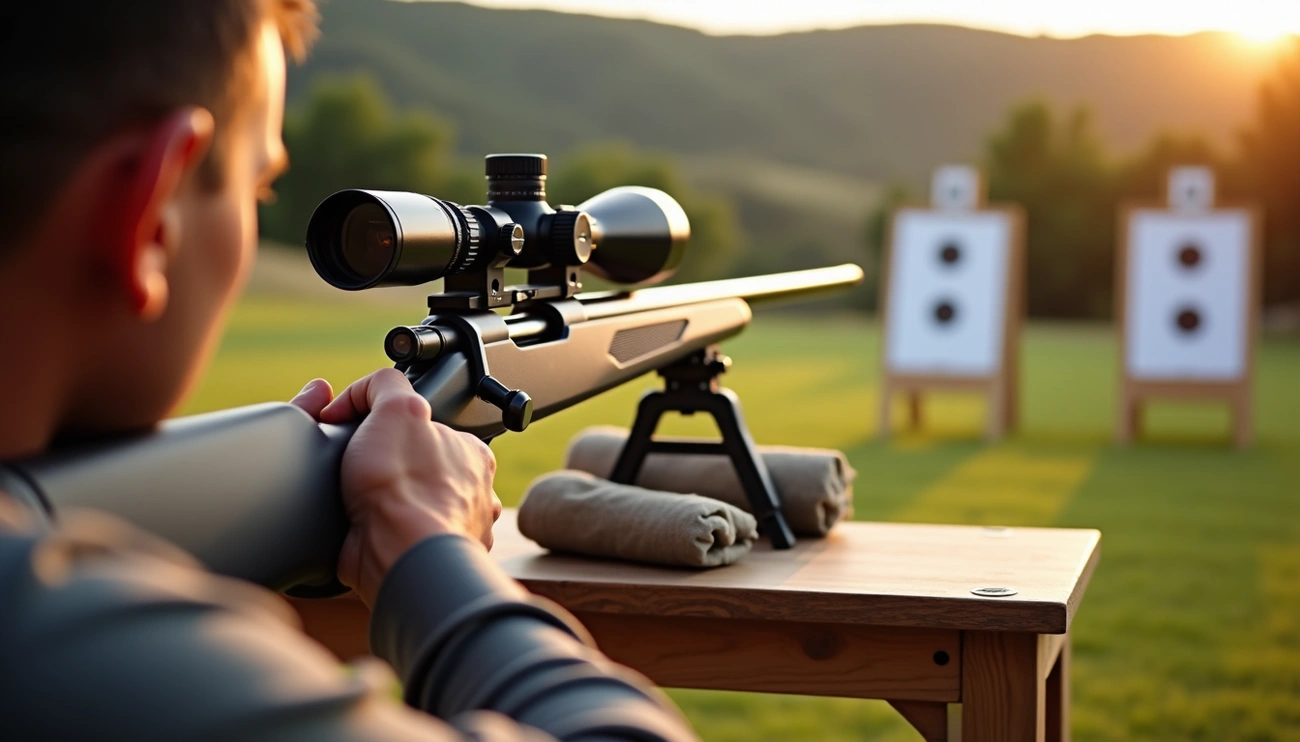
Yes, you can sight in a rifle scope at 100 feet (33 yards). At this distance, bullets impact close to the point of aim. For a 100-yard zero, set the point of impact about 1–2 inches below the target center to account for bullet trajectory.
Is 100 Feet a Good Distance to Sight In?
Many shooters face a common dilemma – they’ve mounted a new optic but lack convenient access to a 100-yard range. This limitation has led to the development of what experts call the “short zero” method, making 100 feet a practical alternative.
Why 100 feet is often used
The primary reason shooters choose 100 feet for sighting in is accessibility. Indoor ranges and many backyard setups simply don’t accommodate the full 100 yards traditionally used for zeroing. Furthermore, at shorter distances like 100 feet, environmental factors have significantly less impact on your bullet’s flight path. Wind, mirage, and other atmospheric conditions that might affect your zero at longer ranges are almost negligible at 100 feet.
Comparing 100 feet vs 100 yards
The mathematical relationship between these distances creates both challenges and opportunities. Since 100 yards equals 300 feet, your bullet’s position at 100 feet represents just one-third of its journey to 100 yards. At 100 feet (approximately 33 yards), a bullet that hits 0.75 inches low will typically be zeroed at 100 yards.
This relationship follows Newton’s physics – gravity affects all objects equally regardless of weight. Therefore, we can predict with remarkable accuracy where a bullet will impact at 100 yards based on where it hits at 100 feet. For adjustments, remember that 1 inch of movement at 25 yards translates to 4 inches at 100 yards, requiring 16 clicks on a 0.25 MOA scope.
When 100 feet makes sense
Zeroing at 100 feet makes perfect sense in several scenarios:
- For hunters in dense forests or thick cover where shots rarely exceed 100 yards
- When you don’t have regular access to longer ranges
- For firearms primarily used at closer distances
- When preparing for a hunting trip but lacking time to visit a long-range facility
Additionally, the 100-foot zero creates less confusion with holdovers. Unlike longer zeros (200+ yards) where you might need to aim lower for closer shots, everything is essentially “up” from a 100-foot/100-yard zero.
Essentially, using a 100-foot zero is about practicality without compromising accuracy. With proper technique and understanding the mathematical relationship, you can achieve results nearly identical to those obtained at a full 100-yard range.
How to Sight In a Rifle Scope at 100 Feet
Properly sighting in a rifle scope at 100 feet requires methodical steps to ensure accuracy at this shorter distance. Following these steps carefully will yield consistent results without wasting ammunition.
1. Set up a safe shooting environment
Safety comes first when sighting in any firearm. Choose a designated shooting area with a proper backstop and clear firing lanes. Always wear protective eyewear and earmuffs to shield against noise and debris. Keep your rifle unloaded until you’re ready to fire and maintain awareness of your surroundings at all times.
2. Use a stable shooting rest or sandbags
Stability dramatically improves accuracy when zeroing a scope. Position your rifle on a solid, non-wobbling platform that allows proper alignment with your target. Sandbags placed under both the rifle’s fore-end and buttstock effectively reduce movement, ensuring consistent shots. According to experts, a proper rest can reduce recoil by up to 95% while keeping your rifle steady on target.
3. Start with bore sighting if possible
Prior to live firing, bore sighting aligns your scope with the rifle’s barrel. This preliminary step saves time and ammunition by getting you “on paper” quickly. Two primary methods exist:
- Visual bore sighting: Remove the bolt (in bolt-action rifles), look down the bore at your target, then adjust the scope to match that point.
- Laser bore sighting: Insert a caliber-specific or universal laser device into the chamber, then align your reticle with the laser dot on the target.
4. Fire a 3-shot group to find your impact point
After bore sighting, fire three carefully aimed shots at your target. Using a 3-shot group rather than a single shot provides a more reliable indication of where your rifle is actually hitting. Grid targets specifically designed for zeroing make measurement much easier.
5. Adjust windage and elevation turrets
Measure the distance between your group’s center and the bullseye. Remember that at 100 feet, adjustments are different than at 100 yards – typically, one click equals 1/4 MOA, which translates to about 0.25 inches at 100 yards. Since 100 feet is roughly one-third of 100 yards, each click moves your point of impact approximately 0.08 inches.
6. Re-test and fine-tune
After making adjustments, fire another 3-shot group to verify the changes. Repeat this process until your shots consistently hit where you’re aiming. Most shooters achieve proper zero within 9-12 rounds.
Common Mistakes and How to Avoid Them
Even skilled shooters make mistakes during the sighting-in process that compromise accuracy. Recognizing these common errors ensures better results when zeroing at 100 feet.
Over-adjusting the scope
All riflescopes have limited internal adjustment capacity that affects your point-of-impact. When you make adjustments but your shots don’t respond accordingly, you’ve likely maxed out your scope’s range. Moreover, some scopes feature mechanical stops preventing over-rotation while potentially having more internal adjustment available. Before attempting more adjustments, check whether your turrets physically stop turning or if point-of-impact remains unchanged despite adjustments. Solutions include using windage-adjustable bases, mounting shims, or elevation-adjustable mounts to correct alignment issues.
Not letting the barrel cool
A hot barrel significantly affects accuracy. During sighting-in, many shooters rush through shots, creating inconsistent results as barrel temperature changes. For hunting rifles with lightweight barrels, experts recommend firing only 3 shots before allowing proper cooling. Twenty minutes between groups is generally adequate for standard calibers, although magnums may require more time. The simple rule: if you cannot comfortably wrap your hand around the barrel, it’s too hot for accurate zeroing.
Using inconsistent shooting positions
Surprisingly, many shooters zero their rifles from bench positions they’ll never use in the field. Consequently, your carefully established 100-foot zero might disappear when shooting from different stances. Most importantly, ensure you’re squared-up behind the rifle rather than bladed, as this affects head position and eye alignment. Test your zero in positions you’ll actually use while hunting or shooting.
Ignoring parallax or eye relief
Parallax occurs when your reticle and target aren’t on the same focal plane. Although generally not problematic under 150 yards, improperly set parallax causes the reticle to move relative to the target when you shift your head position. Alongside this, incorrect eye relief not only causes uncomfortable shooting but potentially dangerous “scope bite” during recoil. Always check both settings at your highest magnification to ensure optimal performance.
How to Translate 100 Feet Zero to Longer Ranges
Translating your 100-foot zero to longer distances requires understanding the mathematical relationship between angular measurements and actual distances. Let me break down how this works so you can apply it to your own rifle setup.
Understanding MOA and click values
MOA (Minute of Angle) is an angular measurement equal to 1/60th of a degree. At 100 yards, 1 MOA equals approximately 1 inch (precisely 1.047 inches). This measurement scales proportionally with distance – 1 MOA at 300 yards equals 3 inches, while at 50 yards it’s only 0.5 inches.
Most hunting scopes adjust in 1/4 MOA per click, meaning each click moves your point of impact 1/4 inch at 100 yards. Some tactical scopes use 1/8 MOA for finer adjustments, whereas others might use 1/2 or 1 MOA clicks.
How to calculate adjustments for 100 yards
Since 100 yards equals 300 feet, your 100-foot zero represents just one-third of this distance. For mathematical conversion:
If your scope has 1/4 MOA clicks and you need to adjust 1 inch at 100 feet, you’ll need approximately 12 clicks (4 clicks per MOA × 3 for the distance ratio). Alternatively, a bullet striking 0.7 inches low at 25 yards will typically be zeroed at 100 yards.
The formula is: (Number of inches adjustment needed) ÷ (inches per MOA at that distance) = MOA adjustment.
Why re-zeroing at 100 yards is still recommended
Despite mathematical precision, re-verifying your zero at actual distance remains crucial. Environmental factors, individual firearm characteristics, and ammunition variables all affect actual bullet trajectory. Notably, ballistic calculators help predict flight paths but can’t account for all real-world variables.
For hunters particularly, confirming your zero prevents potential misses during crucial moments. As the shooting adage goes: “Verify, don’t just trust.” For maximum confidence, test your calculated zero with a three-shot group at 100 yards whenever possible.
Conclusion
Sighting in a rifle scope at 100 feet certainly offers a practical solution for shooters with limited range access. Throughout this guide, we’ve seen that while 100 yards remains the standard, the mathematics of ballistics allows us to achieve excellent results at shorter distances. After all, understanding the 1:3 ratio between 100 feet and 100 yards provides a reliable foundation for accurate shooting.
The key takeaway lies in following proper procedures – using stable shooting rests, starting with bore sighting when possible, and firing consistent 3-shot groups. Additionally, avoiding common pitfalls like over-adjusting your scope, shooting with a hot barrel, or using inconsistent positions will significantly improve your results.
Undoubtedly, the mathematical relationship between MOA adjustments at different distances empowers you to translate your 100-foot zero to longer ranges with confidence. Still, whenever possible, verifying your calculations with actual shots at 100 yards remains the gold standard for maximum accuracy.