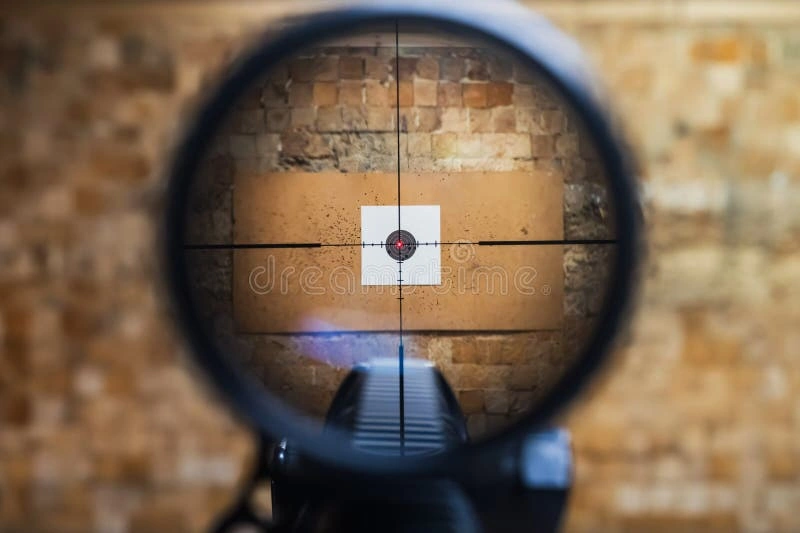
If you’re playing an FPS shooting game, then it would be easy to understand what the field of view means. Field of view (FOV) means the width of the visible area you can see through the scope at a specific distance, usually measured in feet at 100 yards. A larger field of view means you can see more of the area from side to side at that distance. Generally, lower magnification settings provide a wider field of view, allowing you to see more of the surroundings at once. On the other hand, Higher magnification narrows the field of view, focusing on a smaller area but making distant targets appear closer.
What is the Field of View on a Scope?
A scope’s field of view is the width of the area you can see through it when aiming. It shows how much space is visible from left to right at a given distance, usually measured at 100 yards rather than 1,000 yards, as with binoculars.
Definition of the field of view in simple terms
Field of view (FOV) is the maximum width you can see through your scope while aiming. It’s like looking through a window—the wider it is, the more you see without moving. In practice, it’s the area visible from the left edge to the right edge while you stay in position.
How FOV is expressed: feet at 100 yards vs degrees
Scope makers usually list the field of view in two ways. The most common for rifle scopes is linear FOV, measured in feet at 100 yards—for example, ‘42.5 feet at 100 yards.
The second method measures the field of view in degrees. For example, a 6-degree FOV covers about 10.5 yards at 100 yards. To convert degrees to feet at 1,000 yards, multiply the degree value by 52.5, since one degree equals about 52.5 feet at that distance.
Why FOV matters in shooting scenarios
A wide field of view helps you track moving targets and quickly scan your surroundings. This is especially useful when hunting game moving through brush or open areas, as a wider view makes targets easier to find and follow.
The field of view also affects situational awareness, which is critical in hunting and tactical shooting. A wider FOV helps you stay aware of your surroundings while focusing on the target.
There’s always a trade-off between magnification and field of view. As magnification increases, the field of view decreases. That’s why low-power scopes (1–4x or 1–6x) are popular for close-range use and hunting in dense woods.
How Field of View is Measured and Calculated
To measure and calculate the field of view, you need to understand the two measurement systems used in rifle scopes.
Linear vs angular field of view
Rifle scope makers measure field of view in two main ways. Linear FOV shows how wide an area you see at a set distance, usually in feet at 100 yards. Angular FOV is measured in degrees and describes the scope’s field of view. Angular FOV stays the same at any distance, while linear FOV changes with distance.
Converting degrees to feet using the 52.5 constant
You can convert between angular and linear FOV using a standard formula. One degree equals about 52.5 feet at 1,000 yards (often rounded from 52.365). To convert, multiply the angular FOV in degrees by 52.5 to get feet at 1,000 yards, then divide by 10 to find feet at 100 yards.
Linear FOV (feet at 1,000 yards) = Angular FOV (degrees) × 52.5
- Angular FOV = 20° (For Example)
- Conversion factor = 52.5 feet per degree at 1,000 yards
Step 1: Convert angular FOV to linear FOV at 1,000 yards
Linear FOV (1,000 yd)=20×52.5Linear FOV (1,000 yd)=20×52.5=1,050 feet=1,050 feet
Step 2: Convert linear FOV to 100 yards
Since 100 yards is one-tenth of 1,000 yards:Linear FOV (100 yd)=1,05010Linear FOV (100 yd)=101,050=105 feet=105 feet
Final Answer
- Linear FOV at 1,000 yards: 1,050 feet
- Linear FOV at 100 yards: 105 feet
Examples of FOV at different magnifications
Magnification and field of view have an inverse relationship. For example:
At 1x magnification, a scope may show 120 feet at 100 yards. At 4x, that view shrinks to about 30 feet. As magnification increases, the field of view decreases.
With a common 3x variable scope, you might see about 30 feet at 100 yards on the lowest setting. At 9x magnification, that view narrows to roughly 14 feet. This predictable relationship helps shooters know how much area they’ll see at different magnification levels.
Factors That Influence the Scope Field of View
Several technical factors, beyond basic specs, determine how much area you can see through a rifle scope.
Magnification and its inverse relationship with FOV
Magnification and field of view are inversely related: as magnification increases, the field of view decreases. This happens because the objective lens size remains constant while the image is enlarged. For hunters shooting between 50 and 500 yards, a 3–15x scope usually provides a good balance.
Role of focal length and field stop size
The field stop, a metal ring inside the eyepiece, limits how much you can see, while the lens’s focal length sets the viewing angle. Together, they determine your field of view at any magnification.
Why does the objective lens size not affect FOV?
Despite common belief, objective lens size doesn’t determine the field of view. A scope with a large 56mm objective doesn’t automatically offer a wider view than one with a smaller lens.
How eye relief and vignetting impact FOV
Eye relief is the proper distance between your eye and the eyepiece and affects image clarity. If your eye is positioned incorrectly, dark edges (vignetting) can appear.
Understanding tunnelling and how to avoid it
Tunnelling happens when the field of view doesn’t change correctly across magnification levels, creating a narrow, tunnel-like view that makes tracking moving targets harder.
Choosing the Right FOV for Your Needs
Choosing the right field of view depends on your shooting situation and affects how quickly you find targets and how confident you shoot.
When to prioritize wide FOV (e.g., moving targets)
A wider field of view is especially useful for tracking movement. Low magnification with a wide FOV allows faster scanning and quicker target acquisition in close or fast-changing environments. Hunters in dense woods benefit from wide-FOV scopes like 1–4x or 1–6x because they make it easier to follow moving game and maintain situational awareness.
When a narrow FOV is acceptable (e.g., long-range shooting)
For long-range precision shooting, a narrow field of view is acceptable. Higher magnification reduces FOV but provides the detail needed for distant targets. Many hunters can accurately hit deer beyond 200 yards with just a 3x or 4x scope, since long-range shooting values matter more than wide awareness.
How to compare FOV across different scopes
To compare scopes more easily, use field of view listed in degrees instead of linear distance. For example, a 6-degree FOV equals about 10.5 yards at 100 yards. Comparing angular FOV makes it easier to evaluate scopes with different magnification ranges, and scopes with shorter focal lengths usually offer wider viewing angles.
Conclusion
Understanding the field of view (FOV) is key to choosing the right rifle scope. FOV shows how much area you can see through the scope and is measured in feet at 100 yards or in degrees. It directly affects how well you shoot in different situations.
As magnification increases, the field of view decreases—doubling magnification cuts your visible area in half. This means shooters must balance seeing fine detail with maintaining awareness of their surroundings.
Objective lens size doesn’t control FOV. Instead, focal length, field stop design, and proper eye position determine how much you can see and prevent dark edges in the image.
Different shooting situations require different FOVs. Wide fields of view are best for tracking moving targets or shooting in fast-changing environments, while narrow FOVs work well for precise long-range shots.
Although often overlooked, the field of view plays a major role in effective scope use. Choosing the right FOV improves target acquisition, confidence, and overall shooting success. Before buying a scope, consider how its field of view matches your shooting style and typical conditions.